

Most people assume that testing their hormones regularly is a responsible, proactive health move. Why regular hormonal screening might actually work against you is a question few doctors get asked, but the evidence is worth taking seriously. Hormone levels shift constantly — by time of day, stress, sleep, and even what you ate for breakfast. That natural volatility means a single test, or a battery of tests ordered without a clear clinical reason, often produces results that confuse more than they clarify. Here is what the science actually says about when hormone testing helps, and when it does not.
Table of Contents
The basics of hormone function and testing
Hormones are chemical messengers that regulate development, reproduction, metabolism, and mood. When something goes wrong with their balance, the effects show up across multiple body systems at once, which is exactly why hormonal health monitoring has become such a popular topic.
But there is an important distinction clinicians make that most patients never hear. Hormonal testing serves three very different purposes:
-
Diagnosis: Identifying the cause of symptoms like infertility, fatigue, or irregular periods
-
Monitoring: Tracking treatment response when someone is already on hormone therapy
-
Targeted screening: Occasionally checking levels in high-risk populations with specific clinical reasons
The third category is the narrowest. Most of the hormone tests ordered outside of clinical need fall into a gray zone where the results are hard to act on. A common health screening test for blood pressure or cholesterol gives you a number that maps directly to a treatment threshold. A hormone result rarely works that way.
What you get from a hormone test is a snapshot, not a story. A cortisol reading at 2 p.m. on a stressful Tuesday tells your doctor something very different than the same number drawn at 8 a.m. after a full night of sleep. Context is everything.
Pro Tip: Before requesting a hormone panel, write down your specific symptoms and when they occur. That information is often more useful to your doctor than the test result itself.
The value of women and child health checkups comes not just from lab values but from the clinical conversation that surrounds them.
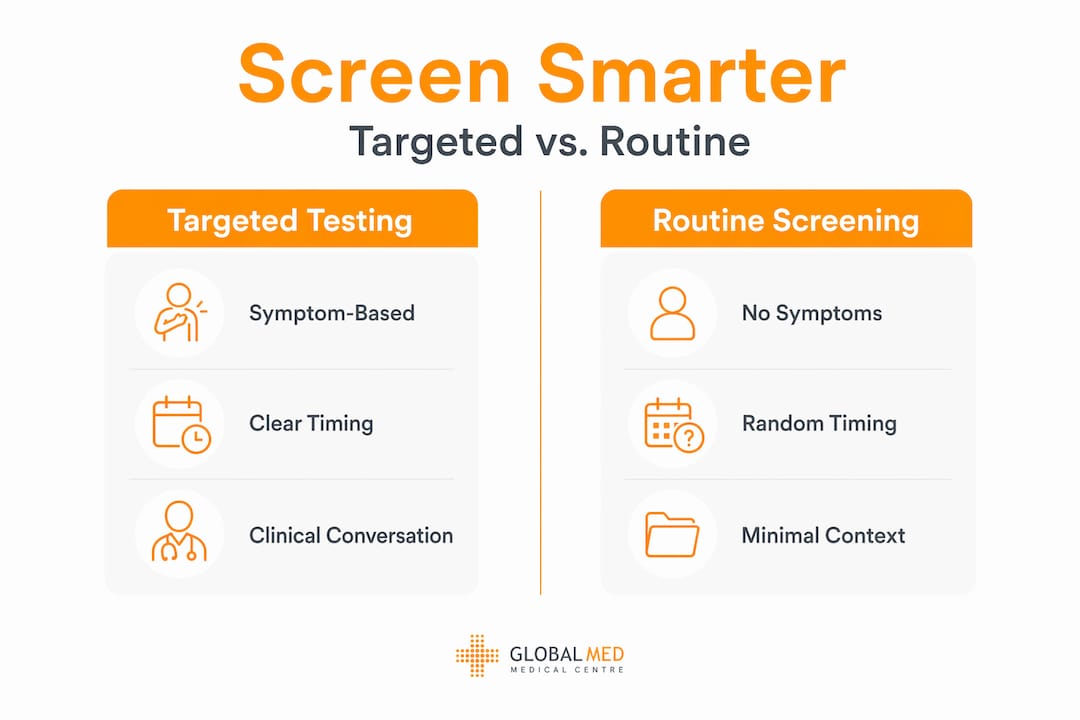
Why routine hormonal screening is generally discouraged
Here is the part that surprises most people. Major medical organizations do not recommend regular hormonal screening for the majority of adults, even those experiencing symptoms typically associated with hormone changes.
“ACOG and other experts do not recommend routine hormone testing for menopausal symptoms because levels fluctuate widely and testing rarely alters treatment.”
That is not a minor footnote. The American College of Obstetricians and Gynecologists is saying that even when you have symptoms, routine testing often does not change what your doctor does next.
Why? Because menopausal hormone levels are inherently unstable. FSH (follicle-stimulating hormone) and estradiol can swing dramatically from week to week, from cycle to cycle, and even from morning to afternoon. Testing on one day versus another can yield completely opposite results. Clinicians also discourage broad hormone panels in perimenopause precisely because the fluctuations mislead patients without guiding care.
The practical consequences of this are real:
-
Patients who see a low estrogen reading may push for hormone therapy they do not need
-
Out-of-range numbers trigger anxiety and follow-up testing that rarely resolves anything
-
Broad panels cost money and generate clinical noise without meaningful signal
-
Symptom-based care, which relies on your reported experience, is routinely more accurate
Understanding the value of regular health screening does not mean testing everything constantly. It means being targeted and intentional, which is actually what health screening for prevention looks like in practice.
When hormonal screening is clinically valuable
Discouraging routine screening is not the same as saying hormone tests are useless. They are genuinely powerful tools when applied correctly. The key phrase is when applied correctly.
Hormone testing is most useful when it is ordered in response to specific symptoms or to evaluate whether a treatment is working. Here are the scenarios where it delivers real clinical value:
-
Suspected infertility or ovulation problems — FSH, LH, estradiol, and AMH testing maps the reproductive picture accurately
-
Thyroid dysfunction symptoms — TSH and free T4 testing has strong diagnostic yield when fatigue, weight changes, or cold intolerance are present
-
Symptoms of low testosterone in men — fatigue, decreased libido, and muscle loss warrant formal testing
-
Monitoring hormone replacement therapy — checking estradiol or testosterone after starting treatment guides dose adjustment
-
Adrenal concerns — specific tests for cortisol are indicated when Cushing’s or Addison’s disease is suspected
Testosterone deficiency diagnosis requires two early-morning tests performed under controlled conditions because of how sharply levels drop across the day. This is not something a single at-home test can reliably capture.
| Hormone | When to test | What it tells you |
|---|---|---|
| FSH / LH | Fertility workup, suspected menopause | Ovarian reserve, pituitary function |
| TSH | Fatigue, weight changes, temperature sensitivity | Thyroid activity |
| Testosterone | Low libido, fatigue, muscle loss in men | Androgen deficiency |
| Estradiol | Monitoring HRT, fertility evaluation | Estrogen status |
| Cortisol | Suspected adrenal disorder | Stress hormone regulation |
Pro Tip: Executive men checkups include targeted hormone assessments designed around your symptom profile, not just a blanket panel that fills a requisition form.
For women, targeted women’s health evaluations follow the same principle: testing what matters based on what you are actually experiencing.
The importance of timing, conditions, and interpretation in hormone testing
Timing is not a minor detail in hormone testing. It is often the difference between a result you can act on and one that sends you down a costly, confusing path.

Consider testosterone. Testosterone shows significant diurnal variation, peaking in the early morning and dropping by as much as 35% by afternoon. This means a test drawn at noon could falsely suggest deficiency in someone whose levels are perfectly normal at 8 a.m. That is not an edge case. It is a standard feature of how the hormone works.
The same principle applies across the hormonal landscape:
-
Cortisol peaks within 30 minutes of waking and is essentially meaningless if drawn later without specific clinical protocol
-
Estradiol and FSH vary by cycle day in premenopausal women, so testing on day 3 versus day 14 produces entirely different numbers
-
Thyroid hormones are more stable but still affected by acute illness, recent surgery, or certain medications
-
Insulin and fasting glucose must be drawn after a minimum 8-hour fast to reflect your actual baseline
Lab testing for menopausal hormone therapy is needed mainly if treatment response is poor, not for routine ongoing screening.
A single off-protocol test does not just miss a diagnosis. It can create a false one. That is the real danger of ordering hormone tests casually or without a clinical framework guiding the timing.
Pro Tip: When scheduling hormone testing, ask your provider exactly when to get the draw, whether you need to fast, and whether any medications should be paused beforehand. These health screening preparation steps are not optional formalities.
How to approach hormonal screening for health management
Knowing the limits of hormone testing does not leave you without options. It just points you toward the right options.
The hormonal screening necessity conversation should start with your symptoms. Not your anxiety about a potential imbalance, not a wellness influencer’s suggestion, but a clear accounting of what your body is actually doing differently.
Here is a practical framework:
-
Track your symptoms with dates, frequency, and severity for at least 4 to 6 weeks before a consultation
-
Bring your full medication and supplement list since many common products affect hormone levels
-
Ask your provider directly whether a hormone test will change their clinical decision
-
Request context with every result — a number without a reference range tied to your age and cycle stage is nearly useless
-
Avoid at-home saliva or urine panels ordered without clinical supervision, as shared decision-making with a qualified clinician is safer and more effective
The key things to avoid:
-
Broad panels ordered online without clinical indication
-
Annual hormone testing just because it “seems like a good idea”
-
Assuming a normal result means no hormonal issue exists
-
Assuming an abnormal result means you need immediate treatment
Hormone therapy should be individualized based on your clinical history, symptoms, and physical examination rather than on routine lab values. That is the standard of care, not a shortcut.
Pro Tip: Executive women checkups at a qualified clinic integrate your symptom history with targeted testing, giving results a clinical home rather than leaving you to interpret numbers alone. You can also explore early detection screening to understand how preventive care fits into your overall health strategy.
A fresh perspective on regular hormonal screening
Here is the uncomfortable truth that the wellness industry does not want to say out loud: the push toward more frequent hormonal testing is often driven by commercial interest, not clinical evidence.
At-home hormone kits, direct-to-consumer lab panels, and supplement brands all benefit when you believe your hormones are perpetually out of balance and need constant monitoring. The reality is that most adults with no symptoms and no chronic conditions gain almost nothing from regular hormone checkups beyond anxiety and unnecessary spending.
What actually works is care that responds to what your body tells you. Hormones are not like blood pressure, where a single clean reading today is reassuring. They are dynamic, context-sensitive, and deeply intertwined with sleep, stress, nutrition, and life stage. A lab result pulled out of that context is, at best, incomplete information.
The patients we see who benefit most from hormone testing are the ones who come in with a specific complaint, a clear timeline, and a willingness to treat the result as one piece of evidence rather than a verdict. The ones who struggle are those who arrive with a printout of 15 hormone values from a mail-in kit, convinced something is wrong because one number is slightly outside a generic reference range.
Good hormonal health monitoring is not about testing more. It is about testing smarter, at the right time, with the right clinical question, and interpreting the result within the full picture of who you are as a patient.
How Globallmed supports your hormonal health
Managing hormonal health well means having a clinical team that asks the right questions before ordering a single test.

At Globallmed, our approach to hormone evaluation starts with your symptoms and medical history, not a default panel. Our medical clinic department provides evidence-based hormone assessments timed and structured to produce results you can actually use. For those who want to address hormonal health as part of broader wellness, our wellness and wellbeing department integrates lifestyle, nutrition, and targeted medical support. Whether you are managing a chronic condition, navigating a life-stage change, or simply want clarity on persistent symptoms, Globallmed offers personalized, clinically grounded care in Macau that meets international standards.
Frequently asked questions
Is regular hormonal screening necessary for everyone?
No, routine hormonal testing is not recommended for most people because fluctuating levels make results difficult to interpret without a specific clinical reason to test.
When is hormone testing recommended?
Hormone testing is most useful when you have symptoms suggesting a hormonal imbalance, when diagnosing a specific condition, or when monitoring whether an existing treatment is working effectively.
Why is timing important in hormone testing?
Testosterone shows diurnal variation requiring morning, fasting conditions and repeated measurements, and many other hormones follow similar time-sensitive patterns that affect result accuracy.
Can hormone levels change without health issues?
Yes, hormone levels fluctuate widely during normal aging, menopause, stress, and daily cycles, which is why a single test often cannot reflect your true hormonal baseline.
How should I discuss hormone testing with my doctor?
Share your specific symptoms and ask whether the test result will actually change the clinical decision, because shared decision-making between patient and provider produces better outcomes than testing driven by worry alone.