

Continuity of care after travel is defined as the uninterrupted coordination of medical treatment from the point of foreign surgery or therapy through full recovery at home. Patients who maintain this coordination reduce hospitalization risk by 18%–28% compared to those who treat each medical encounter as a separate event. That reduction translates directly into fewer emergency visits, lower costs, and safer recoveries. The clinical term for this process is "care transition management," and it applies with particular urgency to medical travelers who return home with complex post-operative needs. GLOBALLMED Medical Center, based in Macau, serves as a local hub for exactly this kind of structured, post-travel follow-up care.
Why continuity of care after travel is a medical necessity
Continuity in healthcare is not a single action. According to BMJ Quality & Safety, it is a tripartite construct built on three distinct dimensions: informational continuity, management continuity, and relational continuity. Each dimension must be clearly assigned among providers to prevent dangerous gaps in post-travel recovery.
Informational continuity means that every clinician involved in your care holds a complete picture of your medical history. For medical travelers, this requires more than a discharge summary. Operative reports contain critical technical details such as surgical technique, tissue handling, and hardware brands. A local physician managing a complication without that information is working blind.

Management continuity refers to a structured schedule of follow-up appointments and care coordination. Best-practice international clinics recommend a five-point telehealth schedule consisting of check-ins at 72 hours, two weeks, one month, three months, and six months after treatment. This schedule creates a safety net that catches complications before they escalate.
Relational continuity addresses accountability. The failure of continuity often stems from unclear professional accountability between foreign surgeons and home-based providers. Without a designated lead for recovery management, patients fall through the cracks between two medical systems that do not communicate with each other.
- Informational: complete operative reports, imaging, and lab results
- Management: structured follow-up schedule with assigned providers
- Relational: clear accountability between foreign and local clinicians
Pro Tip: Before leaving the foreign clinic, ask specifically for the technical operative report, not just the discharge summary. The operative report contains the surgical details your local doctor needs to manage any complication safely.
How does continuity of care after travel prevent complications and reduce costs?
The financial and clinical case for post-travel care coordination is direct. Patients in the highest continuity group reduce healthcare expenditures by 7.4%–10.4% compared to those with fragmented care. That saving comes primarily from avoiding redundant diagnostics and preventable emergency admissions.
When a patient returns home without surgical documentation, local physicians order repeat imaging, blood panels, and specialist consultations to reconstruct what already happened. Providing full surgical reports to a local doctor prevents this cycle of unnecessary repeat diagnostic tests. The financial loss from redundant procedures is avoidable with a single folder of documents.
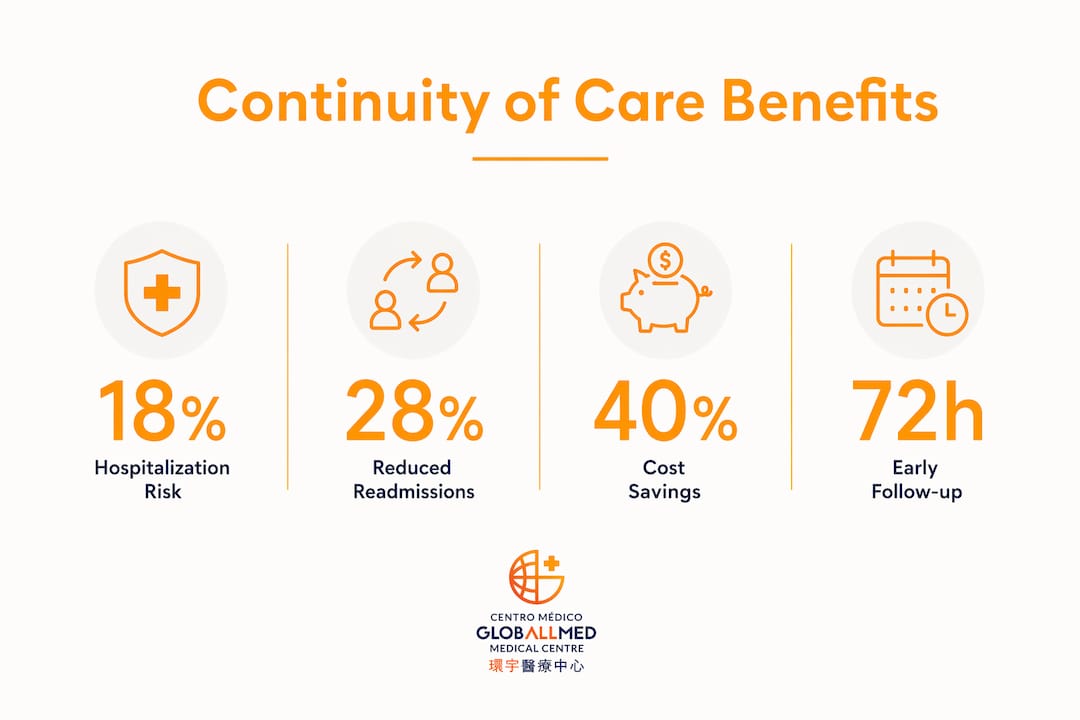
Beyond cost, the clinical stakes are high. Medical travelers often view care as a series of disconnected events. Experts stress that continuity provides stability by ensuring informed medical decisions based on a comprehensive patient history. A new symptom evaluated without that history risks misdiagnosis or delayed treatment.
| Benefit | Without continuity | With continuity |
|---|---|---|
| Hospitalization risk | Baseline | Reduced by 18%–28% |
| Healthcare expenditure | Baseline | Reduced by 7.4%–10.4% |
| Repeat diagnostics | Frequent | Largely avoidable |
| Complication detection | Delayed | Early, via structured follow-up |
The physiological dimension adds another layer of urgency. Failing to prioritize rehydration, sleep, and anti-inflammatory support for at least three days post-return delays immune restoration and healing. Continuous care must therefore incorporate patient education on nutrition and rest, not just clinical appointments.
What are best practices for managing healthcare after traveling?
Patients who take ownership of their care transition achieve significantly better outcomes. The following steps represent the current standard for managing post-travel recovery effectively.
-
Request the technical operative report before discharge. Ask the foreign clinic for the full surgical notes, not just a summary letter. These notes contain the specific details your local physician needs to manage your recovery safely.
-
Organize all documentation into a single medical file. Include operative reports, anesthesia records, pathology results, imaging discs, medication lists, and discharge instructions. A well-organized medical file prevents delays when you present to a local provider.
-
Introduce your local doctor to your foreign surgical team. Proactively connecting providers via email reduces hesitancy and positions you as an active partner in your own care. This single step improves relational continuity more than any other action.
-
Follow the structured telehealth schedule. Confirm check-in appointments at 72 hours, two weeks, one month, three months, and six months with either your foreign team or a local specialist. Missing these windows is when complications go undetected.
-
Document your wound site daily with photographs. Daily high-quality photos of surgical wounds give your local doctor a visual recovery timeline. This history helps distinguish normal healing from early signs of infection or abnormal tissue response.
-
Be fully transparent with every local provider. Disclose your complete medical history, including the foreign procedure, to every clinician you see. Omitting information to avoid judgment creates gaps that lead to dangerous clinical decisions.
Pro Tip: Use your smartphone's photo app to create a dedicated album for wound documentation. Date each photo automatically and share the album with your local physician at your first appointment. This visual record often replaces the need for an in-person wound assessment at the two-week check-in.
The importance of post-travel care extends beyond the surgical site. Nutrition and hydration directly affect immune recovery. Experts recommend adequate intake of omega-3 fatty acids and consistent hydration during the first days after return to support the body's healing response. A follow-up care guide from a qualified local provider should address these physiological needs alongside clinical monitoring.
How does GLOBALLMED Medical Center support returning medical travelers?
GLOBALLMED Medical Center provides a structured environment for patients who need local follow-up care after treatment abroad. Its outpatient model is built for exactly this scenario: patients who arrive with complex medical histories, foreign documentation, and specific recovery needs.
The center's services relevant to post-travel care include:
- Specialist consultations across medical departments that can review foreign operative reports and establish a local care plan
- Outpatient diagnostics for patients who need imaging, laboratory work, or monitoring without hospital admission
- Medication management to reconcile prescriptions issued abroad with locally available equivalents
- Wound assessment and recovery monitoring for patients returning from surgical procedures
- Telehealth coordination to facilitate communication between GLOBALLMED Medical Center clinicians and foreign surgical teams
GLOBALLMED Medical Center's medical specialty departments are staffed by clinicians experienced in managing international patient cases. This experience matters because post-travel cases require a different clinical approach. A physician unfamiliar with cross-border care may not know which questions to ask or which documents to request.
The center also supports patients navigating the administrative side of care transitions. Coordinating records, confirming medication equivalencies, and scheduling structured follow-ups are tasks that require both clinical knowledge and logistical capacity. GLOBALLMED Medical Center provides both within a single outpatient setting in Macau.
Key Takeaways
Continuity of care after medical travel requires informational, management, and relational coordination across providers to prevent complications, reduce costs, and support safe recovery.
| Point | Details |
|---|---|
| Three-part continuity model | Informational, management, and relational continuity must all be assigned to specific providers. |
| Hospitalization risk reduction | Consistent care coordination reduces hospitalization risk by 18%–28% compared to fragmented care. |
| Documentation is non-negotiable | Operative reports, not just discharge summaries, give local doctors the detail needed to manage complications. |
| Structured follow-up schedule | Check-ins at 72 hours, two weeks, one month, three months, and six months form the clinical standard. |
| Local specialist engagement | A qualified local center like GLOBALLMED Medical Center bridges the gap between foreign treatment and home recovery. |
The part of post-travel care most patients underestimate
Most patients focus on the surgery itself. They research the surgeon, the clinic, the destination, and the cost. Very few invest the same energy in planning what happens after they land back home.
The gap between foreign treatment and local follow-up is where outcomes are actually decided. I have seen patients arrive at outpatient consultations weeks after surgery with no operative report, no medication list, and no contact information for their foreign surgeon. Their local physicians had no foundation to work from. That is not a documentation failure. It is a care failure, and it was entirely preventable.
The uncomfortable truth about long-term care post-travel is that the patient carries most of the coordination burden. Foreign clinics close their files at discharge. Local providers often lack the context to ask the right questions. The patient sits in the middle, and without preparation, that middle becomes a void.
What actually works is treating the post-travel care plan as part of the procedure itself. Before you travel for treatment, identify your local follow-up provider. Confirm they are willing to manage a post-travel case. Arrange a bridging consultation between your foreign surgeon and your local physician before you leave. Bring every document home in both digital and physical form.
Technology helps, but it does not replace preparation. Wound photo logs and telehealth apps are useful tools. They work best when a qualified clinician is already engaged and waiting for the data. Partnering with a center like GLOBALLMED Medical Center before you travel, not after, is the decision that changes outcomes.
— IGHS
Post-travel follow-up care at GLOBALLMED Medical Center
Returning from treatment abroad with unresolved recovery needs is a clinical situation that requires a structured local response, not a general practitioner visit.
GLOBALLMED Medical Center offers a full range of outpatient services designed to support patients at every stage of post-travel recovery. From specialist consultations and outpatient diagnostics to medication reconciliation and wound monitoring, the center provides the clinical infrastructure that medical travelers need when they return to Macau. The team is experienced in reviewing international medical records and coordinating with foreign providers to establish a clear, safe local care plan. Schedule a consultation at GLOBALLMED Medical Center to begin your structured follow-up with clinicians who understand the specific demands of post-travel recovery.
FAQ
What is continuity of care after medical travel?
Continuity of care after medical travel is the coordinated, uninterrupted management of a patient's health from the point of foreign treatment through full recovery at home. It involves informational, management, and relational coordination between foreign and local providers.
Why does post-travel care reduce hospitalization risk?
Patients who maintain consistent care relationships reduce hospitalization risk by 18%–28% compared to those with fragmented care. Structured follow-up catches complications early, before they require emergency admission.
What documents should I bring home after surgery abroad?
Request the full technical operative report, anesthesia records, pathology results, imaging files, and a complete medication list. Discharge summaries alone do not contain the surgical detail local physicians need to manage complications.
How often should I follow up after treatment abroad?
Best-practice international clinics recommend check-ins at 72 hours, two weeks, one month, three months, and six months after treatment. This five-point schedule provides consistent monitoring throughout the recovery period.
Can GLOBALLMED Medical Center coordinate with my foreign surgeon?
Yes. GLOBALLMED Medical Center's clinical team is experienced in reviewing international medical records and facilitating communication with foreign surgical teams to establish a coordinated local care plan.