

A cardiology screening consultation is a focused specialist visit that builds your personal cardiovascular risk profile and recommends only the tests and interventions likely to change your management. It is not a blanket battery of scans. The cardiologist synthesizes your history, physical findings, and prior lab results to decide what, if anything, comes next.
Three reasons most people seek one:
- Abnormal primary care results or risk factors — elevated blood pressure, high LDL cholesterol, or a fasting glucose that sits in the prediabetic range.
- Family history or special circumstances — a parent or sibling with early heart disease, pregnancy complications such as preeclampsia, or early menopause, all of which shift risk in ways a general exam may not fully capture.
- Unexplained symptoms — palpitations, syncope, reduced exercise tolerance, or chest discomfort that has not been explained by a prior workup.
One guideline nuance worth knowing upfront: the U.S. Preventive Services Task Force (USPSTF) recommends against routine resting or exercise ECG screening for asymptomatic adults whose 10-year cardiovascular disease (CVD) risk falls below 10%. For that group, the tests are unlikely to improve outcomes and can trigger unnecessary downstream procedures. The consultation model described here is for people who have a clinical reason to be evaluated, not a blanket annual add-on for everyone.
Table of Contents
- How does a cardiology consultation differ from a regular check-up?
- Who should consider a cardiology screening consultation?
- What tests does a cardiologist typically order?
- What happens before, during, and after the visit?
- How are results interpreted and what follow-up looks like
- What are the real benefits and limitations of cardiology screening?
- What do major U.S. guidelines say about cardiology screening?
- Which symptoms require immediate attention rather than a scheduled screening?
- Key Takeaways
- A clinician's perspective on what these consultations actually accomplish
- Authoritative sources and further reading
- GLOBALLMED Medical Center offers integrated cardiology and preventive care
How does a cardiology consultation differ from a regular check-up?
A primary care physical covers a lot of ground quickly. Blood pressure, weight, cholesterol, blood glucose, a brief lifestyle conversation. That breadth is exactly what a general exam is designed for. A cardiology consultation goes narrower and deeper.
A cardiology consultation focuses on building a cardiovascular risk profile and creating an individualized care plan rather than ordering every available test. The cardiologist's job is to integrate your history, exam, and prior data into a targeted decision about what testing or treatment would actually help you.
The practical difference shows up in three areas:
- Risk stratification depth. A cardiologist applies validated tools such as the Pooled Cohort Equations to calculate your 10-year CVD event risk and places you in a low, intermediate, or high-risk category. That number drives every subsequent decision.
- Complex lab interpretation. Borderline lipid panels, elevated lipoprotein(a), or mildly abnormal cardiac biomarkers often need specialist context that a busy primary care visit cannot provide.
- Guideline-based testing decisions. Rather than ordering a stress test because a patient is anxious, a cardiologist asks whether the result would change management. If it would not, the test is skipped.
The output of the visit is concrete: a documented risk estimate, a discussion of modifiable factors (smoking, diet, physical activity, weight), and a clear decision about whether further testing or medication is warranted.

Who should consider a cardiology screening consultation?
Most people with a low 10-year CVD risk and no symptoms are well served by their primary care physician. Specialist input adds the most value when the clinical picture is more complex.
Common indications for a cardiology consultation include:
- Persistently elevated blood pressure (above 130/80 mm Hg) or lipids that have not responded to lifestyle changes
- Type 2 diabetes or prediabetes combined with one or more additional risk factors
- A first-degree relative (parent or sibling) diagnosed with heart disease before age 55 in men or 65 in women
- Unexplained syncope, palpitations, or an irregular heart rhythm found incidentally
- Reduced exercise tolerance that is out of proportion to age and fitness level
- A prior abnormal cardiac test (ECG, echocardiogram, stress test) that was never fully explained
- Pregnancy complications such as preeclampsia or gestational hypertension, which raise long-term CVD risk
- Early menopause (before age 40), which is associated with accelerated cardiovascular aging
Practical rule: If you have one or two of the above and your primary care physician has already addressed them, a referral discussion is appropriate. If you have three or more, or if a single factor is severe (a strong family history of aortic disease, for example), a direct cardiology referral is reasonable without waiting.
Pro Tip: Bring a written family history to your primary care appointment. A clear record of which relatives had heart attacks, strokes, or sudden cardiac death, and at what ages, is the single fastest way to help your physician decide whether a specialist referral is warranted.

What tests does a cardiologist typically order?
Tests are chosen based on what the clinical picture suggests, not ordered as a package. The table below maps common tests to what they measure and the typical triggers for ordering them.
| Test | What it measures | Typical clinical trigger |
|---|---|---|
| Lipid panel | LDL, HDL, triglycerides, total cholesterol | Baseline risk assessment; abnormal prior result |
| Fasting glucose / HbA1c | Blood sugar control and diabetes status | Metabolic risk factors; obesity; family history of diabetes |
| Resting ECG | Electrical conduction, rhythm, prior infarction signs | Palpitations, syncope, pre-procedure evaluation |
| Echocardiogram | Cardiac structure and function | Murmur, reduced exercise tolerance, hypertension with end-organ concern |
| Exercise stress test | Ischemia under physical demand | Exertional chest pain or dyspnea in intermediate-to-high-risk patients |
| Coronary artery calcium (CAC) score | Calcified plaque burden in coronary arteries | Intermediate 10-year risk where result would change statin decision |
| Ambulatory rhythm monitor | Arrhythmia detection over longer ambulatory monitoring | Intermittent palpitations or syncope not captured on resting ECG |
| BNP / NT-proBNP | Cardiac wall stress; heart failure marker | Unexplained dyspnea; suspected heart failure |
A few points worth emphasizing. Coronary artery calcium scoring is ordered selectively, specifically when the result would shift a treatment decision, not as a routine add-on for every patient. The American Heart Association sets a target blood pressure below 120/80 mm Hg, and annual blood pressure checks are recommended for adults with normal readings. That threshold informs how aggressively a cardiologist pursues further workup when hypertension is the presenting concern.
Up to 80% of cardiac events and strokes are potentially preventable with proactive risk management, according to CDC data. That figure is the public-health argument for preventive cardiac screening as a discipline, and it is also why the consultation model focuses on identifying the right tests for the right patient rather than testing everyone.
What happens before, during, and after the visit?
Before the appointment
Preparation makes the visit significantly more productive. Arrive with:
- A complete medication list, including supplements and over-the-counter drugs
- Copies of any prior cardiac tests: ECGs, echocardiograms, stress test reports, or Holter monitor results
- A written family history noting which relatives had heart disease and at what age
- A brief symptom diary if you have been tracking palpitations, chest discomfort, or dizziness
- Fasting for 9–12 hours if your cardiologist has indicated that labs will be drawn at the visit
Pro Tip: Request that your primary care physician send a referral summary before the appointment. A cardiologist who already has your recent labs and BP trend can spend the visit on clinical judgment rather than data collection.
During the visit
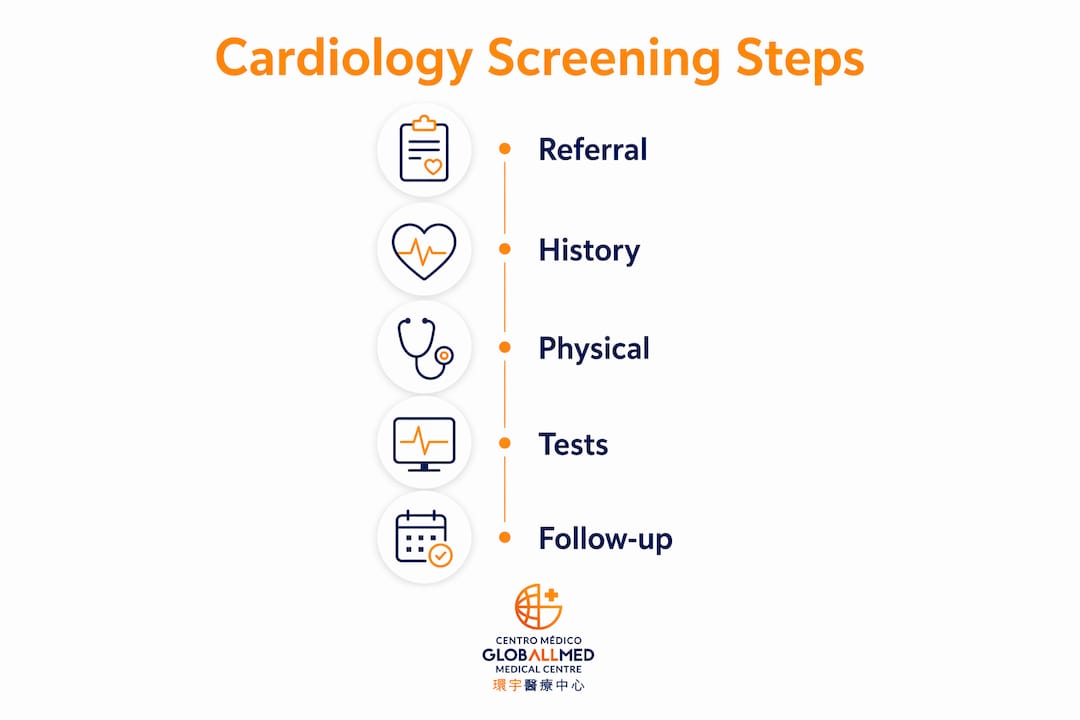
The cardiologist reviews your medical history in detail, performs a focused cardiovascular exam (heart sounds, peripheral pulses, blood pressure in both arms when indicated), and calculates your 10-year CVD risk using a validated tool. Prior test results are reviewed and interpreted in context. The visit ends with shared decision-making: you and the cardiologist agree on whether further testing is warranted, what lifestyle changes are the priority, and whether medication should be started or adjusted.
After the visit
Results from any tests ordered are typically communicated within a few days to two weeks, depending on the test. Your primary care physician receives a consultation note. Follow-up appointments, if needed, are usually scheduled within four to eight weeks for medication titration or to review imaging results.
How are results interpreted and what follow-up looks like
The cardiologist integrates all findings into a 10-year risk estimate using tools such as the Pooled Cohort Equations or Framingham-based variants. That number determines the intensity of the response.
Common follow-up paths after a cardiology screening visit:
- Low-to-intermediate risk with modifiable factors: Structured lifestyle intervention (dietary changes, supervised exercise, smoking cessation) with a repeat risk assessment in 12 months.
- Intermediate-to-high risk: Statin therapy initiation or titration, antihypertensive adjustment, and possibly a CAC score to refine the decision.
- Abnormal structural finding: Echocardiographic follow-up at a defined interval, or referral for further imaging if a valve abnormality or cardiomyopathy is suspected.
- Arrhythmia detected: Ambulatory monitoring, possible electrophysiology referral, and anticoagulation discussion if atrial fibrillation is confirmed.
- High-risk anatomy or ischemia: Referral for coronary angiography or interventional evaluation.
The most valuable outcome of a cardiology consultation is often not a new test but a clear, shared plan. Many patients leave having learned that their risk is lower than they feared, with a concrete set of lifestyle targets and a scheduled follow-up. That clarity alone reduces anxiety and improves adherence to prevention strategies.
Watchful waiting is a legitimate outcome. A cardiologist who finds no indication for further testing will say so explicitly, and that reassurance is itself a clinical service. For long-term wellness, periodic risk review every one to three years is appropriate for most intermediate-risk patients.
What are the real benefits and limitations of cardiology screening?
Benefits
- Early detection of silent conditions. Hypertension, dyslipidemia, and early structural heart disease often produce no symptoms until they are advanced. A consultation catches them while intervention is still straightforward.
- Personalized risk reduction. Rather than generic advice, patients leave with a specific plan tied to their actual risk number.
- Clarification of ambiguous primary care findings. A borderline ECG or mildly elevated troponin that worried a primary care physician often has a benign explanation that a cardiologist can confirm.
Limitations and potential harms
- False positives. An abnormal screening result in a low-risk patient frequently does not represent true disease. It triggers anxiety and additional testing, sometimes including invasive procedures with their own complication risks.
- Overdiagnosis. Labeling a patient with a "cardiac condition" based on a borderline finding can affect insurance, employment, and psychological well-being.
- Downstream procedure risk. Unnecessary angiography or revascularization carries real procedural risk. This is the core reason the USPSTF recommends against routine ECG and stress testing in asymptomatic low-risk adults.
- Cost. Specialist consultations and cardiac imaging carry significant out-of-pocket costs in the U.S. healthcare system, particularly for patients without comprehensive insurance.
The practical mitigation for all of these harms is the same: evidence-based patient selection and shared decision-making. A cardiologist who orders tests only when results would change management protects patients from the harms of indiscriminate screening. The benefits of early detection are real, but they accrue to the right patients, not to everyone.
What do major U.S. guidelines say about cardiology screening?
USPSTF position
The USPSTF recommends against routine resting ECG, exercise ECG (stress test), or electron beam CT (EBCT) for asymptomatic adults whose 10-year CVD risk is below 10%. The evidence shows these tests have poor accuracy in low-risk populations and can cause harm through unnecessary downstream procedures, including angiography and revascularization. This is a Grade D recommendation, meaning the harms outweigh the benefits for that specific group.
AHA/ACC framework
The American Heart Association and American College of Cardiology emphasize risk-factor management guided by validated calculators. Their guidelines support using the Pooled Cohort Equations to estimate 10-year atherosclerotic CVD risk and to guide statin and antihypertensive decisions. Coronary artery calcium scoring is endorsed as a tie-breaker for intermediate-risk patients where the treatment decision is genuinely uncertain.
| Guideline body | Key recommendation | Applies to |
|---|---|---|
| USPSTF | Against routine ECG/stress test | Asymptomatic adults, 10-year risk <10% |
| AHA/ACC | Use Pooled Cohort Equations to guide treatment | All adults with cardiovascular risk factors |
| AHA/ACC | CAC scoring as a decision aid | Intermediate-risk patients (10-year risk 10%–20%) |
| CDC | Proactive risk-factor management for prevention | Population-level prevention focus |
How to apply these guidelines personally
Guidelines describe populations, not individuals. A 48-year-old woman with a 10-year risk of 8% technically falls below the USPSTF threshold, but if she has a strong family history of early coronary disease and a borderline lipid panel, her cardiologist may reasonably order a CAC score because the result would change the statin decision. That is guideline-concordant care, not guideline violation. The key question is always: will this test change what we do?
Which symptoms require immediate attention rather than a scheduled screening?
A cardiology screening consultation is a planned, non-urgent visit. The following symptoms are not screening indications. They require immediate evaluation.
Call 911 or go to the nearest emergency department for:
- Sudden chest pain, pressure, tightness, or heaviness, especially if it radiates to the arm, jaw, or back
- New severe shortness of breath at rest or with minimal activity
- Sudden loss of consciousness or near-syncope with no clear trigger
- Sudden weakness, numbness, slurred speech, or facial drooping (stroke signs)
- Rapid or irregular heartbeat accompanied by lightheadedness or chest discomfort
Contact your physician urgently (same day) for:
- Palpitations that are new, frequent, or associated with dizziness
- Unexplained progressive shortness of breath over days to weeks
- Syncope that resolved but has not been evaluated
If you are unsure whether a symptom is an emergency, treat it as one. When you call 911 or arrive at an emergency department, describe your symptoms specifically: "I have chest pressure that started 20 minutes ago and goes into my left arm." That level of detail helps triage staff prioritize your evaluation immediately.
Key Takeaways
A cardiology screening consultation delivers the most value when it is matched to the right patient: someone with a clinical reason to be evaluated, not a blanket annual add-on for every asymptomatic adult.
| Point | Details |
|---|---|
| Who benefits most | Adults with risk factors, abnormal labs, family history, or unexplained symptoms gain the most from specialist input. |
| What the visit produces | A documented 10-year risk estimate, a personalized prevention plan, and a targeted decision about further testing. |
| Guideline limits on routine testing | USPSTF recommends against routine ECG or stress testing for asymptomatic adults with a 10-year CVD risk below 10%. |
| Minimizing harms | Tests should be ordered only when results would change management; shared decision-making protects against overdiagnosis. |
| GLOBALLMED Medical Center | Offers outpatient cardiology and preventive consultations as part of an integrated care model for local and international patients. |
A clinician's perspective on what these consultations actually accomplish
The most common misconception I encounter is that a cardiology consultation means a full battery of tests. It rarely does. The visit's primary output is clinical judgment: synthesizing what is already known about a patient to decide what, if anything, needs to be added. For many patients, the most useful thing a cardiologist can say is, "Your risk is lower than you think, here is what to focus on, and here is when to come back."
What gets underestimated is the reassurance function. Patients often delay specialist care until symptoms worsen, when earlier input could have clarified risk and reduced anxiety years before. A consultation that ends with no new tests ordered is not a wasted visit. It is a visit where the cardiologist confirmed that the primary care plan is appropriate and gave the patient a clear framework for monitoring their own health.
The other underappreciated value is in the complex cases: women with a history of preeclampsia, patients with a family history of aortic disease, or individuals with borderline findings that have never been fully explained. These are the patients for whom specialist input genuinely changes the trajectory of care, not because more tests are ordered, but because the right tests are ordered at the right time.
Preventive cardiology works best as a partnership between primary care and specialist input, each doing what it does best. At GLOBALLMED Medical Center, our medical clinic services are structured around exactly that model: targeted evaluation, guideline-aligned decisions, and a clear plan the patient actually understands.
Authoritative sources and further reading
The following resources informed this guide and are worth consulting directly for clinical detail:
- USPSTF recommendation on ECG screening — the primary source for the recommendation against routine ECG and stress testing in asymptomatic low-risk adults. Available through the USPSTF website and summarized in JAMA.
- American Heart Association heart health screening guidance — covers standard screening elements including blood pressure targets (below 120/80 mm Hg) and recommended monitoring intervals.
- CDC cardiovascular disease prevention data — the source for the finding that up to 80% of cardiac events and strokes are potentially preventable with proactive risk management.
- AHA/ACC Pooled Cohort Equations — the validated tool used to calculate 10-year atherosclerotic CVD risk and guide treatment decisions.
- USPSTF/AHRQ clinician fact sheet on coronary heart disease screening — addresses selective use of coronary artery calcium scoring and other imaging.
For patients preparing for a consultation, the pre-consultation medical history guide at GLOBALLMED Medical Center walks through exactly what to bring and how to organize your records. The preventive diagnostics overview provides additional context on the diagnostic reasoning behind targeted testing.
This article is general health information, not medical advice. Confirm your individual screening needs with a qualified clinician or your primary care physician.
GLOBALLMED Medical Center offers integrated cardiology and preventive care
For patients who have identified a clinical reason to pursue a cardiology consultation, the next step is booking with a specialist who will evaluate your risk profile and recommend only what your situation warrants.

GLOBALLMED Medical Center provides outpatient cardiology and preventive medicine consultations as part of a fully integrated clinical model in Macau. The center serves local residents, expatriates, and international patients, with multilingual support and direct insurance billing for eligible patients. Rather than a one-size-fits-all screening package, consultations at GLOBALLMED Medical Center are structured around your specific risk factors, prior test history, and clinical questions, producing a personalized plan rather than a generic report.
The medical team coordinates across specialties, so if your cardiovascular evaluation raises questions about metabolic health, weight management, or lifestyle modification, those can be addressed within the same care pathway. View the full range of outpatient medical services or book a consultation directly through the GLOBALLMED Medical Center appointment system to get a clear answer about your heart health.