

Feeling healthy is not the same as being healthy. That gap is exactly where preventive diagnostics operates. Most people assume a doctor's visit is only necessary when something hurts or feels wrong, but subclinical disease can develop silently for years before any symptom appears. In Macau's fast-moving, internationally connected environment, both residents and travelers often deprioritize routine health checks. This guide breaks down what preventive diagnostics actually means, which tests matter most, how their quality is measured, and what the evidence says about real-world outcomes so you can make smarter, proactive decisions about your health.
Table of Contents
- What does preventive diagnostics mean?
- Types of screening: Common tests and what they detect
- How is preventive diagnostics evaluated? Sensitivity, specificity, and guidelines
- Real-world evidence: How preventive diagnostics improve lives
- Breaking down the nuances: Risks, overdiagnosis, and making informed choices
- What most guides miss: Rethinking preventive diagnostics for today's patients
- Accessing top preventive diagnostics and screenings in Macau
- Frequently asked questions
Key Takeaways
| Point | Details |
|---|---|
| Early detection saves lives | Screening tests catch health problems before symptoms develop, making treatment easier and more successful. |
| Choose the right screenings | Work with your doctor to select preventive checks based on age, risk, travel plans, and family history. |
| Understand risks and benefits | While most screenings are low-risk, some carry chances of false alarms or unneeded follow-ups. |
| Consistency matters | Keeping up with regular preventive diagnostics—especially when abroad—leads to the best health outcomes. |
What does preventive diagnostics mean?
Most people encounter medicine reactively: something goes wrong, then you seek help. Preventive diagnostics flips that model entirely. According to its formal definition, preventive diagnostics refers to screening tests and early detection methods applied to people who show no symptoms. The goal is to catch disease or risk factors at a stage when treatment is simpler, more effective, and often less costly.
This is different from a diagnostic test, which a doctor orders when you already have a symptom or complaint. Preventive screening happens before you feel anything is wrong. That distinction matters enormously for outcomes.
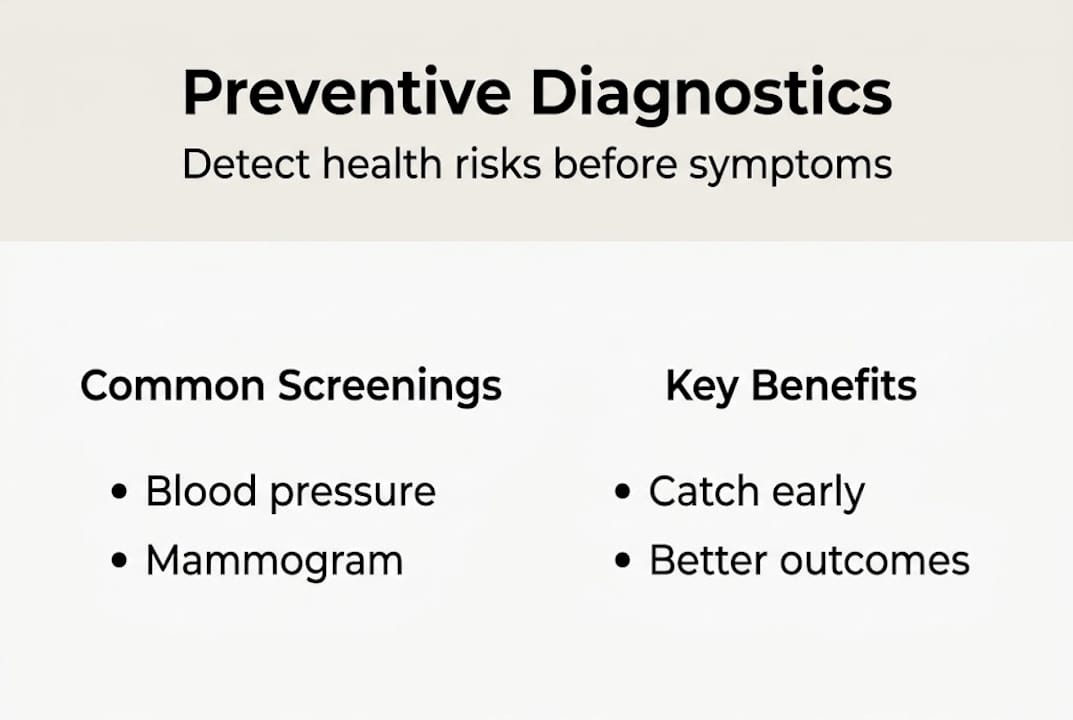
Common preventive diagnostics methods include:
- Blood tests: Cholesterol panels, blood glucose, complete blood counts, and kidney function markers
- Cancer screenings: Mammograms for breast cancer, Pap smears for cervical cancer, colonoscopies for colorectal cancer
- Imaging tests: Chest X-rays, bone density scans, and cardiac imaging
- Vital sign monitoring: Blood pressure, BMI tracking, and vision checks
"Early detection through screening can shift treatment from crisis management to straightforward intervention, dramatically changing a patient's long-term prognosis."
For anyone navigating understanding preventive healthcare, the core insight is that catching a condition at stage one instead of stage three often means the difference between a simple procedure and a major treatment journey. International travelers and expats in Macau face an added complexity: gaps in care when moving between healthcare systems can allow developing conditions to go undetected. Understanding personalized healthcare explained can help you build a screening plan that travels with you. A preventive care overview from major clinical references confirms that the earlier intervention happens, the better the downstream health and economic outcomes.
Types of screening: Common tests and what they detect
Now that you know the purpose, let's look at what screening tests are most commonly used and what they aim to find.
Screenings are specifically designed for symptom-free people. They are not meant to diagnose, but to flag. Think of them as a filter that catches signals you would otherwise miss. Colorectal screening prevents cancer by removing precancerous polyps before they progress, and mammography has been shown to reduce breast cancer mortality in women who screen consistently.

Here is a practical overview of the most common categories:
| Screening type | Target condition | Recommended frequency |
|---|---|---|
| Mammogram | Breast cancer | Every 1-2 years (40+) |
| Colonoscopy | Colorectal cancer | Every 10 years (45+) |
| Fasting blood glucose | Diabetes | Every 3 years (45+) |
| Lipid panel | Cardiovascular risk | Every 4-6 years (adults) |
| Blood pressure check | Hypertension | Annually (18+) |
| Pap smear | Cervical cancer | Every 3 years (21-65) |
Key factors that determine which tests are right for you include:
- Age: Most screening programs have age-specific entry points
- Sex: Certain cancers and conditions are sex-specific
- Family history: First-degree relatives with certain cancers increase your risk profile
- Lifestyle factors: Smoking, diet, and activity level all influence what you should screen for
For a deeper look at common screening tests and how they apply to your specific situation, clinical guidance is your best resource. Women and families should also note that tailored programs exist, including screenings for women and children that address reproductive and pediatric health needs.
Pro Tip: If you are traveling to or through Macau, use the trip as an opportunity to schedule any overdue screenings. International travelers often reset their routines while abroad, and a proactive check while you are here takes advantage of available clinical access.
How is preventive diagnostics evaluated? Sensitivity, specificity, and guidelines
Having seen what tests are available, let's break down how their quality is judged and what global standards exist.
Two numbers define whether a screening test is worth using: sensitivity and specificity. These are the core metrics that distinguish screening for healthy people from diagnostic tests designed for those with symptoms.
- Sensitivity measures how well a test detects true cases. A test with 95% sensitivity correctly identifies 95 out of 100 people who actually have the condition.
- Specificity measures how well a test excludes people who do not have the condition. High specificity means fewer false alarms.
- Positive predictive value tells you how likely a positive result actually means disease is present.
- Negative predictive value tells you how reliably a negative result rules out disease.
Why does this matter for you? A highly sensitive test catches more cases but produces more false positives. A highly specific test reduces false alarms but may miss some real cases. The best screening programs balance both.
Guidelines from bodies like the U.S. Preventive Services Task Force are built on graded benefit recommendations, using systematic reviews and simulation models to determine which populations benefit most from which tests. Grades range from A (strong evidence, high benefit) to D (evidence against use). This system protects patients from being subjected to screenings that cause more harm than good.
Key insight: A grade A recommendation for colorectal cancer screening means the evidence is strong enough that the benefit clearly outweighs the risks for the target population. Grade C or D recommendations require much more individualized discussion with your doctor.
For anyone asking how to interpret their results or decide which tests to book, reviewing screening benefits explained gives a practical foundation for that conversation.
Real-world evidence: How preventive diagnostics improve lives
Theory is useful. Data is convincing. Let's look at what actually happens when populations adopt screening programs.
The evidence is clear and striking. Non-participants in screening have up to 40% higher long-term mortality compared to people who screen regularly for colorectal and breast cancer. That is not a minor statistical difference. That is a massive survival gap driven entirely by whether or not someone showed up for a test when they felt completely fine.
"The strongest predictor of poor long-term health outcomes is not genetics or lifestyle alone. It's skipping screening."
Economic evidence is equally compelling. Dutch preventive programs for colorectal and cervical cancer demonstrate clear cost savings when comparing the cost of screening programs against the cost of treating advanced-stage disease.
Key real-world takeaways include:
- Routine mammography has contributed to measurable reductions in breast cancer death rates across countries with organized screening programs
- Colonoscopy programs that remove precancerous polyps prevent cancers from forming at all, not just catching them early
- Consistent blood pressure monitoring and cholesterol tracking prevent cardiovascular events through timely lifestyle or medication intervention
- Skipping even one or two recommended screening cycles statistically increases your risk profile over time
For practical guidance on building a routine, the wellness screening guide covers actionable steps. And if you want to understand the long-term screening impact on chronic disease prevention, the case for consistency becomes even more compelling.
Pro Tip: If you are a frequent traveler between Macau and other countries, keep a simple personal health record noting which screenings you have completed and when they are next due. This prevents duplication and gaps.
Breaking down the nuances: Risks, overdiagnosis, and making informed choices
As with any tool, screening has risks along with rewards. Here's what to watch for and how to make empowered choices.
Screening is not universally beneficial in every context. False positives can trigger significant anxiety and lead to follow-up procedures that carry their own risks, including biopsies, radiation exposure, or surgery, for conditions that may never have caused harm. This is the challenge of overdiagnosis: detecting abnormalities that would never have progressed to cause symptoms or death.
Important considerations include:
- Some screening recommendations are built on modeling studies rather than direct clinical trials, which can overestimate benefits
- Psychological burden from a false positive result can persist for months and affect quality of life
- Not every abnormality found on a scan or test requires treatment, but communicating that to patients effectively is difficult
- The benefits of screening are real but not identical across all age groups, risk levels, and testing intervals
This does not mean you should avoid screening. It means you should approach it with clear information and a trusted clinical partner. Use maximize screening tips to understand how to optimize your approach, and review the screening procedures guide to know exactly what each test involves before you walk in.
Pro Tip: Before agreeing to any screening, ask your provider two questions: What is the evidence grade for this test in my age and risk group? And what happens if the result comes back positive? Knowing the pathway ahead removes uncertainty.
What most guides miss: Rethinking preventive diagnostics for today's patients
Here is the part most articles skip. The science of screening is well documented. The harder problem is the human side: staying consistently engaged with preventive care when life gets busy, when you are traveling between countries, or when Macau's unique mix of public and private healthcare options creates confusion about where to go.
A table of recommended screenings by age is only useful if you actually show up. The real differentiator between people who benefit from preventive diagnostics and those who do not is not access to information. It is having a consistent, personalized approach to screening that adapts as your life changes.
Travel, relocation, and gaps between healthcare systems are among the most common reasons people fall behind on preventive care. Building a screening plan that is flexible, documented, and supported by a clinical team that understands international patient needs changes that dynamic. The evidence on program benefits and ROI confirms that structured, personalized wellness programs outperform sporadic individual screenings every time. One-size-fits-all screening tables are a floor, not a ceiling.
Accessing top preventive diagnostics and screenings in Macau
Ready to take proactive steps? Here's how Globallmed makes accessing preventive diagnostics easy and tailored to your needs.
Globallmed's outpatient center in Macau provides a full spectrum of preventive screening services aligned with the latest international guidelines. Whether you are a local resident building a long-term health plan or an international traveler looking to complete overdue screenings during your visit, our team is equipped to help.

Our outpatient screening services cover blood diagnostics, cancer screenings, cardiovascular assessments, and more. Appointments are flexible and can be arranged to fit tight travel schedules. We offer consultations in English, Mandarin, and Cantonese, so communication is never a barrier. Our medical clinic department connects you with qualified clinicians who review your history and risk factors before recommending a personalized screening plan. You can also explore our wellness and wellbeing services to round out a complete preventive health strategy. Contact us today to book your screening appointment.
Frequently asked questions
What is the main goal of preventive diagnostics?
The main goal is to detect diseases or risk factors early in healthy, asymptomatic people so that health issues can be addressed before symptoms ever develop.
How do screening tests differ from diagnostic tests?
Screening tests are for people without symptoms to catch diseases early, while diagnostic tests confirm disease when a patient is already experiencing symptoms.
What are some common preventive diagnostics?
Examples include mammograms, colonoscopies, cholesterol screening, blood pressure checks, Pap smears, and diabetes tests. Colorectal and breast screening are among the most evidence-supported options available.
Is preventive diagnostics always risk-free?
No. False positives can cause stress or lead to unnecessary procedures, and some recommendations rely on predictive modeling rather than direct trial evidence.
Why is preventive diagnostics important for travelers and expats?
Consistent screening ensures early detection even when moving between countries or healthcare systems. Proactive early detection improves outcomes for all populations, including those with irregular access to their home healthcare system.