

Integrated outpatient care coordinates medical, behavioral, and mental health services within a single outpatient setting so that one unified team addresses your physical, psychological, and social needs together rather than in isolation. Recognized by the Agency for Healthcare Research and Quality (AHRQ) through its Integration Academy, and operationalized in programs like New York State's Integrated Outpatient Services (IOS) under the Office of Mental Health (OMH), this model is reshaping how Americans access and experience care.
Here is what this guide covers:
- The core definition and principles that distinguish integrated care from fragmented care
- Common delivery models, including co-location, collaborative care, and the patient-centered medical home
- Who is on the care team and what each role does
- Services you can expect, from psychotherapy and medication management to diagnostics and physical therapy
- How U.S. regulation, billing, and insurance apply to integrated outpatient settings
- Evidence on outcomes, plus an honest look at limitations
- A practical checklist for finding integrated outpatient care and what to ask at your first visit
Table of Contents
- What integrated outpatient care is and why it differs from standard care
- Common delivery models and what a U.S. licensure example looks like
- Who is on the care team and what each person does
- What services integrated outpatient care actually includes
- How integrated outpatient care works step by step
- U.S. regulation, billing, and insurance: what patients and clinicians need to know
- What the research shows about integrated outpatient outcomes
- Benefits, limitations, and common barriers to integrated outpatient care
- How to find integrated outpatient care and what to ask at your first visit
- Key Takeaways
- Why integrated care is the standard, not the exception
- GLOBALLMED Medical Center: coordinated outpatient care for the whole person
What integrated outpatient care is and why it differs from standard care
Integrated outpatient care is a team-based model in which medical and behavioral health clinicians work from a shared care plan, often within the same facility, to treat the whole person rather than a single diagnosis. AHRQ's Integration Academy defines this approach as a core component of the advanced patient-centered medical home, one that blends disciplines to address physical, psychological, and social needs simultaneously.
The principles that distinguish it from conventional fragmented care are consistent across settings:
- Whole-person focus: every care decision accounts for medical, behavioral, and social factors together.
- Team-based coordination: clinicians from different disciplines share goals, not just a building.
- Shared Electronic Medical Record (EMR): all providers document in one system so no one is working from incomplete information.
- Warm handoffs: a clinician personally introduces the patient to the next provider rather than issuing a referral and hoping the patient follows through.
- Measurement-based care: validated tools like the PHQ-9 for depression and the GAD-7 for anxiety are used at intake and follow-up to track progress objectively.
- Patient and family participation: the patient is an active partner in goal-setting, not a passive recipient of instructions.
What makes this model clinically meaningful is the last point. As research published through PMC on collaborative, patient-centered models makes clear, patients who are transparent about behavioral and social factors and who engage in shared goal-setting drive better outcomes than those who receive even technically excellent care passively.
Common delivery models and what a U.S. licensure example looks like
No single nationally recognized definition governs how integrated outpatient care must be structured. The Collaborative Family Healthcare Association and similar expert bodies consistently emphasize that models must be tailored to the population and setting. That flexibility is a feature, not a gap, because a rural federally qualified health center serves a fundamentally different patient mix than an urban academic medical center.
The four models you will encounter most often in U.S. outpatient settings are:
- Co-location: behavioral health and medical providers share a physical space but may use separate records and workflows. This is the most common starting point, and also the most frequently misidentified as "integrated" when it is not.
- Collaborative care model: a consultative approach embedded in primary care, where a care manager coordinates between the primary care provider (PCP) and a consulting psychiatrist. The Collaborative Care Model (CoCM), supported by CMS billing codes, is the most studied version of this structure.
- Fully integrated clinic: a single team, a single EMR, and unified care planning. Warm handoffs happen in real time, and the behavioral health clinician is a core team member rather than a consultant.
- Patient-centered medical home (PCMH): a broader organizational model that incorporates integration principles, care coordination, and quality measurement across the full spectrum of a patient's needs.
New York State's Integrated Outpatient Services (IOS) is one of the clearest U.S. examples of how a state operationalizes cross-agency integration at the licensure level. Under NY OMH's IOS framework, licensed behavioral health clinics can formally partner with Article 28 medical providers to deliver coordinated services under a single administrative structure. The framework also highlights a real operational tension: clinics operating under multiple licenses across agencies face significant administrative burden. NY OMH's guidance acknowledges that some clinics adopt a single "host" site model to simplify oversight surveys while preserving integrated workflows.
Pro Tip: When evaluating a clinic that claims to offer integrated care, ask specifically whether providers share a single EMR and whether warm handoffs are a documented workflow step. Co-location without these features is often "co-located but not integrated" in any clinically meaningful sense.
Who is on the care team and what each person does
An integrated outpatient team typically includes the following roles, each with a defined scope and a clear handoff protocol to the next:
Primary care provider (PCP): the clinical anchor. The PCP conducts routine medical visits, manages chronic conditions, orders diagnostics, and initiates referrals or warm handoffs to behavioral health when screening tools flag a concern.

Psychiatrist: provides medication management for psychiatric conditions, consults on complex cases, and collaborates with the PCP on medication interactions. In the collaborative care model, the psychiatrist often functions as a caseload reviewer rather than a direct-care provider for every patient.
Psychologist or licensed therapist: delivers psychotherapy, conducts psychological assessments, and works with the care manager to monitor symptom trajectories using tools like the PHQ-9 and GAD-7.
Care manager: the operational spine of the team. This role coordinates follow-up, tracks patients who disengage from care, communicates between providers, and flags patients whose scores are not improving to the supervising psychiatrist or PCP.
Social worker: addresses social determinants of health, connects patients to community resources, and supports discharge or transition planning for patients stepping down from higher levels of care.
Nurses and medical assistants: administer screenings at intake, support medication management, and often conduct the first warm handoff conversation with a patient before the behavioral health clinician enters the room.
Allied therapists (physical therapist, occupational therapist, speech-language pathologist, dietitian): address functional and nutritional needs that interact directly with chronic disease management and behavioral health. A dietitian in outpatient care, for example, is not an add-on but a core contributor when a patient's depression is compounded by poorly controlled diabetes.
Pharmacist: reviews medication regimens for interactions, counsels patients on adherence, and supports the PCP and psychiatrist in polypharmacy situations. The pharmacist's role in outpatient settings is frequently underused but clinically significant.
Consider a patient named Maria, a 58-year-old with type 2 diabetes and newly identified moderate depression. Her PCP administers a PHQ-9 during a routine diabetes follow-up. The score is 12. Rather than issuing a referral slip, the nurse walks Maria to the behavioral health clinician's office down the hall. The therapist conducts a brief assessment, the care manager schedules a follow-up appointment before Maria leaves the building, and the psychiatrist reviews the case that afternoon during a caseload consultation. Maria's next visit addresses both her HbA1c and her depression score. That is what a warm handoff looks like in practice.
What services integrated outpatient care actually includes
Outpatient care, by definition, covers procedures, consultations, and treatments delivered without an overnight hospital stay. Common outpatient services include:
- Routine primary care and specialist visits
- Medication management (psychiatric and medical)
- Individual and group psychotherapy
- Diagnostic imaging and laboratory tests
- Physical therapy, occupational therapy, and speech-language therapy
- Case management and care coordination
- Health education and chronic disease self-management programs
- Nutritional counseling and dietetics
The clinical advantage of delivering these services within a coordinated pathway is not just convenience. When a PCP identifies depression during a diabetes follow-up, a same-day PHQ-9 screening and warm handoff to behavioral health can happen in a single visit rather than requiring the patient to schedule a separate appointment at a separate location weeks later. That reduction in friction matters enormously for patients managing multiple conditions, because every additional step between identification and treatment is a point where patients disengage.
For a broader look at what outpatient services are available across health and wellness settings, the scope extends well beyond what most patients expect from a single clinic visit.
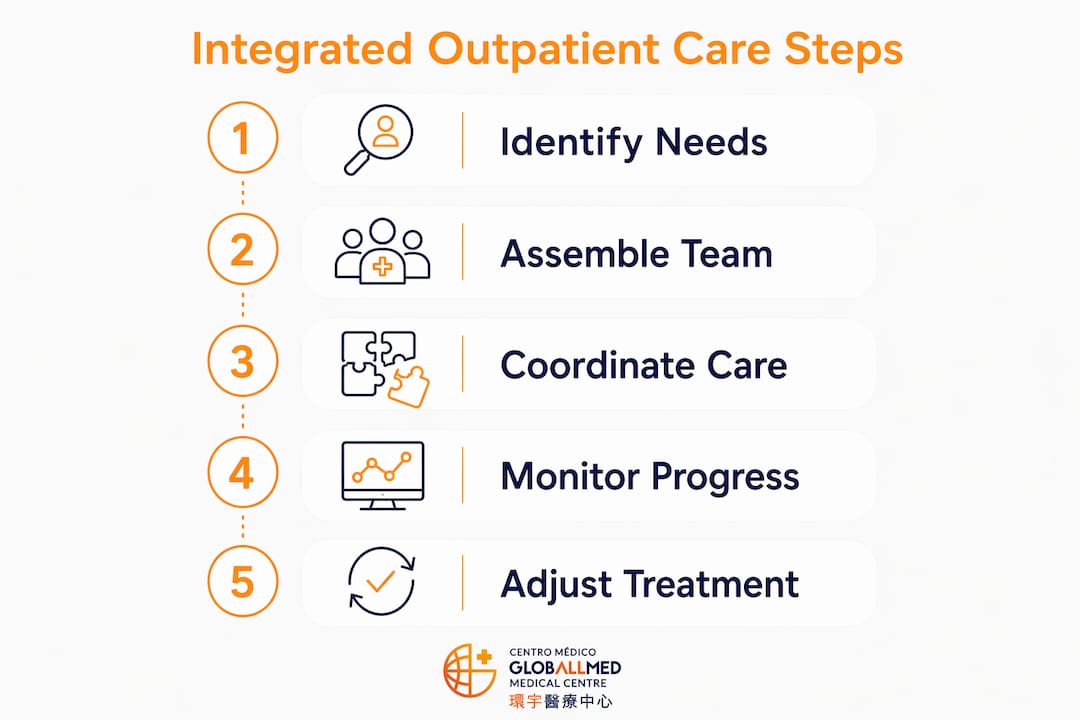
How integrated outpatient care works step by step
The patient journey through an integrated outpatient setting follows a recognizable sequence, even when the specific tools and team composition vary by clinic.
- Intake and universal screening: at the first visit, the patient completes standardized screening tools, typically the PHQ-9 for depression, the GAD-7 for anxiety, and condition-specific measures relevant to their medical history. Results are entered directly into the shared EMR.
- Unified care planning: the PCP and behavioral health clinician review screening results together, either in real time or during a same-day team huddle, and develop a single integrated care plan with shared goals.
- Warm handoff or scheduled behavioral consult: if a behavioral health need is identified, the patient is introduced to the behavioral health clinician before leaving the clinic. If the clinician is unavailable, a same-week appointment is scheduled before the patient exits.
- Shared EMR documentation: every provider documents in the same record. The care manager can see the PCP's notes; the therapist can see the medication list; the pharmacist can flag an interaction without waiting for a fax.
- Measurement-based monitoring: at each follow-up, the patient completes the same validated tools used at intake. A PHQ-9 score that is not improving after four to six weeks triggers a caseload review with the consulting psychiatrist.
- Ongoing care coordination: the care manager tracks patients between visits, follows up on missed appointments, and coordinates referrals to allied services such as physical therapy or dietetics when the care plan requires them.
- Transition or step-down planning: when a patient's condition stabilizes, the team develops a step-down plan, which may include reduced visit frequency, community resource connections, or transition to a lower-intensity setting.
A patient with chronic low back pain and comorbid anxiety illustrates this well. At intake, his GAD-7 indicated severe anxiety. His PCP refers him to physical therapy for the pain and introduces him to the behavioral health therapist the same day. Over time, his anxiety symptoms decrease, his physical therapy attendance improves, and his opioid prescription is reduced. The care manager tracks both trajectories in the shared EMR. No single provider drove that outcome; the structure did.
AHRQ's Integration Academy notes that measurement-based care using tools like the PHQ-9 and GAD-7 supports not only clinical decision-making but also quality reporting and payer conversations about value-based arrangements, which makes routine screening a strategic as well as clinical priority.

U.S. regulation, billing, and insurance: what patients and clinicians need to know
Navigating the regulatory and payment landscape is where many patients and clinics encounter the most friction. The key frameworks are:
- HIPAA: governs the privacy and security of protected health information across all providers in an integrated team. Patients should receive a Notice of Privacy Practices at intake explaining how their information is shared within the team.
- 42 CFR Part 2: a federal regulation that applies specifically to substance use disorder treatment records. Unlike standard HIPAA-covered records, 42 CFR Part 2 records require explicit patient consent before they can be shared, even within an integrated team. Patients receiving substance use treatment in an integrated setting should ask their clinic how this consent is handled.
- Medicare and Medicaid: both programs cover behavioral health integration services, but coverage patterns vary by state Medicaid plan and by the specific service codes billed. Patients should confirm coverage directly with their insurer rather than assuming parity.
- Private insurance: the Mental Health Parity and Addiction Equity Act (MHPAEA) requires most private insurers to cover mental health and substance use disorder services at parity with medical and surgical benefits. In practice, prior authorization requirements and network limitations still create access barriers.
- Sliding scale and grant-funded programs: federally qualified health centers (FQHCs) and community mental health centers often offer integrated services on a sliding fee scale based on income. State and federal grants, including SAMHSA's Certified Community Behavioral Health Clinic (CCBHC) program, fund integrated care in underserved communities.
On the billing side, clinics providing integrated behavioral health services use specific CPT code categories that patients may see on an explanation of benefits. The Collaborative Care Model, for example, is billed using CMS codes (99492, 99493, 99494) that cover the care manager's coordination time and the consulting psychiatrist's caseload review, not just face-to-face visits. Psychotherapy sessions, psychiatric medication management, and medical evaluation and management visits each carry their own code categories. Patients should ask the clinic's billing department which codes apply to their care plan and verify coverage with their insurer before the first visit.
Pro Tip: Ask the clinic's billing coordinator specifically whether they bill for care management time under the Collaborative Care Model codes. If they do not, you may be receiving a less coordinated version of integrated care than you expect, and your insurer may not be covering the coordination services that make the model work.
What the research shows about integrated outpatient outcomes
The evidence base for integrated outpatient care is substantial, though not uniform. The most consistent findings across NIH, AHRQ, and peer-reviewed literature are:
Research published through NIH and NCBI demonstrates that integrated care reduces preventable hospital readmissions and improves outcomes for patients with complex medical and behavioral comorbidities when implemented with fidelity. The operative phrase is "with fidelity": clinics that co-locate providers but do not implement shared EMRs, warm handoffs, or measurement-based monitoring show weaker results than those that do.
AHRQ's patient-centered medical home research consistently shows that centralizing services around shared goals improves access and reduces fragmentation, particularly for patients managing multiple chronic conditions. Patients who would otherwise require separate appointments at separate facilities, often weeks apart, receive coordinated care in fewer visits.
For depression specifically, the Collaborative Care Model has one of the strongest evidence records in behavioral health. Studies consistently show better symptom outcomes compared to usual care, with the PHQ-9 as the primary tracking instrument. The same pattern holds for anxiety disorders measured by the GAD-7.
The limitations are real. Model heterogeneity makes direct comparisons difficult: a study of a fully integrated urban clinic is not directly comparable to a co-location model in a rural health center. Implementation fidelity varies widely, and workforce shortages, particularly for care managers and psychiatrists, constrain what many clinics can actually deliver. Cost savings, while frequently cited, depend heavily on the patient population and the baseline level of fragmentation being replaced.
For patients managing chronic disease, the evidence most directly relevant to their situation is the reduction in avoidable hospitalizations when behavioral and social determinants are addressed alongside physical symptoms.
Benefits, limitations, and common barriers to integrated outpatient care
Benefits
- Fewer separate appointments and referral steps for patients with multiple conditions
- Earlier identification of behavioral health needs through universal screening
- Better medication adherence when pharmacists and care managers are part of the team
- Reduced stigma, because behavioral health services are embedded in primary care rather than siloed in a separate mental health clinic
- Lower cost than inpatient care, since room-and-board charges are eliminated and preventable admissions are reduced
- Improved outcomes for comorbid conditions, particularly depression paired with chronic illness
Limitations and barriers
- EMR interoperability: without a shared record, co-location produces coordination theater rather than genuine integration. Many clinics are still working through technical and contractual barriers to true interoperability.
- Licensing and administrative burden: operating across multiple agency licenses, as NY OMH's IOS framework documents, creates significant overhead. Smaller clinics may lack the administrative capacity to manage cross-agency compliance.
- Workforce shortages: care managers, psychiatrists, and licensed therapists are in short supply in many U.S. markets. A model that depends on these roles cannot function without them.
- Payer coverage gaps: not all insurers reimburse Collaborative Care Model codes, and prior authorization requirements for behavioral health services remain a persistent barrier.
- Equity and access: integrated care is more common in urban academic settings than in rural or underserved communities, creating geographic disparities in access.
Pro Tip: If a clinic cannot tell you whether its providers share a single EMR, that is a meaningful signal about the actual level of integration. A clinic with separate records for medical and behavioral health is co-located, not integrated, regardless of how it markets itself.
How to find integrated outpatient care and what to ask at your first visit
Finding a genuinely integrated outpatient clinic requires more than a Google search. Start with these access routes:
- Ask your current PCP whether their practice offers integrated behavioral health or can refer you to a clinic that does. Use the phrase "integrated behavioral health" or "primary care behavioral health" when asking.
- Contact your insurer's member services and ask for in-network providers offering behavioral health integration or Collaborative Care Model services.
- Search state directories: many states maintain directories of licensed behavioral health clinics, including those operating under integrated licensure frameworks like NY OMH's IOS.
- Check federally qualified health centers (FQHCs): FQHCs are required to offer comprehensive primary care and often include behavioral health integration. The HRSA Health Center Finder is a public tool for locating FQHCs by zip code.
- Ask about CCBHC certification: Certified Community Behavioral Health Clinics are federally designated to provide comprehensive, integrated behavioral health services and are required to meet specific quality standards.
Before your first visit, prepare the following:
- A current medication list, including dosages and prescribing providers
- Any prior PHQ-9 or GAD-7 scores if you have them
- A written list of your active medical diagnoses
- Your insurance card and a copy of your benefits summary
- A list of questions for the team
Questions worth asking at the first visit:
- Do all providers on my care team share the same electronic medical record?
- How are warm handoffs handled if I need to see a behavioral health clinician today?
- Who is my care manager, and how do I reach them between visits?
- How does the clinic handle 42 CFR Part 2 consent if I am receiving substance use treatment?
- What billing codes will be used for my care, and has the clinic verified my coverage?
Red flags to watch for: providers who cannot explain how records are shared, clinics that require you to schedule behavioral health appointments at a separate location weeks out, and intake processes that do not include any standardized screening tools. For practical guidance on preparing for outpatient procedures and what to expect logistically, a step-by-step preparation guide can reduce first-visit uncertainty.
Key Takeaways
Integrated outpatient care works when a shared EMR, warm handoffs, measurement-based monitoring, and a designated care manager are all present together, not when any one element is implemented alone.
| Point | Details |
|---|---|
| Core definition | Integrated outpatient care coordinates medical and behavioral health services in one team and setting for whole-person treatment. |
| Shared EMR is non-negotiable | Co-location without a shared electronic record is not true integration; always confirm this before enrolling. |
| Measurement-based care drives results | PHQ-9 and GAD-7 scores at every visit allow the team to adjust treatment before problems compound. |
| Billing and coverage vary | Collaborative Care Model CPT codes (99492–99494) exist, but payer coverage is not universal; verify before your first visit. |
| GLOBALLMED Medical Center | GLOBALLMED Medical Center offers coordinated outpatient services across primary care, psychotherapy, physiotherapy, and dietetics for patients seeking whole-person care. |
Why integrated care is the standard, not the exception
The conventional framing of integrated outpatient care as a progressive or aspirational model understates how far the evidence has moved. The research is not ambiguous: patients with comorbid physical and behavioral conditions who receive fragmented care, separate appointments, separate records, separate providers who never speak to each other, have worse outcomes than those whose care is coordinated. That is not a nuanced finding. It is a consistent signal across AHRQ, NIH, and peer-reviewed literature.
What the field still underestimates is the implementation gap. A clinic can adopt the language of integration, add a behavioral health provider to the roster, and still deliver fragmented care if the EMR is not shared and the care manager role is not funded. The NY OMH IOS framework is valuable precisely because it forces administrative accountability alongside clinical aspiration. Licensing requirements that mandate shared documentation and defined handoff protocols are not bureaucratic overhead; they are the mechanism that makes the model real.
For patients, the practical implication is this: do not accept a clinic's self-description as integrated at face value. Ask the specific questions listed above. A clinic that cannot answer them clearly is telling you something important about how your care will actually be coordinated.
GLOBALLMED Medical Center: coordinated outpatient care for the whole person
Patients who understand what integrated outpatient care requires often find that the hardest part is locating a clinic that actually delivers it. GLOBALLMED Medical Center, Macau's largest private outpatient clinic, brings together medical and specialist services across general practice, psychotherapy, physiotherapy, dietetics, and diagnostics under one roof, with a clinical team structured around coordinated, whole-person care.

The center's model covers the full range of outpatient services, from routine primary care and health check-ups to behavioral health consultations and allied therapy, supported by direct billing arrangements with major international insurers. International patients and local residents alike can access the full services index and book appointments online. For patients seeking wellness and allied health support as part of a broader care plan, the wellness and allied services department covers dietetics, physiotherapy, and wellbeing treatments in the same integrated setting.
To book a consultation or ask about coordinated care options, visit GLOBALLMED Medical Center and schedule your appointment online.