

Most people picture a hospital bed when they think about receiving medical care. That instinct is understandable, but it's also increasingly outdated. Ambulatory care, as defined in the Medicare context, refers to services provided without an inpatient admission, meaning no overnight stay is expected or required. Far from being reserved for minor complaints, ambulatory care now covers diagnostics, chronic disease management, minor surgery, mental health treatment, and advanced wellness therapies. This article breaks down exactly what that means for you, where it happens, and why it matters more than most patients realize.
Table of Contents
- Defining ambulatory care: What it really means
- Types of ambulatory care settings and services
- Ambulatory care vs. inpatient care: Key differences and why they matter
- Why ambulatory care matters for chronic conditions and prevention
- A modern take: How ambulatory care is reshaping patient expectations
- Explore ambulatory care services with Globallmed
- Frequently asked questions
Key Takeaways
| Point | Details |
|---|---|
| Ambulatory care defined | Ambulatory care means medical services where no overnight hospital stay is needed. |
| Many settings possible | Care is provided in clinics, ambulatory surgery centers, specialty and wellness centers. |
| Patient benefits | Ambulatory care offers lower costs, convenience, and faster recovery time for many treatments. |
| Ideal for chronic care | Ongoing conditions and preventive health are best served through ambulatory follow-up and coordination. |
Defining ambulatory care: What it really means
Before diving into what happens in practice, it's important to first unpack what "ambulatory care" actually means, because the term confuses people in two distinct ways.
The word "ambulatory" comes from the Latin ambulare, meaning to walk. In everyday medicine, it technically has two separate applications. The first is a care setting concept: whether a patient is treated in an outpatient environment versus admitted as an inpatient. The second is a patient functional descriptor: whether a patient is physically capable of walking or moving independently. As Verywell Health notes, the term can shift meaning depending on context, which matters when you're reading discharge instructions, interpreting research, or reviewing your own medical records.
Here is how that plays out in practice:
- A doctor's note describing you as "ambulatory" might simply mean you can walk on your own, with no reference to your care setting at all.
- A billing code marked "ambulatory" signals that your visit was outpatient, meaning no overnight admission was involved.
- Research papers on "ambulatory blood pressure monitoring" use the term to mean continuous measurement during normal daily activity, again a completely separate usage.
Key distinction: When researching your own care options or reading a provider's plan, always check which meaning of "ambulatory" is being used. Context almost always clarifies it, but it pays to ask if you are unsure.
Understanding these definitions matters because it helps you engage more clearly with your healthcare providers and the medical standards for outpatient care that govern how those services are delivered. When you know what "ambulatory" means in each context, you are far less likely to misinterpret your care plan or be caught off guard by a billing statement.
The short summary: in the context of healthcare services, ambulatory care means any form of medical treatment you receive without being formally admitted to a hospital overnight. That is the definition we will use throughout this article.
Types of ambulatory care settings and services
With a concrete definition in mind, let's look at the main types of ambulatory care and where you might encounter them.
Ambulatory care does not happen in just one kind of facility. It spans a wide range of settings, each designed for different levels of need and different types of procedures.
The five most common ambulatory care settings:
- Physician's offices and primary care clinics — The most familiar setting. Routine checkups, vaccinations, prescription management, and initial assessments all happen here. These visits are quick and focused, usually lasting under an hour.
- Urgent care centers — Designed for non-life-threatening conditions that still need same-day attention. Think sprained ankles, minor infections, or flu symptoms. No appointment is usually required, and wait times are far shorter than an emergency room.
- Ambulatory surgery centers (ASCs) — Specialized facilities for planned surgical procedures that do not require hospital admission. Ambulatory surgery centers are certified to deliver surgical care where hospitalization is not expected, and stays are not anticipated to exceed 24 hours, though rare exceptions can occur.
- Specialty clinics — Focused on specific medical areas such as dermatology, orthopedics, cardiology, or ophthalmology. You typically visit these after a referral from a primary care provider.
- Wellness and integrative health clinics — Offering preventive care, aesthetic treatments, mental health services, nutritional counseling, and physical therapy. These are growing rapidly as patients prioritize proactive health management over reactive treatment.
Understanding the differences between these settings helps you choose appropriately. The top outpatient services available today cover far more ground than most patients expect.
| Setting | Best suited for | Typical visit length |
|---|---|---|
| Primary care clinic | Checkups, chronic monitoring | 15 to 45 minutes |
| Urgent care center | Acute minor illness or injury | 30 to 90 minutes |
| Ambulatory surgery center | Planned minor procedures | 2 to 6 hours |
| Specialty clinic | Condition-specific follow-up | 30 to 60 minutes |
| Wellness clinic | Prevention, aesthetics, therapy | 30 to 120 minutes |
One important scenario worth knowing: sometimes a planned ambulatory procedure requires an unplanned hospital admission. This happens when unexpected complications arise during or after a procedure. It is rare, but ASCs have clear protocols for transferring patients to a hospital if needed. Your provider will explain this possibility in advance during the consent process.
Pro Tip: Before any scheduled procedure, confirm with your provider and insurer whether the service is classified as ambulatory or inpatient. This single step can prevent billing surprises and ensure your coverage applies correctly. You can also read a detailed guide to outpatient procedures to understand what questions to ask beforehand.
If you are unsure which setting fits your needs, reviewing medical consultation types can help you identify the right starting point.
Ambulatory care vs. inpatient care: Key differences and why they matter
Now that we've outlined typical ambulatory care settings, it's vital to understand how ambulatory care compares to traditional inpatient care.
The distinction is not simply about physical location. It is about the level of care required, the monitoring intensity, and the administrative and financial processes attached to each. As CMS clarifies, the line between outpatient and inpatient is really about whether a patient requires hospital-level monitoring and formal admission, not merely where the encounter begins.
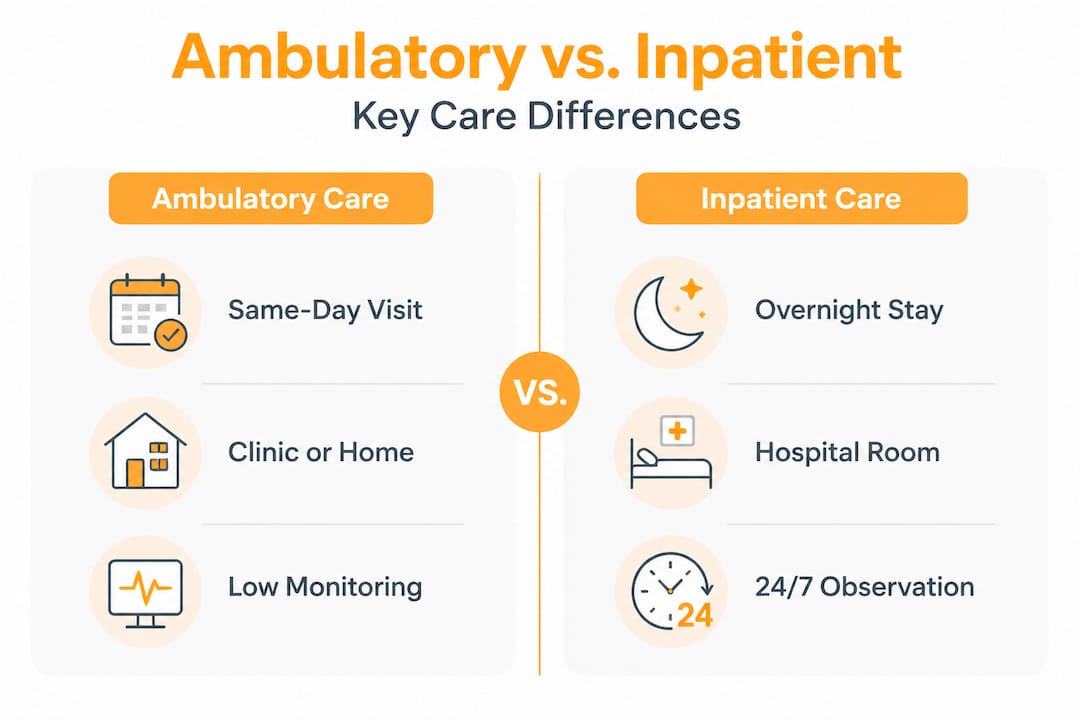
| Feature | Ambulatory care | Inpatient care |
|---|---|---|
| Overnight stay | Not expected | Required |
| Admission process | Check-in and discharge same day | Formal hospital admission |
| Monitoring level | Periodic, focused | Continuous, intensive |
| Typical cost | Lower | Significantly higher |
| Insurance billing | Outpatient coding | Inpatient coding |
| Patient role | Active, self-managed | More dependent on clinical team |
Here are the core differences that affect your experience directly:
- Decision criteria: Ambulatory care is chosen when a patient's condition does not require constant clinical supervision. Inpatient care is chosen when symptoms are unstable, serious, or unpredictable.
- Transitions: A patient can move from ambulatory to inpatient care when circumstances change. For example, a routine colonoscopy could trigger an admission if a complication is discovered during the procedure.
- Patient responsibilities: In ambulatory care, you play a more active role. You manage your own recovery at home, follow discharge instructions carefully, and arrange your own transport.
- Insurance implications: Inpatient and outpatient care are often billed under completely different benefit categories. Your cost-sharing, deductible application, and coverage limits may differ dramatically between the two.
Worth knowing: Being treated in a hospital does not automatically make your care "inpatient." Hospitals also provide outpatient services. Your formal status, whether you are admitted or receiving observation services, determines how your stay is billed and covered.
For a detailed walkthrough of what to expect at each stage, the outpatient treatment steps guide breaks the process down clearly from arrival to discharge.
Why ambulatory care matters for chronic conditions and prevention
Beyond acute treatment, ambulatory care plays a central role in long-term health management and disease prevention.
This is where the real power of ambulatory care becomes clear. Managing a chronic condition like diabetes, hypertension, or asthma does not require hospital admissions for most patients, but it does require frequent, consistent engagement with a healthcare provider. Ambulatory settings make that possible without disrupting your daily life.

The CMS Ambulatory Specialty Model was specifically designed to support upstream management of chronic conditions in outpatient settings, emphasizing coordinated care, prevention, and ongoing monitoring rather than waiting for a crisis to trigger a hospital visit.
Why does this model work so well for chronic care?
- Continuity of care: You see the same providers over time, building a relationship and a detailed health history that enables better decisions.
- Frequency without friction: Short, regular visits in an outpatient setting are far less disruptive than hospital stays. Patients are more likely to keep appointments when the process is simple.
- Early detection: Regular screenings and check-ins catch problems earlier, when they are easier and less expensive to treat.
- Coordinated management: Ambulatory providers often coordinate labs, imaging, specialist referrals, and pharmacy services from a single point of contact. Nothing falls through the cracks.
- Prevention as a service: Vaccinations, health risk assessments, nutrition counseling, and wellness screenings are all core ambulatory services that reduce long-term disease burden.
For patients exploring preventive healthcare strategies, ambulatory care is the primary vehicle through which those strategies are delivered.
Telemedicine is also expanding the reach of ambulatory care significantly. Remote monitoring devices, video consultations, and digital care plans mean that ambulatory care now extends into your home. Learning about telemedicine in outpatient care can help you understand how to take advantage of these tools.
Pro Tip: When managing a chronic condition, ask your ambulatory care provider exactly how follow-up monitoring will be structured between visits. Clear communication about labs, remote check-ins, and escalation pathways prevents gaps that can lead to avoidable complications.
A modern take: How ambulatory care is reshaping patient expectations
With the nuts and bolts of ambulatory care covered, let's reconsider how this model is actively changing what it means to receive outstanding care in 2026.
There is a persistent cultural belief that serious medicine happens inside hospitals. If you are getting a bed, monitors, and a hospital gown, the thinking goes, then you must be receiving the best available care. But that assumption deserves a hard look.
Hospitals are essential for acute emergencies, complex surgeries, and intensive monitoring. But they also carry real risks. Hospital-acquired infections, medication errors, and the general stress of an inpatient environment are well-documented concerns. For the vast majority of care needs, including most surgeries, all chronic disease monitoring, and nearly all preventive services, ambulatory settings deliver equivalent or better outcomes at a fraction of the cost and disruption.
The shift is not subtle. More procedures and services are moving out of hospitals every year, driven by better technology, more capable outpatient teams, and a growing recognition that patient outcomes are not defined by the setting but by the quality and appropriateness of care. Patients who understand this are better equipped to ask the right questions, push back on unnecessary admissions, and seek care in settings that fit their actual clinical needs.
For international patients or those who travel for medical care, understanding ambulatory options is especially valuable. Knowing what services are available in outpatient settings expands your choices significantly. Resources like the outpatient care for international patients guide offer practical context for navigating care across different healthcare systems.
The bottom line is this: being an informed healthcare consumer means knowing that exceptional care often does not require a hospital bed. It requires the right provider, the right setting, and a clear plan tailored to your needs.
Explore ambulatory care services with Globallmed
If you're ready to discover how ambulatory care can support your well-being, here's where to take the next step.
At Globallmed, our private outpatient center in Macau is built around the ambulatory care model, combining clinical rigor with genuine convenience for local and international patients alike. Whether you are exploring routine checkups, specialist consultations, or advanced wellness treatments, our integrated approach means you get coordinated, expert-level care without unnecessary hospital visits.

Browse our full range of outpatient services at Globallmed, from diagnostics to specialist care, all designed to meet international standards. If you are interested in preventive wellness, aesthetic treatments, or holistic care programs, our wellness and beauty treatments department offers targeted solutions. For medical consultations and condition-specific care, visit our medical clinic department to see how our clinical team can support your health goals. Booking an appointment is straightforward, and our team is ready to help you find the right care path.
Frequently asked questions
What procedures can be done in an ambulatory care setting?
Many diagnostic tests, minor surgeries, rehabilitation sessions, and preventive screenings are performed without a hospital stay. Ambulatory surgery centers are certified for surgical care that does not require hospitalization and is completed within 24 hours in most cases.
Does ambulatory care always mean you go home the same day?
Yes, in almost all cases. Ambulatory patients are not expected to stay overnight, though in rare situations where unexpected complications arise, a hospital admission may become necessary.
Is ambulatory care the same as outpatient care?
Effectively, yes. Both terms describe services provided without an inpatient admission. As Medicare defines it, ambulatory care simply means care that does not involve an overnight hospital stay.
How is chronic disease care handled differently in ambulatory settings?
Ambulatory care for chronic conditions focuses on regular monitoring, coordinated specialist involvement, and prevention rather than crisis management. The CMS ambulatory specialty model was specifically designed to support ongoing, upstream management of chronic diseases in outpatient environments.