

A medical specialist network is defined as an organized group of credentialed healthcare professionals who deliver coordinated specialty care under shared quality and cost standards. These networks exist within broader healthcare systems, including accountable care organizations (ACOs) and value-based care frameworks, to connect patients with the right specialist at the right time. Understanding how they work gives you a direct advantage when making healthcare decisions. GLOBALLMED Medical Center operates within this model, integrating specialist coordination across its outpatient departments to meet international care standards.
What is a medical specialist network and how does it work?
A medical specialist network is a structured arrangement between a health plan, hospital system, or outpatient center and a defined group of specialists who meet specific clinical and performance criteria. The term "specialist network" is the recognized industry shorthand, while "high-performance specialty network" describes the more rigorous tier used by ACOs and value-based care programs. Both terms appear throughout this article because they describe different levels of the same system.
The operational model goes well beyond simple administrative contracting. High-performance specialty networks use episode-based data tracking to identify specialists with better outcomes and cost efficiency. An "episode" covers the full arc of a patient's care, from initial diagnosis through recovery, and the data captured during that arc reveals which specialists produce fewer complications and lower total costs.

Primary care providers sit at the center of this model. They initiate referrals, communicate clinical context to specialists, and receive follow-up reports after treatment. Effective specialty networks build accountability boundaries and communication processes between primary and specialty physicians to prevent costly care gaps. Without those processes, patients fall through the cracks between appointments.
Pro Tip: When your primary care provider refers you to a specialist, ask specifically whether that specialist belongs to a high-performance tier within your network. The distinction matters for both your outcomes and your costs.
Traditional referral methods rely on a physician's personal familiarity with colleagues. Specialist networks replace that informal system with real-world clinical data, outcome transparency, and defined care hand-off protocols. The difference is measurable in complication rates and post-surgical recovery times.
What are the benefits of specialist networks for patients?
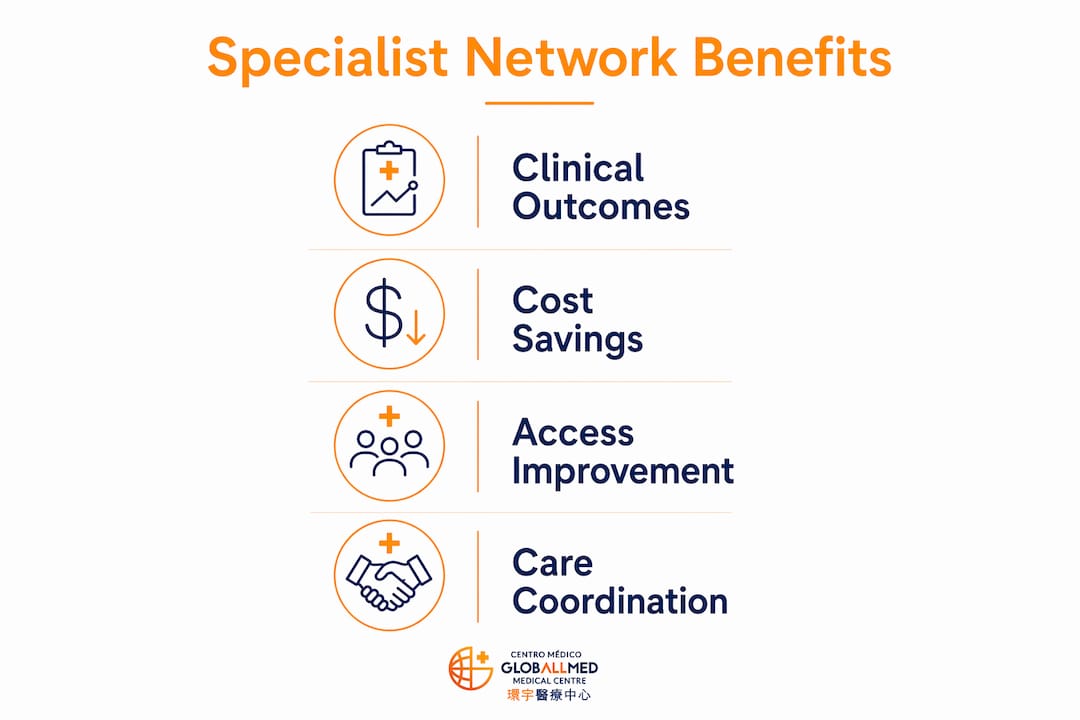
Specialist networks deliver three concrete advantages: better clinical outcomes, lower costs, and faster access to the right expertise.
Clinical outcomes improve through vetting
Many patients overlook that high-performance networks reduce surgical complications by using real-world clinical data to identify top specialists. A specialist who appears in a high-performance network has been evaluated against outcome benchmarks, not simply credentialed. That distinction matters most for complex procedures where surgeon volume and technique directly affect recovery.
Cost savings come from negotiated rates
In-network providers have negotiated rates with insurance plans, resulting in lower out-of-pocket costs compared to out-of-network providers. Some plans strictly require in-network use to avoid high costs. Patients who verify network status before scheduling an appointment avoid surprise billing and protect their annual deductible progress.
Access to subspecialty expertise becomes structured
Broad specialty coverage is insufficient for many complex diagnoses requiring niche expertise. A network that maps adequacy at the subspecialty level connects patients with a spine surgeon who focuses on minimally invasive techniques, not simply any orthopedic surgeon. That precision is the difference between a generic referral and a genuinely useful one.
The full list of patient benefits includes:
- Lower complication rates from outcome-vetted specialists
- Reduced out-of-pocket costs through pre-negotiated in-network pricing
- Faster referrals supported by shared electronic records and care protocols
- Access to subspecialists with documented expertise in specific conditions
- Coordinated follow-up care that reduces post-treatment gaps
Patient care best practices consistently show that coordinated specialty care reduces readmissions and improves long-term health outcomes. The network structure makes that coordination systematic rather than dependent on individual physician relationships.
How can patients find and verify medical specialists within a network?
Finding the right specialist requires more than a quick online search. Online directories are a starting point, but they carry a significant limitation: publicly available provider directories can have outdated information. Network participation changes when contracts expire, physicians retire, or practices change affiliations. A directory that was accurate three months ago may not reflect today's reality.
The most reliable verification process follows these steps:
- Start with your insurance plan's online directory. Search by specialty and location to generate an initial list of in-network candidates.
- Call the specialist's office directly. Provide your insurance ID number and group number and ask the staff to confirm current in-network participation. This step is non-negotiable.
- Ask your primary care provider for a referral. Primary care physicians maintain working relationships with specialists and can direct you toward those with strong clinical reputations within the network.
- Confirm the facility is also in-network. A specialist may be in-network while the hospital or outpatient center where they practice is not. Verify both.
- Request a written confirmation. Ask the specialist's billing department to confirm network status in writing before your appointment date.
Pro Tip: Always call with your insurance card in hand. The combination of your member ID and group number allows the provider's billing staff to run a real-time eligibility check, which is more accurate than any printed directory.
Medical provider networks must meet state regulatory standards for network adequacy, including provider availability and timely access. Those standards cover primary care, mental health, women's healthcare, and emergency services. Knowing your rights under those regulations gives you grounds to request an out-of-network exception if a required specialist is unavailable within your plan's network.
What are the structural challenges and future trends in specialist networks?
Specialist networks face real operational challenges that affect the care patients receive. The most significant is network adequacy at the subspecialty level. Plans that prioritize subspecialty adequacy outperform those focused only on general specialties, improving patient access to relevant expertise. Building that level of precision requires detailed data mapping and continuous monitoring.
Data quality is the second major challenge. High-performance specialty networks require data analytics capable of linking clinical events and costs to individual patient episodes for continuous quality improvement. Without that linkage, network managers cannot distinguish a high-performing dermatologist from an average one. The analytics infrastructure is expensive and technically demanding.
The table below summarizes the key structural challenges and the trends addressing them:
| Challenge | Current Impact | Emerging Solution |
|---|---|---|
| Subspecialty adequacy gaps | Patients referred to generalists for complex conditions | Precision adequacy mapping at subspecialty level |
| Outdated provider directories | Patients unknowingly see out-of-network providers | Real-time eligibility verification systems |
| Manual specialist vetting | Slow onboarding, limited network growth | AI-enabled and self-serve vetting workflows |
| Care coordination gaps | Post-surgical complications and readmissions | Defined accountability boundaries and hand-off protocols |
| Payment model misalignment | Fee-for-service incentives conflict with value-based goals | CMS episode-based payment models like TEAM |
Self-serve and AI-enabled vetting workflows allow specialist networks to rapidly onboard experts outside traditional operational hours. These workflows shift vetting from synchronous phone calls to expert-initiated processes, which improves registration rates and reduces administrative bottlenecks. The practical result is a larger, more current network available to patients.
Specialty networks are evolving from administrative tools into clinical integration platforms that enhance care coordination and quality. Payment models like CMS's Transforming Episode Accountability Model (TEAM) accelerate that shift by tying reimbursement directly to episode-level outcomes. Networks that invest in data infrastructure and subspecialty precision now will be better positioned as those payment models expand.
Key Takeaways
A medical specialist network improves patient outcomes by connecting people to outcome-vetted specialists through structured referral processes, negotiated pricing, and continuous data-driven quality monitoring.
| Point | Details |
|---|---|
| Definition and purpose | A specialist network is an organized group of credentialed providers coordinated to deliver high-quality specialty care. |
| Outcome-based vetting | High-performance networks select specialists using episode-level clinical data, not just credentials or reputation. |
| Cost protection | In-network providers offer negotiated rates that reduce out-of-pocket costs; always verify status before scheduling. |
| Verification process | Call the provider directly with your insurance ID to confirm real-time network participation before any appointment. |
| Future direction | AI-enabled vetting and subspecialty adequacy mapping are closing the gaps that traditional networks leave open. |
Why network quality matters more than network size
Most patients assume that a larger network is automatically a better network. That assumption is wrong. A network with thousands of specialists but no outcome differentiation gives you no reliable way to choose between a high-performing surgeon and an average one. The number of names in a directory tells you nothing about complication rates, readmission frequency, or patient satisfaction scores.
What I have seen consistently is that patients who engage with high-performance networks, and who ask the right questions before their first appointment, experience fewer post-treatment complications and shorter recovery times. The difference is not marginal. It is the kind of difference that changes whether a procedure is a success or a setback.
The challenge is that most patients do not know to ask those questions. They receive a referral, confirm the specialist is "in-network," and assume the work is done. True network quality requires one more step: asking whether the specialist has been evaluated against outcome benchmarks, not just credentialed. Institutions that publish outcome data and maintain transparent quality standards are the ones worth seeking out.
GLOBALLMED Medical Center's integrated care model reflects this standard. Its clinical team operates within defined coordination protocols, and its specialist departments are structured to support the kind of continuous communication that prevents care gaps. Patients who engage with that model benefit from more than a single appointment. They benefit from a system designed to track their care from referral through recovery.
— IGHS
GLOBALLMED Medical Center's approach to specialist care
GLOBALLMED Medical Center, Macau's largest private outpatient clinic, organizes its specialist departments around the same principles that define high-performance networks: outcome accountability, coordinated referrals, and access to subspecialty expertise.

Patients seeking specialist care through GLOBALLMED Medical Center benefit from a clinical team that communicates across departments, reducing the gaps that typically occur between primary and specialty care. The center's outpatient services span medical, cosmetic, and wellness specialties, all coordinated under one integrated care model. Patients can also review the full range of medical specialty departments available at the center to identify the right specialist for their condition before scheduling an appointment.
FAQ
What is a medical specialist network in simple terms?
A medical specialist network is an organized group of credentialed healthcare providers who deliver specialty care under shared quality and cost standards. Patients access these specialists through referrals or insurance plan directories.
How do I know if a specialist is in my network?
Call the specialist's office directly with your insurance ID and group number to confirm current in-network participation. Online directories may be outdated and should not be your only verification method.
Why does it matter which specialist I see within a network?
Not all in-network specialists perform equally. High-performance networks differentiate specialists based on outcome data, so choosing a vetted specialist reduces your risk of complications and improves recovery results.
What is subspecialty network adequacy?
Subspecialty network adequacy means a health plan has enough specialists in specific fields, such as spine surgery or behavioral health, to meet patient demand with timely access. Plans that map adequacy at this level provide better care for complex diagnoses.
Can I see a specialist outside my network?
You can, but out-of-network care typically costs significantly more. Some plans require in-network use entirely. If no in-network specialist meets your clinical needs, you may be eligible to request an out-of-network exception from your insurer.