

Most people think of healthcare as something you seek when something goes wrong. That framing is costly, both financially and physically. Preventive care cuts risk of heart disease, stroke, and diabetes by over 80%, yet the majority of healthcare spending still goes toward treating conditions that could have been avoided. Preventive healthcare flips the script: instead of reacting to illness, you actively manage your health before problems develop. This article breaks down what preventive healthcare actually means, how it works at every level, and how you can apply it to your own life, whether you live in Macau or are visiting from abroad.
Table of Contents
- What is preventive healthcare?
- Levels of preventive healthcare: From environment to rehabilitation
- Methods and interventions in preventive healthcare
- Evidence and impact: Why prevention matters
- Limitations, controversies, and expert perspectives
- Applying preventive healthcare: Practical tips for individuals
- Integrating prevention into primary healthcare systems
- Preventive care services at Globallmed: Your next step
- Frequently asked questions
Key Takeaways
| Point | Details |
|---|---|
| Prevention works | Evidence shows targeted preventive care can reduce major disease risks by more than 80%. |
| Risks need customization | Personalized screenings and interventions avoid harm and deliver better results. |
| Systems matter | Integrating prevention into primary healthcare improves access, equity, and efficiency for all patients. |
| Not all screenings help | Be selective—only evidence-based screenings improve health outcomes and avoid unnecessary care. |
| Next steps are accessible | Most clinics and healthcare providers offer preventive services for local and international residents. |
What is preventive healthcare?
Preventive healthcare is not just about eating well or exercising. It is a structured, evidence-based approach to health management. Preventive care is defined as medical care focused on preventing health problems from occurring, diagnosing issues early before symptoms develop, and reducing risks based on individual profiles including age, sex, genetics, lifestyle, and environment.
This matters for everyone, not just people with existing conditions. International patients traveling to Macau, expats living abroad, and local residents all benefit from understanding their personal risk profile and acting on it early. The goal is not to medicalize everyday life but to make informed, targeted choices.
Here is why preventive healthcare delivers real value:
- Lower illness risk: Addressing risk factors before they become diagnoses keeps you healthier longer.
- Early detection: Catching conditions like cancer or high blood pressure early dramatically improves treatment outcomes.
- Reduced costs: Preventing a disease is almost always cheaper than treating it.
- Better quality of life: Fewer chronic conditions mean more energy, mobility, and independence as you age.
For a broader look at how prevention fits into overall wellness, holistic prevention explained offers useful context on integrating these principles into daily care.
Levels of preventive healthcare: From environment to rehabilitation
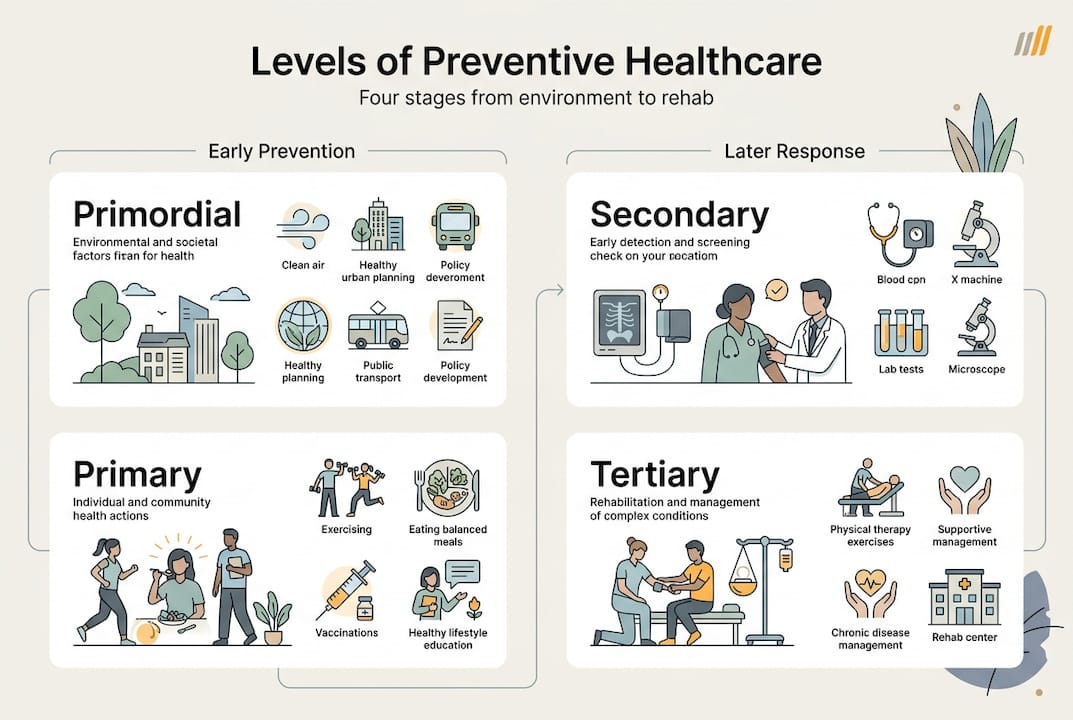
Preventive healthcare is not a single action. It operates across four distinct levels: primordial, primary, secondary, and tertiary, with a fifth level, quaternary prevention, focused on avoiding overtreatment.

| Level | Focus | Example |
|---|---|---|
| Primordial | Population-wide risk reduction | Anti-smoking policies, urban planning |
| Primary | Preventing disease onset | Vaccines, lifestyle counseling |
| Secondary | Early detection | Cancer screenings, blood pressure checks |
| Tertiary | Managing existing disease | Cardiac rehab, diabetes management |
| Quaternary | Avoiding overtreatment | Limiting unnecessary procedures |
A typical patient journey through these levels might look like this:
- Population exposure reduced through public health policy (primordial).
- Individual risk addressed through vaccination and lifestyle changes (primary).
- Screening identifies early-stage disease before symptoms appear (secondary).
- Treatment and rehabilitation minimize disability and complications (tertiary).
- Overtreatment avoided through evidence-based clinical decisions (quaternary).
Lifestyle changes alone can reduce cardiovascular disease risk by more than 80%. Screenings add value when targeted correctly, but broad, untargeted screening programs carry their own risks, including false positives and unnecessary interventions.
Understanding medical wellness and prevention at each level helps you ask better questions when you visit a provider. The WHO's framework for primary healthcare systems also shows how these levels are integrated into national and regional health strategies.
Methods and interventions in preventive healthcare
Knowing the levels is one thing. Understanding how interventions are actually delivered is where prevention becomes practical. Key preventive methodologies include screenings, immunizations, counseling, risk assessment, and population-level interventions.
Here is a breakdown of the major tools:
- Screenings: Cholesterol panels, blood glucose tests, mammograms, colonoscopies, cervical cancer screenings, and blood pressure monitoring.
- Immunizations: Childhood vaccines, annual flu shots, HPV vaccines, travel vaccines for international patients, and pneumococcal vaccines for older adults.
- Lifestyle counseling: Nutrition guidance, smoking cessation, alcohol reduction, stress management, and physical activity planning.
- Risk assessments: Family history reviews, genetic risk profiling, and cardiovascular risk calculators.
For a practical overview of what to expect, screening for wellness walks through the most common tests and their purpose. You can also explore common health screening tests for a more detailed breakdown by age and risk group. For women and families, women and child health services offer targeted preventive programs.
Pro Tip: Do not rely on a single annual checkup as your entire prevention strategy. The most effective approach combines targeted screenings based on your specific risk factors with consistent lifestyle habits and follow-up care.
Evidence and impact: Why prevention matters
The data behind preventive healthcare is compelling. Lifestyle changes cut coronary heart disease risk by more than 80%, avoidable mortality rates are declining in countries with strong preventive systems, and screenings consistently reduce late-stage diagnoses when applied correctly.
| Intervention | Effectiveness | Key Impact |
|---|---|---|
| Cardiovascular lifestyle changes | Over 80% risk reduction | Fewer heart attacks and strokes |
| Childhood immunizations | Up to 99% disease prevention | Near-elimination of polio, measles |
| Cervical cancer screening | 70-80% mortality reduction | Early-stage detection and treatment |
| Blood pressure monitoring | Significant stroke risk reduction | Prevents hypertension complications |
| Colorectal cancer screening | 60-70% mortality reduction | Polyp removal before cancer develops |
The OECD tracks treatable mortality, deaths that should not occur with timely, effective care, at around 100 per 100,000 people in high-income countries. Nations with stronger preventive systems consistently outperform those focused primarily on curative care.
For individuals, the math is straightforward. Preventing a condition costs far less than managing it for decades. A wellness screening guide can help you identify which tests offer the best return for your profile. You can also review health screening tests explained to understand what each test measures and why it matters.
Limitations, controversies, and expert perspectives
Preventive healthcare is not without its complications. Honest engagement with its limits makes you a smarter patient.
Key nuances to understand:
- Overdiagnosis: Some screenings detect conditions that would never have caused harm, leading to unnecessary treatment.
- Overtreatment: Not all general checkups reduce mortality, and some interventions carry risks that outweigh benefits for low-risk individuals.
- Public preference: Research shows that people often prefer curative care over preventive care due to the perceived urgency of treating existing illness.
- Access disparities: Prevention is not equally available. Cost, geography, language barriers, and insurance gaps all affect who benefits.
- Cost-effectiveness variation: Some preventive interventions deliver exceptional value; others are expensive with modest outcomes.
Targeted, evidence-based screening delivers better results than broad, population-wide programs. The goal is to match the right intervention to the right patient at the right time, not to screen everyone for everything.
Pro Tip: Before agreeing to any screening, ask your provider two questions: Is this recommended for my specific risk profile? And what happens if the result is positive? Understanding the downstream implications helps you make genuinely informed decisions.
For a deeper look at how personalized approaches improve outcomes, personalized healthcare guide explains how tailored care models reduce unnecessary interventions. Research on targeted interventions also supports focusing resources on high-risk populations for maximum impact.
Applying preventive healthcare: Practical tips for individuals
Knowing the theory is useful. Applying it to your own life is where the real benefit comes from. Tailoring preventive strategies to your individual risk profile, through screenings, lifestyle counseling, and primary care integration, is the most cost-efficient and equitable approach.
Essential steps to get started:
- Know your risk factors: Family history, age, sex, lifestyle habits, and existing conditions all shape your prevention priorities.
- Choose reputable providers: Look for clinics with qualified staff, evidence-based protocols, and clear communication.
- Seek counseling, not just tests: Behavioral counseling for diet, exercise, and stress is as important as any lab result.
- Keep records: Maintain a personal health file with past screenings, vaccinations, and results for continuity of care.
Here is how to integrate prevention into daily life:
- Schedule a baseline health assessment to identify your current risk profile.
- Follow up on any flagged results within the recommended timeframe.
- Build consistent habits: regular movement, balanced nutrition, adequate sleep, and stress management.
- Revisit your prevention plan annually or after any major health change.
- For international patients, confirm that your provider can accommodate language needs and coordinate with your home country insurance.
For a full overview of available services, health checkup options at Globallmed cover a range of targeted preventive programs. The CDC's cost-effectiveness priorities also offer useful guidance on which interventions deliver the most value.
Integrating prevention into primary healthcare systems
Individual action matters, but the system you access shapes what is possible. Primary healthcare (PHC) is the foundation that makes prevention scalable, equitable, and sustainable. PHC-based systems yield better outcomes and greater efficiency compared to disease-specific, specialist-only approaches.
Key benefits of PHC-integrated prevention:
- Accessibility: Primary care is the first point of contact, making prevention available before problems escalate.
- Cost-efficiency: Coordinated care reduces duplication, unnecessary referrals, and expensive emergency interventions.
- Equity: PHC systems are designed to serve diverse populations, including expats, low-income residents, and those with language barriers.
- Continuity: Long-term relationships with a primary provider improve adherence to prevention plans.
For families, expats, and long-term residents in Macau, having a trusted primary care provider who understands your full health history is one of the most valuable investments you can make. Explore medical wellness integration and personalized healthcare to see how these principles are applied in practice. You can also learn more about the Globallmed medical center and its integrated care model.
Preventive care services at Globallmed: Your next step
At Globallmed, we believe prevention is not a one-size-fits-all checklist. It is a personalized, ongoing process built around your specific health profile, lifestyle, and goals. Our team in Macau works with local residents and international patients to design evidence-based prevention plans that actually fit your life.
Whether you are looking for a baseline health assessment, targeted screenings, or a full wellness program, our preventive health services cover the full spectrum of care. Our comprehensive checkups are designed to identify risks early and give you a clear picture of your health. Visit the Globallmed medical center page to learn more about our team, facilities, and how to book your first appointment.
Frequently asked questions
How do I start a preventive healthcare plan?
Begin by assessing your personal risk factors, including age, family history, and lifestyle, then consult a primary healthcare provider for a tailored screening and counseling plan.
Do all preventive screenings reduce mortality?
No. Not all general checkups reduce mortality, so focus on screenings that are specifically recommended for your age group and risk profile.
Is preventive healthcare cost-effective?
Most preventive interventions save money over time, but value varies. High-value preventive methods like vaccines and targeted screenings consistently deliver the best return on investment.
Can preventive healthcare help international patients?
Absolutely. Primary healthcare supports equity and cost-efficiency for diverse populations, including international residents who may face language or insurance challenges.
What are the main risks of preventive healthcare?
Overdiagnosis and overtreatment are real concerns. Targeted screening is recommended over broad programs to minimize harm and focus resources where they deliver genuine benefit.