Bilingual English and Chinese speech therapy evaluates and treats communication and swallowing difficulties across both languages at once, rather than treating one language while ignoring the other. It suits children with speech or language delays growing up in Mandarin, Cantonese, or English-speaking households, bilingual learners who seem to lag behind monolingual peers, and adults recovering language function after a stroke or traumatic brain injury. The clinical priority is straightforward: if concerns show up in both languages, or interfere with daily communication in either one, that warrants a bilingual speech-language pathologist (SLP) evaluation, in person or through telepractice.
What that first evaluation typically looks for:
- Communication difficulty present in both English and Chinese, not just one
- Speech sound errors that do not match typical bilingual development patterns
- Swallowing or feeding concerns alongside speech or language delay
- Adult patients with new language difficulty following a neurological event
Key Takeaways
Effective bilingual English and Chinese speech therapy requires assessing both languages separately, coaching caregivers on daily carryover, and matching treatment technique to each language's specific sound system.
| Point | Details |
|---|---|
| Evaluate both languages | A disorder shows up in both languages; a difference usually shows up in only one. |
| Caregiver coaching drives progress | Embedding strategies into play, meals, and storytime improves carryover more than clinic time alone. |
| Match technique to language profile | Tone-based errors need different treatment than English-style phonological errors, including adapted MIT and lingual control training. |
| Telepractice works for many goals | Language and articulation goals often transfer well to telepractice with adequate audio and video quality. |
| Choose coordinated, multilingual care | GLOBALLMED Medical Center integrates speech therapy within its multi-therapy department for coordinated, bilingual evaluation and treatment. |
This article is general information, not a substitute for advice from a qualified doctor. Consult a qualified healthcare professional about your own circumstances before acting on anything here.
Table of Contents
- Benefits of Bilingual Therapy and Why Family Coaching Matters
- How Does Bilingual Assessment Differ From Monolingual Testing?
- Practical Assessment Steps: Intake, Tools, and Goal Setting
- Therapy Approaches and Techniques Adapted for Chinese Languages
- Delivery Modes: In-Person, School-Based, and Telepractice
- What to Expect: Timeline, Sessions, and Cost
- Why Clinic Credentials and Family-Centered Care Matter
- Get Started With Bilingual Speech Therapy at GLOBALLMED Medical Center
Benefits of Bilingual Therapy and Why Family Coaching Matters
A child who gets to describe her school day in Cantonese, then switch to English for a favorite cartoon, is doing something a monolingual therapy session cannot replicate: expressing herself in the languages she actually lives in. Therapy delivered across both languages tends to feel more natural to the patient and reduces the risk that a session becomes an exercise in translation rather than communication.
Caregiver coaching is not a nice add-on. Clinicians who train parents to embed language strategies into play, mealtime, and storytime routines see stronger carryover than sessions confined to a clinic room, largely because most communication practice happens at home, not in a 45-minute appointment.
A well-designed bilingual therapy plan should build both languages rather than push one aside. Three things tend to separate strong bilingual programs from weak ones:
- Dual-language goal setting. Objectives target skills in Mandarin, Cantonese, or English separately, based on where the gaps actually are.
- Structured caregiver coaching. Parents learn specific prompts and routines they can repeat daily, in the language they are most comfortable using.
- Progress tracked in both languages. Reassessment checks growth in each language rather than assuming skills automatically transfer.
Pro Tip: Ask your therapist to teach you one specific phrase or prompt per week in each language you speak at home. Small, repeatable habits carry over faster than an hour of formal drills.
How Does Bilingual Assessment Differ From Monolingual Testing?
Diagnosing a genuine speech or language disorder in a bilingual child requires more than running an English test and calling it done. A pattern that looks like a disorder in isolation can be a normal feature of learning two languages with very different sound systems.
Putonghua, Cantonese, and English differ substantially in their consonant inventories, tone systems, and syllable structure. A clinician has to map an error to the rules of the specific language before deciding whether it signals a problem. Backing errors or tone substitutions in Putonghua, for example, carry different diagnostic weight than a similar-sounding substitution in English, because the two languages organize their sound systems differently.
The clinical red flag that actually matters: impairment that shows up in both languages, not just one.
- Test and sample both languages rather than relying on English norms alone.
- Compare error patterns against language-specific expectations (tone errors and backing in Putonghua look different from English phonological errors).
- Use dynamic assessment (test, teach, then retest) to separate limited exposure from a true disorder.
- Gather family language history, including which language was learned first and how much exposure the child gets in each.
There simply are not enough standardized, culturally valid assessment tools available in Mandarin Chinese, which is one reason dynamic assessment and detailed language sampling matter so much in this field right now. A clinician who only has English-normed tools on hand and applies them to a Cantonese-dominant child risks a false positive for disorder when the real story is uneven language exposure.
Practical Assessment Steps: Intake, Tools, and Goal Setting
A thorough bilingual evaluation follows a fairly predictable sequence, even though every child's language profile looks different.
- Intake and language history. The clinician documents exposure history for each language, which dialect the family speaks (Mandarin or Cantonese), the language(s) used at school, and the family's functional communication priorities.
- Formal and informal testing. Because standardized Chinese-language tools remain limited, clinicians often supplement formal testing with structured language sampling and dynamic assessment, watching how the child responds to teaching cues in real time.
- Cross-linguistic error analysis. Errors get compared against expected patterns in each language separately, not scored against a single-language benchmark.
- Goal setting with the family. Functional, bilingual goals get built around real household and school routines, and caregivers help decide which language to prioritize for early targets.
This sequence protects against two opposite mistakes: mislabeling normal bilingual development as a disorder, and missing a genuine impairment because it only shows up clearly in the family's home language.
Therapy Approaches and Techniques Adapted for Chinese Languages
Once assessment identifies a real disorder, the treatment approach has to match the language profile, not a generic template. Several techniques come from mainstream speech pathology but require real adaptation for tonal, non-alphabetic languages.
Melodic Intonation Therapy (MIT), originally built around English pitch and rhythm, has been adapted for tonal languages and described in the clinical literature as beneficial for stroke and aphasia patients when the melodic contours are adjusted to reflect actual lexical tones rather than imposed English-style intonation.
Lingual control and speech-motor training show measurable improvement in Putonghua-speaking children with speech sound disorders in case-study and small-sample research, particularly for disordered consonant initials that do not respond to phonological approaches alone.
Choosing between a phonological approach and a motor-based approach depends on the error profile: a child substituting entire sound classes according to a rule-based pattern likely needs phonological intervention, while one struggling with the physical placement or coordination of specific sounds, common with retroflex and aspirated consonants in Putonghua, often responds better to motor-based, lingual control methods.
Typical session activities include:
- Tone discrimination drills using minimal pairs (like mā, má, mǎ, mà)
- Auditory bombardment with target sounds embedded in meaningful words
- Tactile and visual cueing for tongue placement on difficult consonants
- Family-led carryover activities built into daily routines
Adapting a technique built for one language's sound system to Chinese's tones, retroflexes, and aspiration contrasts is not a cosmetic tweak. It changes which errors count as clinically meaningful and which treatment actually generalizes.
Delivery Modes: In-Person, School-Based, and Telepractice
Telepractice has become a legitimate option for a wide range of language and articulation goals, not a fallback substitute, provided the platform delivers clear enough audio and video for the clinician to catch subtle tone and consonant errors.
- Telepractice works well for language stimulation, tone discrimination practice, and many articulation goals, and it opens access to bilingual clinicians for families who cannot find one nearby.
- In-person sessions remain preferable for feeding and swallowing evaluations, complex motor-speech disorders, and cases where hands-on cueing matters.
- Hybrid scheduling, mixing in-person evaluation with telepractice follow-up, works well for many families balancing convenience with clinical need.
Before a telepractice session, test your internet connection, use headphones to reduce echo, and pick a quiet room with good lighting so the clinician can see mouth movements clearly.
What to Expect: Timeline, Sessions, and Cost
A bilingual evaluation typically runs about an hour or longer and ends with a written report outlining diagnosis, language-specific goals, and recommended session frequency.
- Initial evaluation: 60 to 90 minutes, covering both languages, intake history, and formal or dynamic testing.
- Therapy frequency: most patients start with weekly or biweekly sessions, adjusted based on progress and severity.
- Timeframe for progress: measurable gains often appear within several weeks for articulation goals, while language and fluency goals can take a few months of consistent therapy.
- Billing: ask providers directly whether they offer private pay rates, accept insurance direct billing, and whether bilingual assessment carries any additional fee.
Pro Tip: Ask any clinic upfront how they bill for bilingual assessment specifically. Some providers charge extra for dual-language testing time, and knowing that in advance avoids surprises.
Why Clinic Credentials and Family-Centered Care Matter
Not every clinic that lists "bilingual services" actually staffs clinicians trained in cross-linguistic assessment. Families should ask direct questions before booking: What language pairs does the therapist actually work in? How is caregiver coaching built into the plan? Is intake conducted in the family's preferred language?
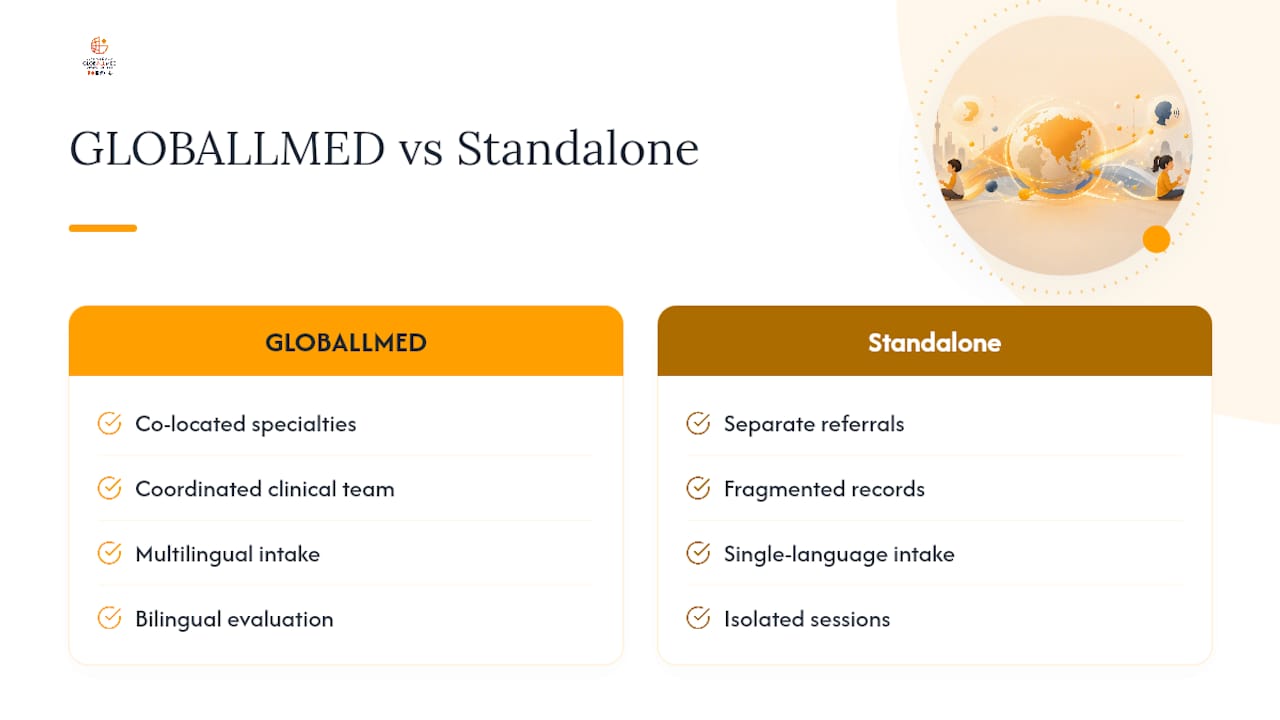
A clinic built around multidisciplinary, multilingual care answers these questions before you have to ask. GLOBALLMED Medical Center's multi-therapy department integrates speech and occupational therapy within a broader medical team, so a child with feeding concerns alongside a speech delay does not need referrals across separate clinics.
Families evaluating any provider should expect:
- Clear credential and licensure checks for speech-language pathologists
- Structured family coaching built into the therapy plan, not offered as an afterthought
- Multilingual intake so history-taking happens in the language the family is most comfortable using
Get Started With Bilingual Speech Therapy at GLOBALLMED Medical Center
GLOBALLMED Medical Center gives families in Macau something rare in outpatient care: speech and occupational therapy delivered inside a full medical center, alongside pediatrics, ENT, and dietetics, rather than as a standalone referral to a separate practice. That matters when a child's speech delay overlaps with feeding difficulty or a hearing concern, because the same clinical team can coordinate care instead of passing the file between unconnected offices.

The center's medical center brings together licensed professionals across specialties, supporting international and local families who need multilingual intake and coordinated evaluation rather than a single isolated session. Whether the concern is a toddler mixing up tones in Cantonese and English or an adult relearning speech after a stroke, the starting point is the same: a proper evaluation that looks at both languages, not just one.
If communication concerns show up at home, at school, or after a medical event, book a consultation through GLOBALLMED Medical Center's medical clinic department and get a clear, bilingual evaluation scheduled rather than waiting to see if the issue resolves on its own.