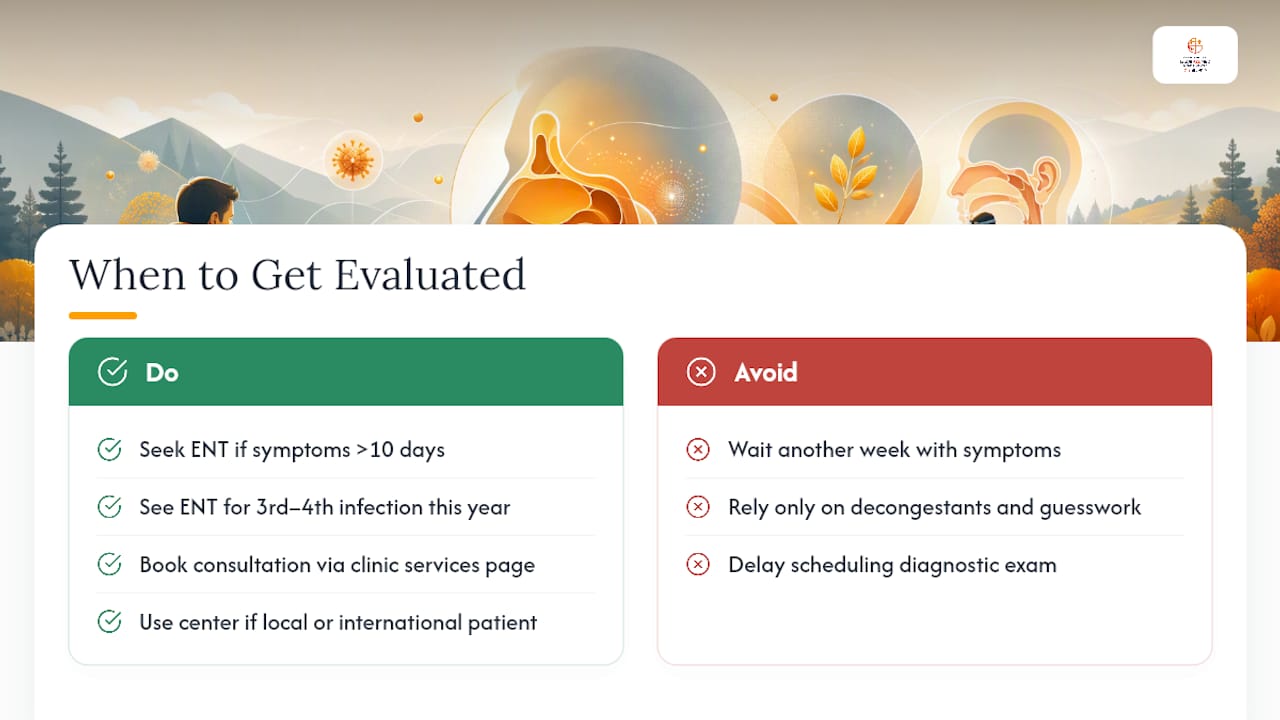
See an ENT if your sinus symptoms have lasted longer than 12 weeks, if you get multiple sinus infections per year, or if standard treatment has already failed. Contact your primary care provider first for symptoms lasting more than 10 days or worsening after initial improvement. Go to an emergency room immediately for vision changes, severe facial swelling, high fever, stiff neck, or confusion, since these can signal a spreading infection.
TL;DR:
- Chronic sinusitis persisting beyond 12 weeks or recurring more than four times a year should prompt an ENT consultation rather than repeated antibiotics.
- Symptoms worsening after 10 days or returning after initial improvement may indicate bacterial infection and require medical evaluation.
- Emergency care is necessary if symptoms include vision changes, severe facial swelling, high fever, stiff neck, or confusion, due to potential spread of infection.
- ENT diagnosis often involves nasal endoscopy, with CT scans reserved for complex or long-term cases to plan treatment or surgery.
- Long-term management may include allergy testing, addressing anatomical issues, and possibly surgical procedures like balloon sinuplasty or sinus surgery when conservative treatments fail.
Table of Contents
- Sinusitis Symptoms: What Sinus Pain Actually Feels Like
- When Should You See a Doctor for Sinusitis?
- What Are the Warning Signs That Need Emergency Care?
- How Do ENT Specialists Diagnose Sinus Problems?
- What Sinusitis Treatments Do ENT Specialists Offer?
- Why Do Some People Get Sinus Infections Over and Over?
- What Happens at Your First ENT Visit for Sinus Issues?
- What Can You Do While Waiting to See a Specialist?
- GLOBALLMED Medical Center's Approach to Sinus Evaluation
- Get Sinus Symptoms Evaluated at GLOBALLMED Medical Center
Sinusitis Symptoms: What Sinus Pain Actually Feels Like
Sinusitis produces four telltale symptoms, and most patients have at least two of them at once. Facial pain, pressure, or fullness typically centers around the cheeks, forehead, or between the eyes. Nasal obstruction makes breathing through the nose difficult, sometimes on just one side. Discolored nasal discharge (yellow or green, not clear) or thick postnasal drip is a common giveaway. Decreased sense of smell rounds out the core group.
Fever, cough, and fatigue often ride along with these symptoms, especially early on. What trips people up is mistaking sinus pain for something else entirely.
- Migraines cause throbbing pain but rarely produce discolored discharge
- Dental infections mimic cheek pressure but stay localized to one tooth
- TMJ disorders cause jaw and ear pain without nasal congestion
- Allergic rhinitis brings clear discharge and itching, not thick colored mucus
Acute sinusitis runs under four weeks. Subacute stretches from four to twelve weeks. Past twelve weeks, you're dealing with chronic sinusitis, and that timeline alone should push you toward an ENT doctor for sinus issues rather than another round of guesswork.
When Should You See a Doctor for Sinusitis?
Most sinus infections are viral, run their course in about a week, and clear up without antibiotics. The trouble starts when symptoms don't follow that script. Here's how clinicians actually sort this out:
- The 10-day rule. If sinus infection symptoms haven't improved after 10 days, or if they got better and then suddenly worsened again, that's a signal worth calling your primary care provider about. A second wave of fever or facial pain after initial improvement often points toward a bacterial infection layered on top of the original viral one.
- The 12-week threshold. Chronic sinusitis is defined as symptoms lasting 12 weeks or longer. This is the single clearest reason to request a chronic sinusitis consultation with an ENT rather than cycling through another course of antibiotics from urgent care.
- The recurrence pattern. Some clinical guidance considers recurrent rhinosinusitis as more than four acute episodes in a year, and frequent infections are a reason for ENT evaluation. If you're refilling the same antibiotic prescription every few months, that pattern itself is diagnostic.
- Treatment failure. If topical steroids and antibiotics haven't touched your symptoms, continuing to repeat the same treatment rarely changes the outcome. That's a treatment-resistant case, and it's squarely in ENT territory.
Urgent care is fine for a straightforward, uncomplicated flare that hasn't yet crossed the 10-day mark. Once you're past that point repeatedly, your primary care physician should be the one coordinating an ENT referral, not another urgent care visit for the same complaint.
What Are the Warning Signs That Need Emergency Care?
A small number of sinusitis symptoms point toward something more dangerous than a stuffy nose. Watch for:
- Double or blurry vision
- Swelling or redness around one or both eyes
- Severe swelling on one side of the face
- Severe headache paired with a stiff neck
- High fever that won't come down
- Sudden confusion or difficulty staying alert
These signs matter because the sinuses sit directly next to the eyes and brain. An infection that spreads beyond the sinus cavity can reach the orbital tissue around the eye or, less commonly, the space around the brain. Mayo Clinic guidance specifically flags vision changes, severe headache with stiff neck, high fever, and confusion as reasons for immediate evaluation, not a wait-and-see approach. If any of these show up, go to an emergency department or call emergency services. This isn't a "call the ENT office in the morning" situation.
How Do ENT Specialists Diagnose Sinus Problems?
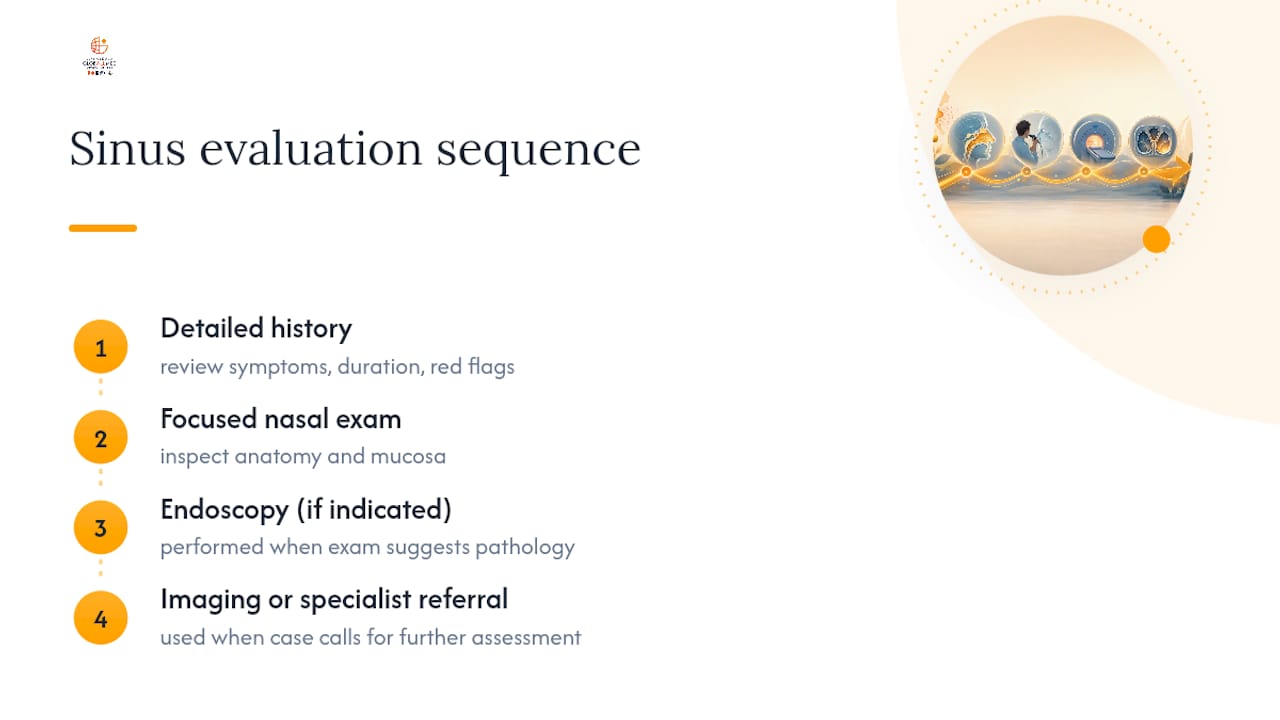
An ENT visit for sinus symptoms starts the same way any medical visit does: a detailed history and a focused nasal exam. From there, the workup depends on what's already been tried and how long symptoms have persisted.
- Nasal endoscopy is the workhorse tool. A thin, lighted scope lets the specialist see directly into the nasal passages, checking for polyps, pus, inflamed tissue, or structural blockages that a basic exam with a light can't catch.
- CT imaging comes into play for chronic cases or when surgery is being planned. It's not typically ordered for a first acute episode, since it won't change the initial treatment plan.
- Allergy testing helps identify whether environmental triggers are driving repeat infections.
- Immunodeficiency screening gets considered for patients with unusually frequent or severe infections that don't fit a typical pattern.
- Cultures are reserved for cases that haven't responded to standard antibiotics, to pinpoint exactly what's causing the infection.
Direct visualization through endoscopy often changes the treatment plan on the spot, which is exactly why it's a standard part of any sinusitis treatment options discussion with an ENT.
What Sinusitis Treatments Do ENT Specialists Offer?
Treatment starts conservative and escalates only when necessary. Saline irrigation, intranasal corticosteroid sprays, and short courses of antibiotics (when there's a clear bacterial component) form the first line. Oral steroids get used selectively, usually for significant inflammation or nasal polyps.
When medical therapy alone isn't enough, ENTs have two procedural options:
- Balloon sinuplasty uses a small balloon catheter to widen blocked sinus passages, done in-office or as a quick outpatient procedure with minimal downtime.
- Endoscopic sinus surgery removes obstructive tissue, polyps, or diseased bone, and it's reserved for more extensive or complicated disease.
Surgery gets considered when optimized medical therapy has already failed, when there's clear anatomic obstruction, nasal polyps, fungal sinus disease, or complications from infection spreading beyond the sinus cavity. Recovery from balloon sinuplasty is typically measured in days; endoscopic sinus surgery recovery runs longer, often a few weeks before full activity resumes.
Pro Tip: Keep a simple symptom log, noting which days you used antibiotics, steroids, or saline rinses. Bringing that record to your ENT doctor for sinus issues saves an entire visit's worth of guesswork about what has and hasn't worked.
Why Do Some People Get Sinus Infections Over and Over?
Recurrent or chronic sinusitis rarely has a single cause, which is why the workup often expands beyond the nose itself.
- Allergy testing identifies environmental triggers, like dust mites or seasonal pollen, that keep reigniting inflammation.
- Immunodeficiency screening gets considered when infections are frequent, severe, or don't respond the way they should.
- Anatomic contributors, such as a deviated septum or narrow sinus openings, get addressed alongside long-term management like topical steroids and regular saline irrigation.
Chronic rhinosinusitis care is often multidisciplinary, meaning your ENT may coordinate with an allergist or immunologist rather than managing everything alone.
What Happens at Your First ENT Visit for Sinus Issues?
Walking in prepared makes the visit far more productive.
- Bring a written timeline of your symptoms, any prior imaging results, medications you've tried, and a list of known allergies.
- Expect a structured exam: history first, then nasal endoscopy, followed by additional testing or a CT scan if your case warrants it.
- Leave with one of three outcomes: an adjusted medical plan, scheduled allergy or imaging workup, or a referral for surgical consultation if your case meets those criteria.
What Can You Do While Waiting to See a Specialist?
Saline nasal irrigation, intranasal steroid sprays, humidification, and over-the-counter pain relievers are reasonable while you wait things out.
- Most viral sinus infections improve within 7 to 10 days on their own.
- No improvement after 10 days, or symptoms that worsen after getting better, means it's time to call your primary care provider.
- Past 12 weeks, you're in chronic sinusitis territory, and that's the point to request an ENT referral rather than continuing self-care.
GLOBALLMED Medical Center's Approach to Sinus Evaluation
The medical center is a private outpatient clinic serving local and international patients with a clinical team and treatment protocols aligned with professional standards. Sinus evaluation at the center follows the same clinical sequence outlined above: a detailed history, focused nasal exam, endoscopy when indicated, and imaging or specialist referral when the case calls for it, rather than assuming every patient needs every test. Readers ready to move from research to an actual appointment can review the medical center's clinical departments to see how ENT evaluation fits into the broader outpatient model.
Get Sinus Symptoms Evaluated at GLOBALLMED Medical Center
If you've been cycling through decongestants and guesswork for weeks, the medical center provides a direct path to an ENT evaluation, with history, nasal exam, and endoscopy coordinated by a clinical team in an outpatient setting to minimize delays between steps.

That matters most for anyone who has already hit the 10-day mark, or who's dealing with a third or fourth sinus infection this year and suspects the problem is bigger than the current flare. GLOBALLMED Medical Center's medical center services are built for exactly that kind of case, whether you're a long-term Macau resident or an international patient coordinating care from abroad. If your symptoms fit any of the referral criteria covered above, the practical next step is booking a consultation through the clinic's services page to get a proper diagnostic exam scheduled rather than waiting out another week of uncertainty.
This article is general information, not a substitute for advice from a qualified doctor. Consult a qualified healthcare professional about your own circumstances before acting on anything here.