

Most people assume counseling is something you seek after things fall apart. You hit a breaking point, a crisis builds, and only then do you call for help. But that model leaves a massive gap in mental healthcare. Preventive healthcare benefits are already well recognized in physical medicine, and the same logic applies to mental health. Preventive counseling flips the script entirely. Instead of waiting for distress to become disorder, it builds your psychological strength before problems take root. This guide explains what preventive counseling actually is, how it works across three distinct levels, what the research says, and how both patients and providers can make the most of it.
Table of Contents
- What is preventive counseling? Core concepts and definitions
- How preventive counseling works: The three levels of prevention
- Methods and interventions: Tools for prevention
- Does preventive counseling work? Evidence and edge cases
- Who benefits and how: Patients, providers, and system impacts
- A fresh perspective: Why preventive counseling is more than just 'early warning'
- Discover more ways to invest in your mental wellness
- Frequently asked questions
Key Takeaways
| Point | Details |
|---|---|
| Proactive approach | Preventive counseling works to stop mental health issues before they develop. |
| Three prevention levels | Primary, secondary, and tertiary strategies serve everyone from the general public to high-risk individuals. |
| Diverse methods | Effective interventions include risk screening, education, and skill-building for resilience. |
| Variable impact | Research shows short-term improvements, with ongoing engagement needed for long-term benefit. |
| Widespread benefits | Both patients and health systems gain from prevention-focused counseling and care. |
What is preventive counseling? Core concepts and definitions
Counseling, in the traditional sense, is reactive. Someone experiences anxiety, depression, grief, or trauma, and they seek professional support to work through it. That model has real value. But it misses the enormous window of opportunity that exists before symptoms develop at all.
Preventive counseling is a proactive approach in psychology focused on preventing mental health issues before they develop. Its roots lie in public health thinking, where epidemiologists recognized decades ago that reducing disease risk was more effective and more humane than treating disease after the fact. Preventive counseling applies that same logic to emotional and psychological wellbeing.
The contrast with traditional therapy is not just philosophical. It's structural. Consider the differences:
- Traditional counseling responds to an identified problem (a diagnosis, a crisis, a relapse)
- Preventive counseling addresses risk factors and builds protective factors before a problem emerges
- Traditional counseling measures success by symptom reduction
- Preventive counseling measures success by resilience built, skills developed, and problems avoided
"Preventive counseling is forward-looking and empowering, while traditional therapy focuses on symptom-focused remediation. The distinction matters because it shifts the client from patient to active participant." (Preventive counseling)
This shift in framing matters enormously. When someone engages in preventive counseling, they are not being treated for a disorder. They are investing in their psychological toolkit. That changes the power dynamic. You come in as someone managing your health, not as someone who has already struggled.
How preventive counseling works: The three levels of prevention
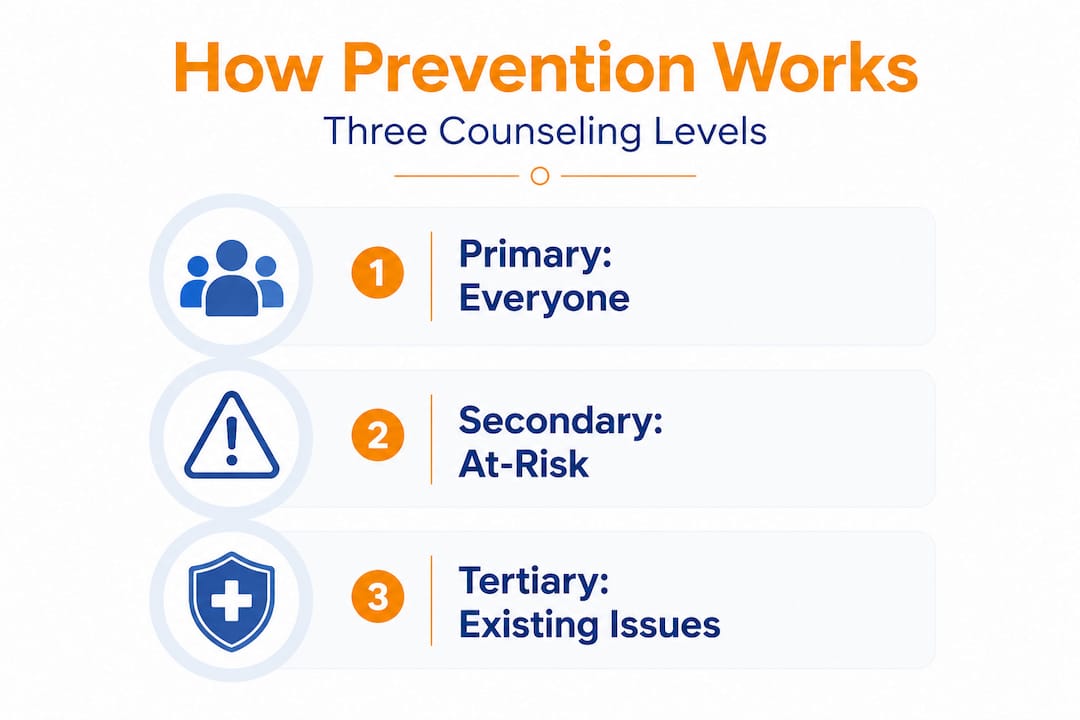
Preventive counseling operates through three levels: primary, secondary, and tertiary prevention. Each level targets a different population with different needs and different types of support.

| Prevention level | Target audience | Typical methods |
|---|---|---|
| Primary | General population, no identified risk | Psychoeducation, resilience training, stress management workshops |
| Secondary | Individuals with identified risk factors | Screening, early intervention, brief counseling, coping skill development |
| Tertiary | Those recovering from or managing existing conditions | Relapse prevention, rehabilitation counseling, support groups |
Understanding these three levels is useful for both patients and providers because they define what kind of intervention makes sense at any given point. A healthy adult with a demanding career might benefit from primary prevention. Someone who has recently experienced a major loss might need secondary support. A person managing long-term depression benefits most from tertiary strategies.
Here's how a provider typically selects and applies preventive strategies in practice:
- Initial assessment. The provider gathers information about stressors, life history, coping styles, and current mental health status to identify which prevention level applies.
- Risk and protective factor mapping. Risk factors (chronic stress, trauma history, social isolation) are weighed against protective factors (strong social support, emotional regulation skills, access to resources). Explore this approach further through our preventive diagnostics guide.
- Goal setting with the client. Preventive counseling is collaborative. The client and provider agree on specific outcomes, whether that's building better emotional regulation, improving communication skills, or reducing occupational stress.
- Intervention delivery. Methods are deployed based on the level and goals: workshops for primary prevention, targeted skill-building sessions for secondary, and structured relapse prevention programs for tertiary.
- Progress tracking and adjustment. Outcomes are monitored. If a person moves between risk levels, the approach shifts accordingly. Our health screening tips offer a practical lens for how tracking evolves over time.
Pro Tip: Preventive counseling is most effective when interventions are tailored to the individual's specific risk profile, not delivered as a one-size-fits-all program. Ask your provider how they assess which prevention level is right for you.
Methods and interventions: Tools for prevention
Now that you understand the levels, it helps to know exactly what preventive counseling looks like in practice. The methodologies include assessment of risk and protective factors, education on wellness, and targeted interventions designed to build long-term psychological strength.
Here's a comparison of the most commonly used tools:
| Intervention type | What it involves | Best suited for |
|---|---|---|
| Risk assessment | Structured questionnaires to identify vulnerability areas | All levels; helps triage intervention type |
| Psychoeducation | Teaching clients about mental health, coping, and triggers | Primary and secondary prevention |
| Resilience training | Building adaptive skills through structured exercises | Primary prevention, high-stress populations |
| Stress inoculation | Gradual exposure to manageable stressors to strengthen response | Secondary prevention, high-risk individuals |
| Skill-building sessions | Teaching communication, conflict resolution, emotional regulation | All levels |
| Group-based programs | Peer learning and shared experience in structured settings | Schools, workplaces, community health centers |
One thing providers often underestimate is how setting shapes the effectiveness of these tools. Methods that work in a clinical one-on-one session may need significant adaptation for a school counselor running a classroom program or a workplace wellness coordinator. The core principles transfer, but delivery must match the context.
Practical preventive counseling methods by setting:
- Schools and universities. Classroom-based emotional literacy programs, peer mentoring, and brief check-ins with school counselors
- Primary care clinics. Quick risk screenings embedded in routine appointments, brief motivational interviews, and onward referrals
- Workplaces. Stress management workshops, leadership coaching on psychological safety, employee assistance programs
- Community settings. Group psychoeducation, parenting support programs, community resilience workshops
For patients exploring these options, our wellness screening guide walks through what to expect from a preventive health assessment. Providers interested in how holistic approaches fit into clinical care will find value in our holistic wellness care overview.
Does preventive counseling work? Evidence and edge cases
Asking whether preventive counseling actually works is the right question, and the honest answer is: largely yes, with important nuance. Systematic reviews indicate that preventive interventions reduce depression and PTSD incidence in the short term. The effect sizes are meaningful. For example, targeted programs have shown up to a 30 to 50 percent reduction in new depression cases among high-risk youth and adults in controlled settings.
Short-term results are consistently strong. People who complete structured preventive counseling programs report better emotional regulation, improved stress tolerance, and higher perceived control over their mental health. These outcomes are measurable and clinically significant.
Long-term results are more variable, and that's worth being honest about. Personalization, parental involvement, and time constraints all play a role in how long benefits last. Programs that include ongoing follow-up and maintenance sessions perform significantly better than those that end after a fixed block of sessions with no further contact.
Evidence is strongest in these populations:
- Children and adolescents. Early intervention during developmental windows produces the most durable results, especially when parents or caregivers are involved
- High-risk adults. Those facing trauma exposure, caregiver stress, or significant life transitions show strong response to secondary prevention programs
- Occupational groups. First responders, healthcare workers, and educators benefit substantially from targeted resilience training before burnout develops
- Post-crisis recovery. People who have experienced one episode of depression or anxiety often respond well to tertiary preventive counseling that reduces the likelihood of relapse
Environmental factors matter enormously. Someone receiving preventive counseling while also managing poverty, housing instability, or social isolation will see different outcomes than someone with strong structural support. This doesn't mean prevention fails for those with more complex situations. It means interventions need to account for those factors explicitly. For a broader view of outcomes across wellness programs, see our wellness program outcomes resource.
Pro Tip: If you're a provider, integrating social-psychological strategies such as helping clients identify community resources, build peer networks, and address practical stressors alongside skill-building consistently improves outcomes compared to skill-building alone.
Who benefits and how: Patients, providers, and system impacts
Now that we've seen the evidence, it's worth spelling out who gains from preventive counseling and in what concrete ways. The benefits operate at three levels: the individual, the provider, and the healthcare system as a whole.
For patients:
- Early risk identification builds self-agency and resilience, helping individuals recognize their own warning signs before they escalate
- Clients develop practical coping tools they can use independently, not just in sessions
- Engaging with prevention reduces the stigma of seeking mental health support by reframing it as health management rather than crisis response
- Patients who participate in preventive programs report higher satisfaction with their overall healthcare experience
For healthcare providers:
- Structured preventive frameworks give practitioners a clear, repeatable care model rather than responding ad hoc to crisis presentations
- Providers working in prevention often report greater professional satisfaction because they are collaborating with clients toward growth, not just managing decline
- Preventive approaches align naturally with integrated care models that combine physical and mental health
For the healthcare system:
- Preventive strategies reduce healthcare costs and improve outcomes when integrated early, a finding consistently backed by health economics research
- Reducing the incidence of depression, anxiety, and PTSD reduces emergency presentations, hospitalizations, and long-term disability claims
- Systems that invest in preventive counseling create a population that requires less intensive and expensive intervention downstream
"The strongest barrier to realizing these benefits isn't the evidence. It's inconsistent delivery. Prevention programs that are underfunded, undertrained, or poorly integrated into existing care pathways consistently underperform their potential." (Merck Manuals)
The key benefits of early health screening parallel the gains seen in preventive counseling. Both operate on the same principle: finding and addressing problems early is better for everyone involved.
A fresh perspective: Why preventive counseling is more than just 'early warning'
Here's what most guides about preventive counseling miss: the biggest obstacle isn't a lack of programs. It's a lack of mindset.
When patients and even providers treat prevention as a checklist item, they extract very little from it. You fill out a risk assessment. You attend a workshop. You receive a pamphlet. And then you carry on exactly as before because you didn't truly internalize the shift that preventive counseling is asking you to make.
Real prevention is not a box you check. It is a sustained orientation toward your own mental health that has to be actively practiced. Resilience is not something you build in four sessions and then carry forever. It's something you maintain through habits, relationships, social structures, and repeated small acts of self-awareness.
The most effective preventive counseling we've seen in integrated care settings isn't the one-off screening. It's the model where chronic disease prevention logic is fully absorbed into how care is delivered continuously, not just at intake.
For providers, this means becoming a genuine partner rather than a periodic auditor of risk. It means asking not just "what are your stressors today?" but "what does your support system look like? What habits are you building? What early signs would you recognize in yourself?" Those are partnership questions. They signal to clients that prevention is relational, not transactional.
For patients, the practical wisdom is this: don't wait until you feel like you need it to engage with preventive support. The value of preventive counseling is highest when you're not in crisis, because that's when you have the mental space to actually absorb and practice what you learn. Use periods of relative stability to build the skills you'll rely on when things get hard.
The providers and patients who get the most from preventive counseling are the ones who treat it the way elite athletes treat conditioning. They don't train only when they're injured. They train so they're less likely to get injured, and so when strain does come, they recover faster.
Discover more ways to invest in your mental wellness
Understanding preventive counseling is the first step. Taking action is the next one.
At Globallmed, our medical clinic department integrates preventive health assessments with expert clinical care, so you're never just reacting to problems. Our beauty, wellness, and wellbeing department takes a whole-person approach that aligns naturally with preventive mental wellness principles. Whether you're looking for proactive screening, counseling support, or an integrated wellness program, you can explore the full picture through our services listing. Preventive care works best when it's planned, personalized, and consistently supported. Our team in Macau is ready to help you build exactly that.
Frequently asked questions
Is preventive counseling suitable for everyone or only for high-risk groups?
Preventive counseling is designed for both the general population and high-risk groups, with strategies tailored to each. Primary prevention targets the general population, while secondary and tertiary approaches address those with identified risk factors or existing conditions.
Can preventive counseling be used with children and adolescents?
Yes. Children and adolescents respond strongly to preventive counseling, especially when programs include parental involvement. Children in prevention trials show significant effect sizes, particularly when family engagement is built into the program design.
How long do the benefits of preventive counseling last?
Short-term benefits are well documented, with meaningful reductions in depression and anxiety risk after structured programs. Long-term results are mixed, and follow-up sessions or maintenance programs significantly improve how durable the gains are over time.
How can healthcare providers integrate preventive counseling into routine care?
Providers can begin with brief risk screenings embedded in standard appointments, followed by targeted psychoeducation or referrals. Structured assessments and brief interventions within primary care visits are among the most scalable and evidence-backed entry points for prevention-focused practice.