

Most people assume a heart attack strikes without warning. The reality is far less dramatic and far more manageable: the vast majority of cardiac events build quietly over years, driven by risk factors that a clinician can measure, track, and address long before you feel a single symptom. Preventive cardiac screening is the practice of evaluating heart health in people who feel perfectly fine, with the goal of catching those risks early. This guide walks you through what preventive cardiac screening includes, who stands to benefit most, how each test works, and what your results actually mean for your long-term care.
Table of Contents
- What is preventive cardiac screening?
- Who benefits most from preventive cardiac screening?
- How preventive cardiac screening works: Tools and methods
- Interpreting results and what happens next
- A smarter approach to heart health: Why personalization beats one-size-fits-all
- Take charge of your heart health with expert-guided screening
- Frequently asked questions
Key Takeaways
| Point | Details |
|---|---|
| Targeted screening works best | Preventive cardiac screening is most effective when used for individuals with intermediate or unclear risk profiles. |
| Modern tools improve decisions | Risk calculators and tests like CAC scoring help personalize your prevention plan and reduce unnecessary medication. |
| Results guide action | Screening outcomes shape lifestyle, medication, and follow-up choices—talk with your provider for next steps. |
| Focus on long-term health | Proactive, outpatient-based screening supports ongoing heart wellness, not just one-time testing. |
What is preventive cardiac screening?
Preventive cardiac screening is a proactive evaluation of heart health performed in individuals who have no current symptoms of cardiovascular disease. The goal is not to diagnose a problem you already feel. It is to identify risk factors silently building in the background so that you and your care team can act before those factors cause real damage.
There is an important distinction worth understanding here. Population-wide screening casts a broad net, testing everyone in a demographic group regardless of individual risk. Targeted individual screening, on the other hand, focuses on people with identifiable risk factors. Targeted individual screening is preferred over broad population screening for cardiovascular risk factors, because testing low-risk individuals generates unnecessary anxiety, false positives, and treatments people do not need.
A standard preventive cardiac screening visit typically includes several components:
- Risk scoring using validated calculators to estimate your 10-year probability of a cardiovascular event
- Blood tests measuring total cholesterol, LDL (low-density lipoprotein, the "bad" cholesterol), HDL, triglycerides, and Lp(a) (lipoprotein a, a genetically driven risk marker)
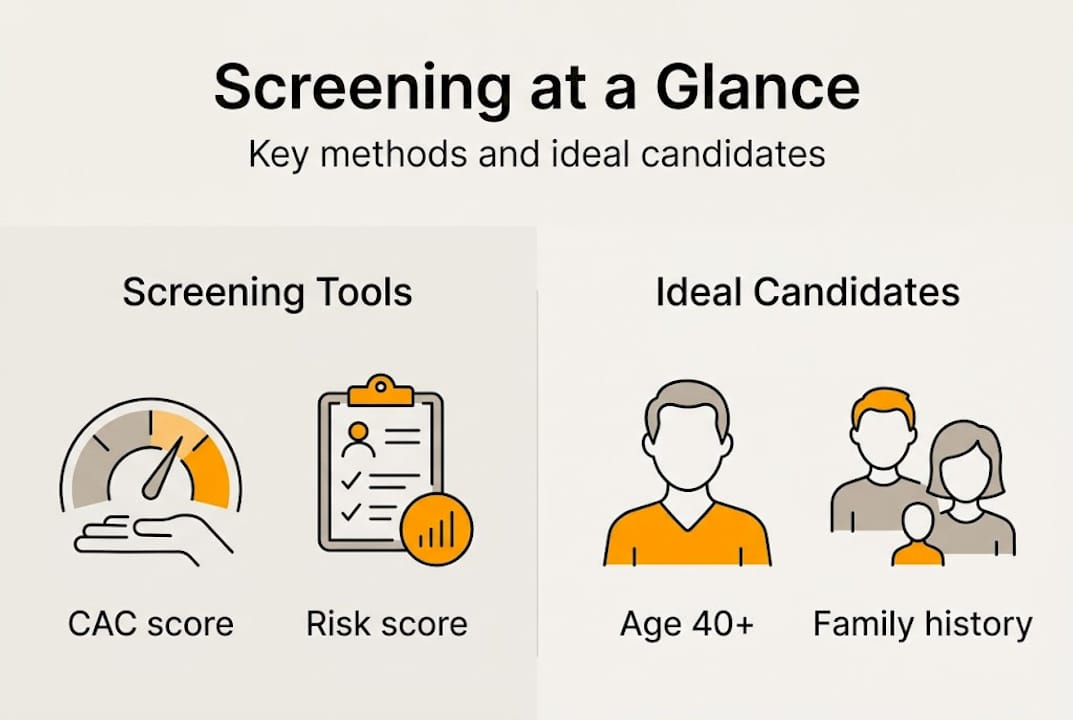
- Imaging such as CAC (coronary artery calcium) scoring, which detects plaque deposits in the coronary arteries
- Lifestyle and family history assessment to put numbers in context
Preventive cardiac screening can help identify cardiac risk before symptoms appear and is most effective when targeted to individuals rather than mass population programs. You can explore how this fits into a broader approach in our prevention and wellness screening guide.
Pro Tip: If your risk profile is unclear based on standard tests alone, targeted screening tools like CAC scoring offer the most value. People at the extremes of low or high risk rarely need advanced imaging to make a decision.
Who benefits most from preventive cardiac screening?
Not everyone needs a full cardiac workup. Preventive screening is not designed for someone already experiencing chest pain or shortness of breath. Those individuals need diagnostic evaluation, not preventive screening. Equally, a healthy 28-year-old with no risk factors and no relevant family history is unlikely to benefit from a CAC scan. The sweet spot for preventive cardiac screening is the intermediate-risk individual: someone with some risk factors but no clear clinical guidance on how aggressively to treat them.
Screening is most valuable for adults with intermediate risk, family history of premature heart disease, or elevated blood lipids, not for very low-risk or already-symptomatic individuals.
Ask yourself whether any of these apply to you:
- Age 40 or older, particularly men over 45 and women over 55
- Family history of heart disease in a first-degree relative before age 55 (men) or 65 (women)
- Elevated cholesterol or blood pressure, even if currently controlled
- Type 2 diabetes or prediabetes
- Smoking history, current or within the past decade
- Overweight or sedentary lifestyle combined with one or more of the above
- Ethnicity-specific risk (South Asian descent, for example, carries higher baseline cardiovascular risk)
If two or more of these apply to you, a conversation with a provider about screening for early detection is well worth your time.
"Population screening for cardiovascular risk factors does not reduce CVD mortality, but targeted screening helps tailor therapy for those who genuinely need it."
Pro Tip: Bring a written summary of your family's cardiac history to your first screening appointment. It saves time and significantly improves the quality of your risk assessment.
How preventive cardiac screening works: Tools and methods
Modern preventive cardiac screening draws on several well-validated tools. Understanding what each one does helps you have a more informed conversation with your provider.

CAC scoring, PREVENT equations, and Lp(a) testing are key methods for refining heart risk, with PREVENT (Predicting Risk of CVD EVENTs) better calibrated for today's populations than the older Pooled Cohort Equations (PCE).
| Test | What it measures | Best suited for | How results guide action |
|---|---|---|---|
| PREVENT / PCE risk score | 10-year CVD event probability | All adults 40+ | Decides whether advanced testing is needed |
| LDL / Lp(a) blood panel | Cholesterol and genetic lipid risk | Anyone with family history or borderline risk | Flags candidates for lipid-lowering therapy |
| CAC score (CT scan) | Calcified plaque in coronary arteries | Intermediate-risk adults | Reclassifies risk up or down; guides statin use |
| Blood pressure evaluation | Arterial pressure load on the heart | All adults | Triggers lifestyle or medication intervention |
The typical screening process follows a clear sequence:
- Complete a risk calculator (PREVENT or PCE) using age, sex, blood pressure, cholesterol, and smoking status
- Order a fasting blood panel to confirm cholesterol fractions and check Lp(a) if family history suggests it
- Decide whether CAC imaging adds value based on your preliminary score
- Obtain and score the CAC scan if indicated
- Interpret combined results with your provider to determine treatment strategy
ACC/AHA guidelines set LDL targets at under 100 mg/dL for borderline-risk patients and under 70 mg/dL for high-risk patients, with retesting intervals guided by your CAC result. For a deeper look at specific tests, see our overview of screening procedures explained.
Interpreting results and what happens next
Getting your results is only half the work. Knowing what to do with them is the part that actually protects your heart.
Your CAC score is reported as a number, and that number carries real clinical weight. A CAC score of zero correlates with a very low event rate, generally under 1% per year, and may allow you and your provider to safely defer statin therapy. A CAC score above 100 or 300, on the other hand, shifts the approach toward more aggressive management including statins and potentially low-dose aspirin.
It is also worth knowing that newer risk equations change who qualifies for treatment. PREVENT equations reduce statin eligibility by about two-thirds compared to older risk equations, meaning many people previously flagged for medication may no longer need it under current standards.
| Result | Risk classification | Recommended next step |
|---|---|---|
| CAC = 0 | Very low | Lifestyle monitoring; retest in 5-10 years |
| CAC 1-99 | Low to moderate | Lifestyle changes; discuss statin candidacy |
| CAC 100-299 | Intermediate to high | Statin therapy; retest in 3-5 years |
| CAC 300+ | High | Aggressive statin therapy; evaluate aspirin use |
| LDL 100-129 mg/dL | Borderline | Dietary changes; recheck annually |
| LDL under 70 mg/dL | At target (high risk) | Maintain; confirm Lp(a) if not done |
Typical next steps by risk tier include:
- Low risk (CAC=0, LDL on target): Focus on lifestyle, regular screening for wellness, and retesting per guideline intervals
- Intermediate risk (CAC 1-99 or borderline LDL): Initiate dietary and exercise changes, discuss statin initiation
- High risk (CAC 100+, LDL elevated): Start or intensify lipid-lowering therapy, consider cardiology referral
LDL benchmarks and follow-up intervals are set by ACC/AHA guidelines: under 100 mg/dL for borderline risk and under 70 mg/dL for high risk, with retesting intervals that match your CAC score tier. Shared decision-making with your provider is not optional here. These numbers matter, but your personal values, medication tolerance, and lifestyle context all shape the right plan for you.
A smarter approach to heart health: Why personalization beats one-size-fits-all
Here is something the general conversation around cardiac health tends to miss: more testing is not always better care. For decades, the instinct was to screen broadly, catch everything, and treat aggressively. The evidence increasingly tells a different story.
Targeted individual screening using risk calculators and advanced imaging leads to better outcomes than systematic population-wide programs. The reason is simple. When you screen everyone, you also find things in people who would never have had an event, and you end up treating them with medications that carry their own side effects and costs. Over-testing harms low-risk individuals more than it helps them.
The people who genuinely benefit are those sitting in the uncertain middle: intermediate-risk adults for whom a CAC score can tip the decision one way or the other. For them, a single scan can either confirm that therapy is needed or buy years free from unnecessary medication. That is a powerful and precise use of medical technology.
The smartest preventive care uses risk tools, imaging when warranted, and real conversations between patients and providers to build a plan that fits the individual, not a statistical average. See how this philosophy connects to learn more about wellness screening and a broader preventive care strategy.
Pro Tip: Before requesting a CAC scan, ask your provider to run your PREVENT score first. If you score very low, the scan may not change your management plan at all, and you can avoid both cost and radiation exposure.
Take charge of your heart health with expert-guided screening
Understanding the evidence is the first step. Acting on it is what actually moves the needle on your long-term health.

At Globallmed, our team guides you through a personalized preventive cardiac screening process, starting with a proper risk assessment and moving through testing only when it adds genuine clinical value. Our comprehensive outpatient cardiac screenings are designed around current guidelines, not outdated mass-screening models. Whether you are starting from scratch or following up on a previous result, our medical clinic department in Macau offers the expertise and tools to make your screening experience both efficient and meaningful. Book your consultation and take a well-informed first step.
Frequently asked questions
What age should you consider preventive cardiac screening?
Most guidelines suggest starting preventive screening conversations around age 40, though those with a strong family history or additional risk factors may benefit from earlier evaluation.
Are preventive cardiac screenings covered by insurance?
Coverage varies by location and individual policy; basic blood work and risk assessments are more commonly covered, while advanced imaging like CAC scoring is often an out-of-pocket cost.
What is a CAC score and when should you get one?
CAC scoring measures calcified plaque in the coronary arteries and is most useful for intermediate-risk patients where the result can meaningfully shift treatment decisions in either direction.
Does everyone need preventive cardiac screening?
No. Population screening does not reduce mortality, and those at very low risk or who already have symptoms are typically managed differently; screening delivers the most value for those with uncertain or elevated cardiovascular risk.
How often should you repeat preventive cardiac screening?
Repeat intervals depend on your results: retesting every 3-5 years is typical for elevated CAC scores, while a CAC of zero generally allows a longer 5-10 year interval before retesting.