
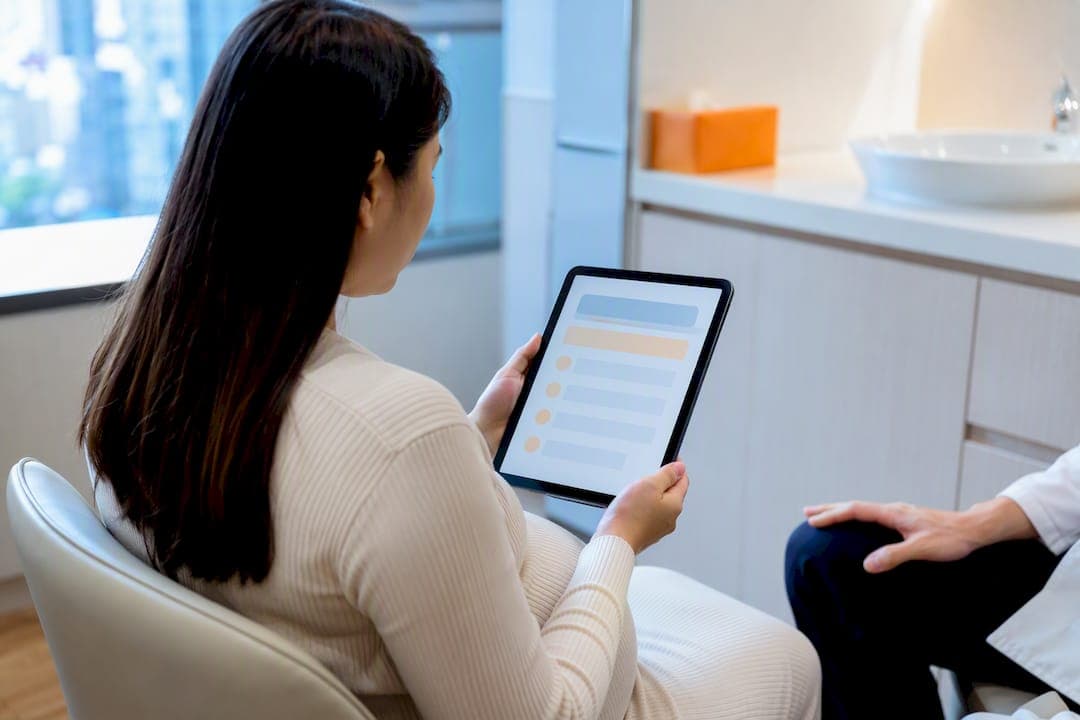
If your sadness, anxiety, or trouble bonding with your baby has lasted more than two weeks since childbirth, this may be postpartum depression, not the baby blues. If you have thoughts of harming yourself or your baby, call 988 or your local emergency number now. Otherwise, ask your health provider for an Edinburgh Postnatal Depression Scale (EPDS) screening this week. GLOBALLMED Medical Center can help arrange outpatient follow-up for patients with ties to Macau.
TL;DR:
- Postpartum depression affects many women beyond the baby blues, with symptoms lasting longer than two weeks and including persistent sadness, anxiety, and difficulty bonding.
- Early screening with the Edinburgh Postnatal Depression Scale, especially in the second trimester, can predict postpartum risk and should be followed by clinical assessment if scores are high.
- Treatment options like therapy and medication are safe during breastfeeding, with newer medications such as brexanolone and zuranolone approved specifically for severe postpartum depression.
- Immediate crisis support is available via the 988 Lifeline, National Maternal Mental Health Hotline, and Postpartum Support International, with emergency care needed for thoughts of harming oneself or the baby.
- In Macau, gaps in screening and cultural stigma hinder diagnosis, but private clinics like GLOBALLMED facilitate coordinated, confidential mental health care tailored for new mothers.
Table of Contents
- What Is Postpartum Depression, and How Is It Different From Baby Blues?
- How Common Is Postpartum Depression in the US, and What Does Macau Research Show?
- How Is Postpartum Depression Screened and Diagnosed?
- What Treatments Work for Postpartum Depression, and Are They Safe While Breastfeeding?
- What Immediate Help Is Available in the US Right Now?
- How Can Readers With Macau Ties Access US-Standard Care?
- When Does Postpartum Depression Become a Medical Emergency?
- What Local Resources Exist in Macau for Postpartum Depression?
- How Does Stigma Around Postpartum Depression Show Up in Macau?
- What Are the Legal and Healthcare Policy Considerations for Maternal Mental Health in Macau?
- Where Can Mothers in Macau Find Support Groups and Community Networks?
- How GLOBALLMED Medical Center Supports Postpartum Mental Health Care
What Is Postpartum Depression, and How Is It Different From Baby Blues?
Baby blues fade within two weeks. Postpartum depression (PPD) does not, and that single distinction is the one clinicians rely on most when sorting a rough patch from a medical condition that needs treatment. PPD is a mood disorder that can begin during pregnancy or in the months following delivery. Most cases start within a few weeks after birth, though onset can happen anytime in the first year.
The baby blues bring tearfulness, mood swings, and fatigue that resolve on their own as hormones settle and sleep normalizes. PPD digs in deeper and lasts longer, and it typically comes with a cluster of symptoms rather than one or two passing moods.
Watch for:
- Persistent sadness, emptiness, or hopelessness most of the day
- Anxiety or panic that doesn't ease with rest or reassurance
- Trouble bonding with your baby or feeling disconnected from the experience of parenting
- Significant changes in sleep or appetite, beyond what's expected with a newborn
- Intrusive, unwanted thoughts, sometimes about harm coming to the baby
- Difficulty concentrating or making everyday decisions
Any of these lasting beyond two weeks warrants a conversation with a health provider, not a wait-and-see approach.
How Common Is Postpartum Depression in the US, and What Does Macau Research Show?
That figure makes PPD one of the most common complications of childbirth, more common than gestational diabetes in most reported ranges.
Prevalence estimates shift depending on how and when screening happens, which is where a Macau-based study adds useful context. Researchers surveyed perinatal women in Macao and found relatively low maternal-infant health literacy alongside moderate social support.
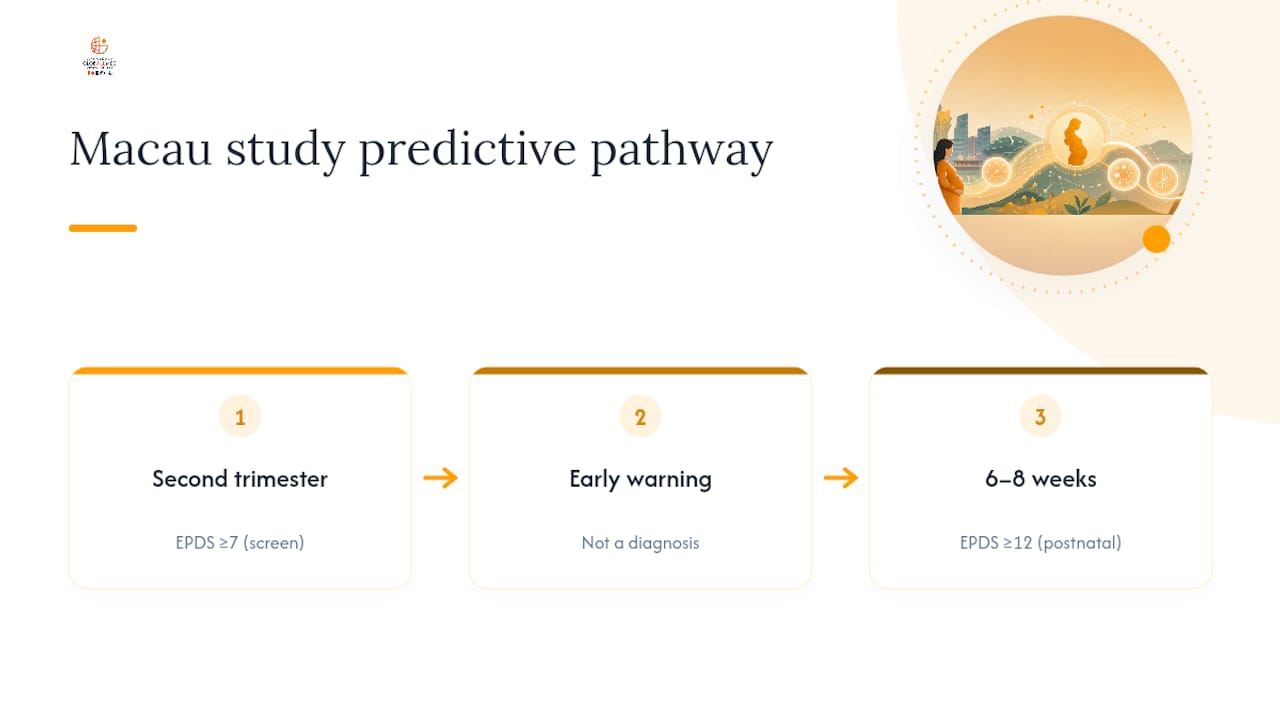
The more striking finding: screening in the second trimester with an EPDS score of 7 or higher predicted a postnatal EPDS score of 12 or higher at six to eight weeks. That's an early-warning signal, not a diagnosis, but it shows how earlier screening timing can catch risk before symptoms fully surface. It also illustrates why comparing raw prevalence numbers across countries can mislead. Where health literacy is lower or screening happens less consistently, reported rates often undercount the real burden.
How Is Postpartum Depression Screened and Diagnosed?
The Edinburgh Postnatal Depression Scale is the tool most clinicians reach for first. It's a 10-item questionnaire, validated internationally and translated into more than 20 languages, that a patient completes in a clinic or through telehealth in about five minutes. It does not diagnose PPD on its own, but it flags who needs a fuller clinical assessment.
Score interpretation varies slightly by guideline, but the general pattern looks like this:
- A total score of 12 or 13 and above is widely used as the threshold suggesting likely depression requiring further evaluation
- The Macau study's second-trimester finding, an early score of 7 or higher predicting a later score of 12 or higher, shows why some clinicians now screen earlier in pregnancy rather than waiting until the postpartum visit
- A single high-scoring item, especially one touching on self-harm, warrants immediate follow-up regardless of the total score
If your screen comes back positive, ask your clinician three things: what a full diagnostic assessment involves, whether a safety plan is needed, and which treatment options fit your situation. A positive EPDS score is a starting point for conversation, not a verdict.
What Treatments Work for Postpartum Depression, and Are They Safe While Breastfeeding?
Treatment for PPD generally combines therapy, medication, or both, and most people see meaningful improvement within weeks to a few months of starting.
Psychotherapy often comes first, particularly cognitive behavioral therapy (CBT) and interpersonal therapy, both of which have strong evidence behind them for perinatal mood disorders. Group programs and peer support add real value here too, especially for the isolation that often comes with new parenthood.
Medication typically means an SSRI or SNRI antidepressant, chosen partly based on breastfeeding compatibility. Two newer options exist specifically for severe PPD: brexanolone, an intravenous medication administered over 60 hours in a monitored clinical setting, and zuranolone, an oral pill taken once daily for 14 days. Both are FDA-approved for postpartum depression specifically, not depression generally, and both require clinician oversight given their fast-acting mechanism and monitoring needs.
- CBT or interpersonal therapy, often the first-line approach for mild to moderate PPD
- SSRIs or SNRIs, selected with breastfeeding safety in mind
- Brexanolone (IV) for severe cases needing rapid, monitored intervention
- Zuranolone (oral) as a newer at-home option for severe PPD.
- Combination therapy and medication together, common when symptoms are moderate to severe
Pro Tip: Bring a written symptom timeline to your first appointment. Clinicians move faster toward the right treatment when they can see exactly when symptoms started and how they've changed week to week.
Breastfeeding safety is not one-size-fits-all. Discuss it directly with your prescriber rather than assuming any single medication is off-limits.
What Immediate Help Is Available in the US Right Now?
If you're in crisis, don't wait for an appointment. Use these resources in order of urgency:
- 988 Suicide & Crisis Lifeline. Call or text 988 if you have thoughts of harming yourself or your baby, or if you feel unable to keep everyone safe right now. This connects to trained crisis counselors around the clock.
- National Maternal Mental Health Hotline (1-833-9-TLC-MAMA). This line offers 24/7 support in multiple languages for pregnant and postpartum individuals, staffed by counselors trained specifically in perinatal mental health.
- Postpartum Support International (PSI) HelpLine (1-800-944-4773). PSI connects callers to peer support, local resources, and the Connect by PSI app, though it is not a substitute for clinical treatment.
For readers arranging care by telehealth, expect an intake call that screens for safety first, then schedules a fuller evaluation. Language support and interpreter access are commonly available on request. Say so when you first call.
How Can Readers With Macau Ties Access US-Standard Care?
Deciding where to seek care often comes down to urgency and insurance. A crisis needs the nearest emergency department, full stop. A non-urgent concern gives you more room to weigh options: a local Macau provider, a US-based telehealth appointment, or an international outpatient clinic that coordinates across both.
Before your first contact, gather a short history: when symptoms started, any prior mental health diagnoses, current medications, and whether you're breastfeeding. If English isn't your first language, ask upfront whether interpreter support is available. It usually is, and asking early saves time.
- Confirm whether your insurance covers telehealth or requires an in-person visit
- Ask how the provider coordinates with your OB/GYN or primary care physician
- Request a follow-up schedule before you hang up, not after
GLOBALLMED Medical Center, Macau's largest private outpatient clinic, supports this kind of coordination for patients moving between Macau and international care. The center's checkup services include screening appointments suited to postpartum follow-up, and its multilingual staff regularly assist patients navigating care across two health systems.
Pro Tip: Ask any clinic, Globallmed included, whether they can send a written summary to your OB/GYN. Continuity between your mental health provider and your obstetric team matters more than most new parents realize.
When Does Postpartum Depression Become a Medical Emergency?
Certain symptoms mean you need emergency care immediately, not an appointment next week. These red flags include thoughts of hurting yourself or your baby, any sign of psychosis such as hallucinations or disorganized thinking, and an inability to care for your baby safely.
If any of these apply, call 988 or your local emergency number, or go directly to the nearest emergency department. Bring someone with you if possible. What you share with providers in this setting stays confidential, and disclosing these thoughts leads to help, not judgment or punishment.
What Local Resources Exist in Macau for Postpartum Depression?
Macau's public healthcare system, run through the Health Bureau (Serviços de Saúde), offers maternal health follow-up through its network of health centers, and referrals to psychiatric services at Centro Hospitalar Conde de São Januário for more complex cases. Private options extend that reach for families wanting shorter wait times or English-language services.
GLOBALLMED Medical Center operates as a private outpatient option in Macau offering coordinated care across specialties relevant to postpartum recovery, including OB/GYN and general medical consultations and psychotherapy referrals. For new parents, having a single clinic that can screen, refer, and follow up cuts down on the back-and-forth that often causes people to disengage from care after a first appointment.
Access barriers still exist locally, and they mirror what the Macau perinatal study identified: modest health literacy and inconsistent screening timing. A mother who isn't offered an EPDS screening at her postpartum visit may go undiagnosed for months, not because symptoms are absent but because nobody asked the right questions at the right time. That's precisely why proactive screening, ideally starting in the second trimester rather than waiting until after birth, matters as much in Macau as it does anywhere else.
Families splitting time between Macau and other countries face an added logistical layer: finding providers on both ends who will actually talk to each other. Ask any Macau-based clinic directly whether they'll share records or summaries with a provider abroad, and don't assume it happens automatically.
How Does Stigma Around Postpartum Depression Show Up in Macau?
Cultural expectations around new motherhood in Macau, shaped heavily by broader Chinese cultural norms, often emphasize resilience and family harmony over individual emotional disclosure. That framing can make it genuinely difficult for a new mother to name what she's feeling, let alone bring it to a doctor.
Traditional postpartum practices, like the "confinement" period (zuo yuezi) focused on rest and recovery, sometimes overlap unhelpfully with depression symptoms. Fatigue and low mood during confinement can get waved off as normal recovery, when in fact they might be early signs of something that needs clinical attention. The Macau study's finding of relatively low maternal-infant health literacy fits this pattern: mothers weren't necessarily being dismissive of their own symptoms, they often lacked a clear frame for recognizing what was and wasn't typical.
Family involvement in Macau tends to run deep, for better and worse. Extended family often provides genuine hands-on support during the postpartum period, which the study noted as a moderate protective factor. But that same family closeness can also create pressure to appear as though everything is fine, particularly when older generations view mental health struggles as a private matter rather than a medical one.
Clinicians and clinics that normalize screening as a routine part of postpartum care, rather than something reserved for visibly struggling patients, tend to catch more cases early. Framing an EPDS screen as standard practice, the way a blood pressure check is standard, removes some of the burden from the mother to self-identify as someone with a problem.
What Are the Legal and Healthcare Policy Considerations for Maternal Mental Health in Macau?
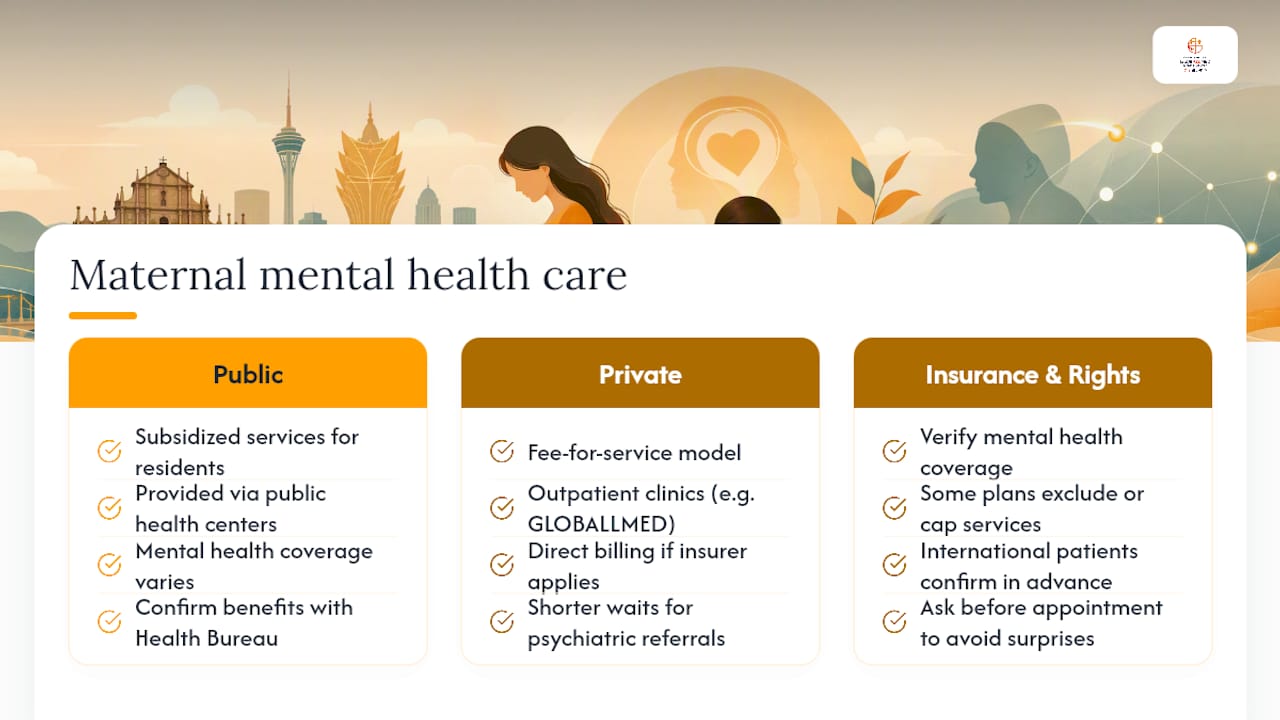
Macau's public healthcare system provides subsidized maternal health services, including prenatal and postpartum checkups, through its network of public health centers, and residents holding a Macau Resident Identity Card generally have access to these subsidized services. Coverage specifics for mental health screening and treatment as part of routine maternal care can vary, so confirming current benefits directly with the Health Bureau or your insurer before your appointment is the most reliable approach.
Private healthcare, including outpatient clinics like GLOBALLMED Medical Center, typically operates on a fee-for-service basis with direct billing available for patients holding applicable insurance plans. This route often means shorter waits for a psychiatric or psychotherapy referral compared to public channels, which matters when symptoms are actively affecting a mother's ability to function.
Patient rights around confidentiality apply to mental health disclosures the same way they apply to any other medical information in Macau. A mother disclosing distressing thoughts to a clinician should expect that information to be handled with the same discretion given to any other diagnosis, not treated as grounds for judgment or reported without clinical necessity.
International patients or Macau residents with overseas insurance should verify in advance whether their plan covers mental health treatment specifically, since some policies exclude or cap psychiatric services differently than general medical care. Asking this question before an appointment, rather than after, avoids unwelcome billing surprises during an already difficult stretch.
Where Can Mothers in Macau Find Support Groups and Community Networks?
Peer support fills a gap that clinical treatment alone doesn't always reach. Talking to another mother who has been through PPD carries a kind of validation a textbook explanation can't replicate.
Macau's expatriate and local parenting communities have grown online support networks, often organized through social media groups and messaging apps, where new mothers trade advice and simply vent to people who understand the specific pressures of parenting in Macau. These informal networks tend to be more active and accessible than formal support groups, partly because Macau's small geographic footprint makes in-person group meetings harder to sustain regularly.
For mothers wanting a more structured option, international resources like the Postpartum Support International HelpLine (1-800-944-4773) and the Connect by PSI app remain accessible from Macau by phone or internet, offering peer support and resource navigation even without a local Macau-based support group. This bridges a real gap for mothers who want a level of clinical framing that informal social groups don't provide.
Encouraging a partner or family member to actively participate in postpartum checkups and screenings, rather than leaving mental health entirely as the mother's private concern, is one of the more practical shifts a household can make.
How GLOBALLMED Medical Center Supports Postpartum Mental Health Care
Coordinating care across public clinics, private specialists, and international providers takes more effort than most new parents have energy for. GLOBALLMED Medical Center removes that friction for readers in Macau by offering EPDS screening, OB/GYN follow-up, and psychotherapy referral under one roof, with multilingual staff who handle the coordination piece directly instead of leaving it to an exhausted new parent.
The clinic suits readers who want a single point of contact rather than juggling separate bookings across public health centers, private psychiatrists, and follow-up obstetric visits. Its services page outlines the full range of specialties available, including general checkups suited to a first postpartum visit if you're unsure where to start. If your low mood, anxiety, or trouble bonding has lasted more than two weeks, book a screening appointment through GLOBALLMED Medical Center this week rather than waiting for symptoms to resolve on their own.