
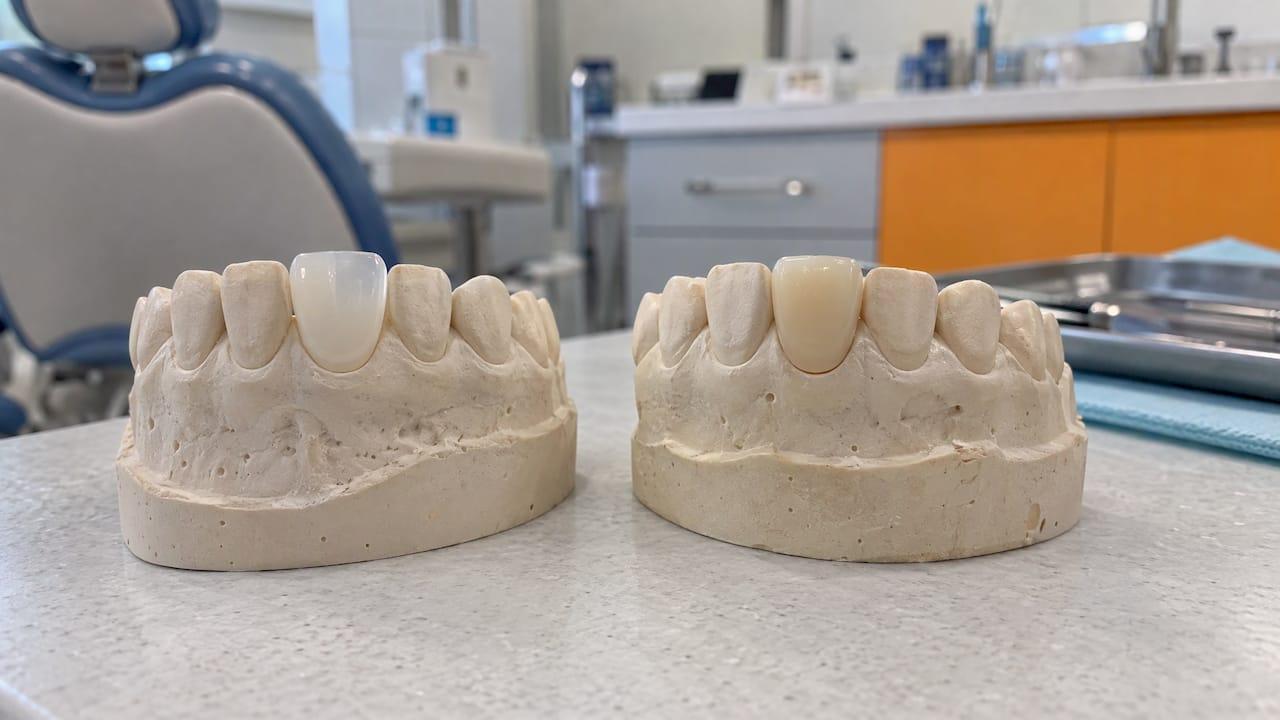
Porcelain veneers last longer and resist staining better, while composite veneers need less tooth preparation, are usually completed in fewer visits and are easier to repair. For most patients the right choice depends on three things: how much change the teeth need, whether you clench or grind, and how long you expect the result to last. This guide sets out the differences in plain terms so that you arrive at a dental consultation knowing which questions matter. Our dental department at Globallmed Medical Center in Macau assesses these factors in person before any material is recommended.
Table of Contents
- What a veneer is, and how the two types are made
- Appearance and stain resistance
- Durability: what long-term studies show
- Tooth preparation, visits and reversibility
- Repair, maintenance and replacement
- Clenching, grinding and bite: the deciding factor for many patients
- Which option suits which patient
- Cost: what determines the price, including a set of 12
- Planning treatment if you travel to Macau for dental care
- Seeing a dentist at Globallmed
- Frequently asked questions
What a veneer is, and how the two types are made
A veneer is a thin shell that covers the front surface of a tooth. It changes the colour, shape, length or apparent alignment of the tooth. Both porcelain and composite veneers are bonded to the tooth with an adhesive, but the materials and the way they are produced differ.
Porcelain veneers are ceramic shells. The dentist prepares the tooth, takes an impression or digital scan, and a dental laboratory fabricates the shell. The finished veneer is then bonded to the tooth at a later visit. Because the ceramic is made outside the mouth under controlled conditions, it is dense, polished and consistent.
Composite veneers are made of tooth-coloured resin. In the direct technique, the dentist builds the resin up on the tooth in layers and shapes it during the same appointment. An indirect technique also exists, in which the resin shell is made in a laboratory and bonded later, but the direct technique is the one most patients mean when they ask about composite veneers or composite bonding.
This distinction matters because many comparisons mix the two composite methods. Direct composite is the quick, adjustable option. Indirect composite behaves more like a laboratory-made restoration. When you read a study, check which one was tested.
Appearance and stain resistance
Porcelain has a glass-like surface that reflects light in a way close to natural enamel. It keeps its polish for years and does not absorb pigments from coffee, tea, red wine or tobacco. Colour is chosen at the planning stage and stays stable. This is the main reason porcelain is preferred when the front teeth are the focus of a smile and the result is expected to remain consistent over time.
Composite resin can look very natural when it is placed by an experienced dentist, and the colour can be matched closely to neighbouring teeth. Its surface, however, is more porous and gradually roughens. Over time it picks up stain more readily and loses some of its shine. Polishing at routine visits restores much of the finish, but the material is not as stain-resistant as porcelain. The American Dental Association's patient information service, MouthHealthy, makes the same point: composite veneers are not as resistant to stains and wear as porcelain.
A randomized split-mouth trial published in 2019 by Gresnigt and colleagues, which followed veneers for ten years, reported that colour match and surface roughness were significantly worse for the indirect resin composite veneers than for ceramic. In practical terms, if a bright, even and long-lasting colour is your priority, porcelain has the advantage.
Durability: what long-term studies show
The strongest evidence on veneers concerns porcelain. A 2021 systematic review by Alenezi and colleagues pooled 25 clinical studies covering about 6,500 porcelain laminate veneers and reported a 10-year cumulative survival rate of 95.5%. Survival here means the veneer was still in place and functioning. The same review found that veneers with incisal coverage, meaning the ceramic wraps over the biting edge of the tooth, performed better than those without. It also found that fracture was the most common complication, followed by debonding, and that both tended to occur in the first years after cementation.
A 2012 meta-analysis by Layton, Clarke and Walton estimated five-year survival of feldspathic porcelain veneers at about 95.7%, with more variable results at ten years. Feldspathic porcelain is the traditional, highly aesthetic ceramic. Newer, stronger ceramics are used in some cases, and the Alenezi review noted that non-feldspathic veneers performed better.
For direct comparison of the two materials, the 2019 trial by Gresnigt and colleagues is the most informative. Each patient received both ceramic and indirect resin composite veneers on opposite sides of the mouth. After ten years, survival was 100% for ceramic and 75% for indirect composite, and every failure, whether from debonding or fracture, occurred in the composite group. The authors concluded that, when indicated, ceramic laminate veneers may be preferred over indirect composite ones.
Several dental practice guides state typical lifespans of roughly 10 to 15 years for porcelain and a shorter period, often in the range of 4 to 8 years, for composite. Treat these as general ranges rather than promises: the actual lifespan depends on your bite, your hygiene, the thickness of the veneer, how much enamel remains and the skill of the clinician.
One caution applies to all such figures. A 2022 to 2023 university review of the veneer literature noted that only two of the eleven investigations it included were randomised controlled trials, so the overall level of evidence is modest and results should be read with care. The direction of the findings is consistent, but individual outcomes vary.

Tooth preparation, visits and reversibility
This is where composite has its clearest advantage.
Porcelain. The dentist usually removes a thin layer of enamel from the front of the tooth so that the veneer can sit flush with its neighbours. The Hong Kong Department of Health's Oral Health Care Zone describes the sequence: removal of facial enamel, impressions, laboratory fabrication, then etching and cementing the veneer. Typically this means at least two visits, with a temporary covering or none between them, depending on the case. Preserving as much enamel as possible matters, because porcelain bonds more reliably to enamel than to the softer dentin beneath it. Reviews of the literature link higher failure rates to preparation that exposes large areas of dentin.
Composite. Direct composite often needs little or no removal of enamel, and it can usually be completed in one visit. The ADA notes that composite veneers may require less enamel removal and fewer visits than porcelain.

Reversibility. Where enamel is removed, the treatment cannot be undone, because enamel does not grow back. This applies to porcelain in particular, and it is why a thorough assessment and a clear plan should come before any preparation. Composite placed on an untouched tooth is the more conservative route and leaves more options open for the future.
Repair, maintenance and replacement
A chipped composite veneer can usually be repaired in the chair by adding and re-polishing resin, often in a single short visit. This ease of repair is one of its practical strengths, and it is also why composite is sometimes chosen as a trial of a new smile shape.
A chipped or cracked porcelain veneer generally cannot be patched as invisibly. Small defects may be polished or bonded, but a significant fracture normally means the veneer is remade by the laboratory. Porcelain fractures less often, but when it does, the repair is more involved.
For both types, daily care is the same as for natural teeth: brushing twice a day with fluoride toothpaste, cleaning between the teeth, and regular check-ups and professional cleaning. Avoid using veneered teeth to open packaging, bite nails or crack hard items. Any decay or gum disease must be treated before veneers are placed, as the ADA states, since veneers do not protect the underlying tooth from disease.
Clenching, grinding and bite: the deciding factor for many patients
Heavy biting forces are the main threat to any veneer. The Hong Kong government's oral health information describes porcelain as brittle and liable to fracture under heavy biting force. The ADA says veneers may not suit patients who clench or grind their teeth, or who have a deep overbite.
The literature adds detail. The university review mentioned above reported that feldspathic porcelain veneers worn with an occlusal splint (a night guard) survived at a markedly higher rate over seven years than those worn without one, and that bruxism increased the risk of fracture. A night guard is therefore a common part of treatment planning for patients who grind.
The American College of Prosthodontists gives a useful rule of thumb: when the changes needed are minor and the teeth function properly, composite bonding is appropriate; when teeth are spaced, broken or dark, or the patient clenches or grinds, porcelain may be the preferred option, with a night guard to protect the result. The two statements are consistent. Porcelain is the stronger material, but any veneer is safest when the bite has been assessed and managed.
Tell your dentist if you wake with jaw ache, notice flattened or chipped edges on your teeth, or have been told that you grind at night. Each is relevant to the choice of material.
Which option suits which patient
The table summarises the usual differences. Your own examination decides where you fall.
| Factor | Porcelain veneers | Composite veneers |
|---|---|---|
| Appearance | Natural, glass-like finish, stable colour | Natural when well placed, may dull over time |
| Stain resistance | High | Lower, needs periodic polishing |
| Typical lifespan | Often 10 to 15 years or more | Often several years, commonly 4 to 8 |
| Enamel removal | Usually a thin layer | Often minimal or none |
| Visits | Usually two or more, with laboratory work | Often one |
| Repair | Small chips polished, major damage means remaking | Usually repaired chairside |
| Suited to | Discoloured, worn, spaced or broken teeth, larger changes | Minor changes, small chips or gaps, conservative approach |
| Bite considerations | Night guard often advised for grinders | Chipping risk is higher in heavy bite forces |
Porcelain is usually the stronger choice when:
- you want a long-lasting, stain-resistant result on the front teeth;
- teeth are discoloured and have not responded to whitening;
- there are several gaps, fractures or worn edges to correct;
- you accept the permanence of enamel preparation in return for durability.
Composite is usually the better fit when:
- the change needed is small, such as a minor chip or narrow gap;
- you prefer to keep as much natural enamel as possible;
- you need a result in one visit;
- you want a lower-commitment option while deciding about a long-term plan.
There are also teeth that are poor candidates for either material. The university review lists weak, root-treated teeth, insufficient enamel, poor oral hygiene and untreated bruxism as disqualifying or limiting factors, and notes that porcelain veneers work best on vital front teeth that are discoloured but unresponsive to whitening, or that have fractures, enamel defects, congenital malformations or mild gaps. In some of these cases, crowns, orthodontic treatment or whitening may be the more suitable route, and a dentist should explain why.
Cost: what determines the price, including a set of 12
Patients often ask what 12 veneers cost, because a full smile makeover typically covers the upper teeth that show when you smile. Published figures vary widely between clinics and cities, and a number quoted without an examination can be misleading. The factors that move the total are consistent:
- Material. Porcelain involves laboratory fabrication and is generally priced higher per tooth than composite. Within porcelain, the type of ceramic affects cost.
- Number of teeth. Costs are normally quoted per tooth, so a set of 12 multiplies the per-tooth fee and the amount of chair time.
- Preparatory work. Treating decay, gum disease or a bite problem, and making a night guard, add to the plan.
- Case complexity. Heavily discoloured teeth, large shape changes and bite adjustments take longer to plan and fabricate.
- Longevity. A lower initial cost for composite may be followed by repairs and replacement within a few years, while porcelain costs more at the start and is expected to last longer. Comparing the cost per year of use gives a fairer picture than comparing the first invoice.
We do not publish veneer prices on this page, because an accurate figure can only be given after an examination and a treatment plan. A written plan that lists the number of teeth, the material and any preparatory treatment is the document to compare against any other quotation.
Planning treatment if you travel to Macau for dental care
If you live in Hong Kong, elsewhere in the Greater Bay Area or overseas, a veneer plan needs to be sequenced around your travel. Porcelain treatment involves a preparation visit, a laboratory period and a bonding visit, followed by a check after the veneers have settled. Composite can often be completed more quickly. Raise your schedule at the first consultation so that the plan can be arranged to suit it, and so that you know what follow-up is advisable once you are home.
Bring any recent dental records or X-rays, a list of medicines you take, and photographs of smiles you like. Mention any history of teeth grinding, jaw pain, gum bleeding or previous dental work. International patients can also ask about insurance direct billing, which Globallmed arranges with major international insurers.
Seeing a dentist at Globallmed
Globallmed Medical Center is Macau's largest private outpatient clinic, and its integrated model serves patients of more than 60 nationalities with multilingual staff and government-certified medical professionals. Dental care sits within the medical clinic departments, where you can book a consultation to have your teeth, gums and bite examined and to discuss whether porcelain, composite or another approach suits your goals.
If your concerns reach beyond the teeth, such as skin quality or facial aesthetics, the beauty, wellness and wellbeing department covers dermatology and plastic surgery, so related questions can be addressed within one centre. You can start through the Globallmed website, which includes an online appointment form.
Frequently asked questions
Are porcelain veneers better than composite veneers?
Porcelain is better on durability and stain resistance, and the long-term clinical evidence supports it. A ten-year randomized trial found 100% survival for ceramic veneers against 75% for indirect composite. Composite is better when you want minimal tooth removal, a single visit or an easier repair, so the better choice depends on your teeth and your goals.
How long do porcelain and composite veneers last?
Systematic reviews report ten-year survival of about 95% for porcelain veneers. Composite veneers typically last for a shorter period, commonly quoted as 4 to 8 years, although this varies with the technique and your bite. Hygiene, regular check-ups and managing grinding with a night guard all extend the life of either type.
Can veneers be removed or reversed?
Treatment that involves removing enamel is not reversible, as the American Dental Association explains, because enamel does not regenerate. Composite placed with little or no preparation is the most conservative option. Discuss preparation in advance so that you understand what will be changed permanently.
Can I have veneers if I grind my teeth?
Often yes, but the bite must be assessed and managed first. Grinding raises the risk of fracture and debonding, and studies show that wearing an occlusal splint reduces veneer failure. A dentist may recommend porcelain with a night guard, or may advise another restoration, depending on the examination.
Why do some dentists advise against veneers?
Because veneers are not suitable for every mouth. Decay, gum disease, thin enamel, weak root-treated teeth and untreated grinding all need to be resolved or considered first. When those conditions are addressed, or another treatment fits better, a dentist will explain the alternatives and the reasoning.