

Polycystic ovary syndrome cannot be cured, but it can be managed effectively across three separate goals: symptom control, fertility, and metabolic risk. First-line care combines lifestyle change with guideline-recommended medications, most notably combined oral contraceptives (COCP) for menstrual irregularity and hirsutism, letrozole for ovulation induction, and metformin for insulin resistance and metabolic features. Anti-androgens, weight-loss medications, and surgery serve as second-line or adjunctive options depending on individual goals and health status.
TL;DR:
- Treatment should be tailored to the patient's main goal, such as symptom management, fertility, or metabolic risk reduction, based on individual factors like age, BMI, and health status.
- First-line medications like combined oral contraceptives and metformin are most effective when prescribed according to specific symptoms and health risks, with adjunct therapies added as needed.
- Ovulation induction typically involves starting with letrozole, then progressing to gonadotropins or surgical options if oral agents fail after several cycles.
- Lifestyle modifications, especially modest weight loss combined with aerobic and resistance exercise, can restore ovulation and improve metabolic health.
- Coordinated multidisciplinary care, including specialist input from OB/GYN, dietitians, and mental health providers, enhances overall management beyond medication alone.
Table of Contents
- Why PCOS Treatment Isn't One-Size-Fits-All
- Medications That Treat the Symptoms and the Metabolism
- Getting Pregnant With PCOS: Ovulation Induction Step by Step
- Diet, Exercise, and Weight: What Actually Moves the Needle
- Mental Health Care Belongs in the Treatment Plan, Not on the Side
- Do Supplements and Acupuncture Actually Help?
- When Surgery Enters the Conversation
- Your PCOS Treatment Checklist: Questions Worth Asking
- What Coordinated PCOS Care Looks Like in Practice
- Where GLOBALLMED Medical Center Fits Into Your PCOS Care
- Guideline and Government Resources Worth Knowing
- FAQ
Why PCOS Treatment Isn't One-Size-Fits-All
Treating polycystic ovary syndrome starts with a question most people never think to ask: symptom control, fertility, or metabolic risk reduction. Which one? A 28-year-old trying to conceive needs a completely different approach than a 40-year-old managing irregular cycles and prediabetes with no interest in pregnancy. Clinicians build the treatment plan around that priority first, then layer in the rest.
Several factors shape which path makes sense for a given patient:
- Age and pregnancy intentions determine whether ovulation induction or contraception takes priority.
- Body mass index (BMI) influences whether weight-focused interventions come first.
- Glucose tolerance and insulin resistance flag whether metformin or other insulin-sensitizing strategies belong in the plan.
- Cardiovascular risk factors like blood pressure and lipid levels affect medication choice and monitoring frequency.
- Contraindications, including a history of blood clots or liver disease, can rule out certain hormonal therapies outright.
Once those variables are mapped, the actual treatment categories, hormonal therapy, insulin sensitizers, ovulation agents, anti-androgens, weight-management drugs, and in some cases surgery, get slotted in based on what the patient actually needs, not a generic protocol applied to every diagnosis.
Medications That Treat the Symptoms and the Metabolism
Pharmacological treatment for PCOS splits into two broad jobs: regulating the menstrual cycle and calming hyperandrogenism, or correcting the metabolic dysfunction underneath it. Few drugs do both well, so most treatment plans combine more than one.
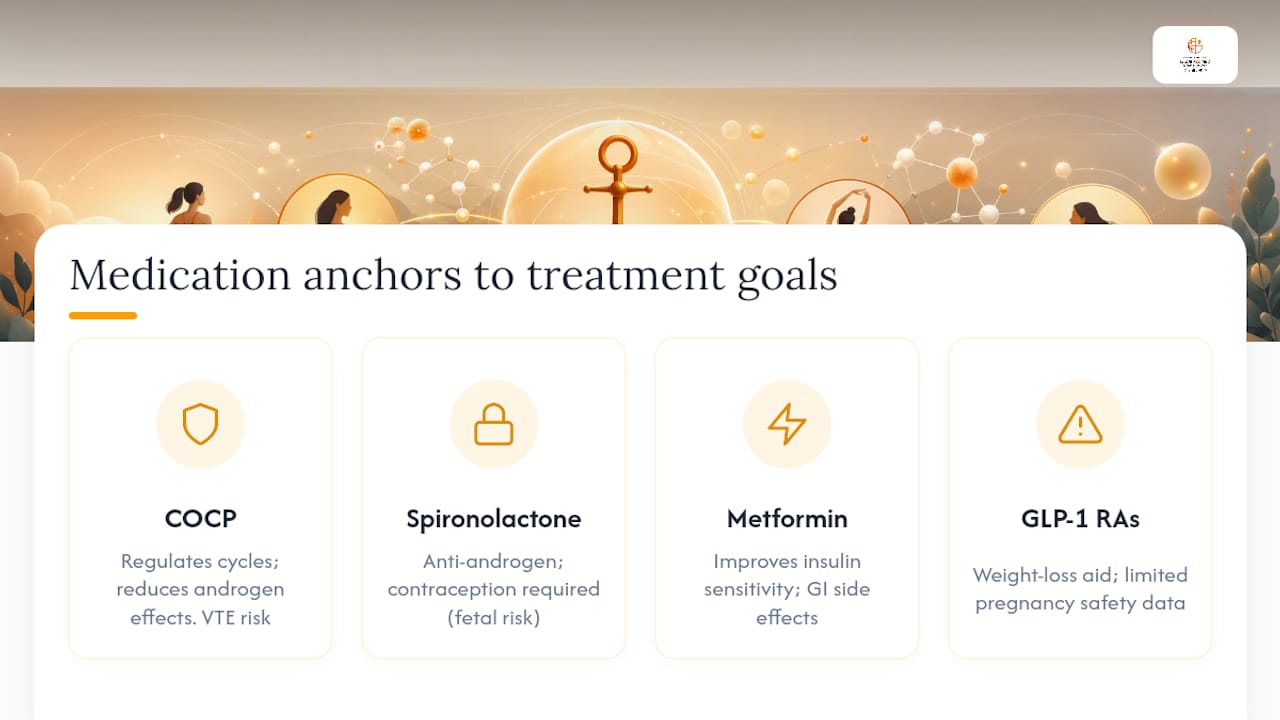
Combined oral contraceptive pills remain the first-line pharmacological treatment for menstrual irregularity and hirsutism in reproductive-age patients not currently trying to conceive. COCP works by suppressing ovarian androgen production and increasing sex hormone binding globulin, which lowers free testosterone. Most formulations regulate cycles within two to three months and improve acne and excess hair growth over four to six months. The tradeoff is a modest increase in venous thromboembolism risk, which rules COCP out for patients with a clotting history, uncontrolled hypertension, or migraine with aura.
Progestin-only therapy and hormonal IUDs offer an alternative for patients who cannot take estrogen. They protect the uterine lining from the endometrial hyperplasia risk that comes with chronic anovulation, without addressing hirsutism or acne.
Spironolactone, an anti-androgen, is commonly added when hirsutism or acne persists despite COCP, or used alone in patients who cannot take hormonal contraception. Because spironolactone carries a theoretical feminization risk to a male fetus, reliable contraception is mandatory during use.
Metformin targets the metabolic side of PCOS directly by improving insulin sensitivity and lowering circulating insulin, which in turn reduces ovarian androgen production. The 2023 International evidence-based guideline for PCOS recommends metformin primarily for metabolic indications, weight management support, and glucose regulation, rather than as a first-line fertility drug. Gastrointestinal side effects, nausea, bloating, and diarrhea, affect a meaningful share of patients starting the medication, which is why most clinicians start at a low dose and titrate upward over several weeks.
GLP-1 receptor agonists such as liraglutide and semaglutide have moved into PCOS care as weight-management tools, considered for adults per general population obesity guidelines rather than as PCOS-specific therapy. They can produce meaningful weight loss that indirectly improves ovulatory function, but pregnancy safety data remain limited, so effective contraception is required throughout treatment.
Pro Tip: Ask directly whether a prescribed medication is being used off-label for PCOS. Off-label use of several ovulation and metabolic agents is common and not a red flag, but you deserve to know what evidence supports the dose and duration you've been given.
Getting Pregnant With PCOS: Ovulation Induction Step by Step
Anovulatory infertility is one of the most treatable aspects of PCOS, and the sequence clinicians follow is fairly standardized.
- Letrozole first. This aromatase inhibitor is the preferred first-line pharmacological therapy for ovulation induction in PCOS, outperforming clomiphene citrate in live birth rates for patients with anovulatory infertility. It works by lowering estrogen feedback to the pituitary, which increases follicle-stimulating hormone release.
- Clomiphene citrate as an alternative. Some patients still start here, particularly when letrozole is unavailable or not tolerated, and it's sometimes combined with metformin in patients with significant insulin resistance to improve ovulation rates.
- Gonadotropin injections for resistant cases. When oral agents fail to induce ovulation after several cycles, injectable gonadotropins offer a second-line option, though they require closer ultrasound monitoring to avoid overstimulation and multiple pregnancy.
- Laparoscopic ovarian drilling. This surgical option is reserved for clomiphene-resistant patients, particularly those who also need laparoscopy for another gynecological indication, and can restore ovulation without the multiple-pregnancy risk that comes with gonadotropins.
- IVF, ICSI, or in vitro maturation. These represent the later-line options when ovulation induction alone hasn't led to pregnancy, or when other fertility factors are involved. They carry their own risks, most notably ovarian hyperstimulation syndrome (OHSS), which is more common in PCOS patients because of their higher antral follicle counts.
The practical takeaway: oral ovulation induction is worth pursuing for several cycles under a clinician's supervision before escalating. If six or so cycles of letrozole don't produce pregnancy, that's typically the point to bring in a fertility specialist rather than continuing to cycle through oral agents indefinitely. Lifestyle optimization, particularly weight management, ideally happens before starting ovulation induction, since even modest weight loss can restore ovulation on its own in some patients.
Diet, Exercise, and Weight: What Actually Moves the Needle
Weight loss of a modest amount of body weight can restore ovulation and meaningfully improve insulin sensitivity, blood pressure, and lipid profiles in patients with PCOS and excess weight. That's a modest, achievable target, not a demand to reach an ideal body weight, and it's often where treatment plans start before any medication gets added.
No single diet outperforms all others for PCOS. Low-glycemic-index eating patterns, Mediterranean-style diets, and straightforward calorie reduction all show benefit in different patients, and the evidence doesn't support declaring one universally superior. What matters more is a plan the patient can sustain, because inconsistent adherence undoes the metabolic benefit regardless of which diet was chosen.
Exercise prescription for PCOS works best as a combination:
- Aerobic activity (150 minutes weekly of moderate intensity) improves cardiovascular fitness and supports weight management.
- Resistance training two to three times weekly builds muscle mass, which improves insulin sensitivity independent of weight change.
- Reduced sedentary time between structured workouts adds metabolic benefit that exercise sessions alone don't fully capture.
Behavioral support matters as much as the plan itself. Referral to a registered dietitian or a structured weight-management program improves adherence far more than a printed handout ever does, and it gives patients a place to troubleshoot when progress stalls.
Pro Tip: If you've plateaued despite consistent diet and exercise changes, ask your care team about a formal weight-management referral before assuming you need medication. Structured programs with regular check-ins tend to outperform self-directed efforts over the long run.
Bariatric or metabolic surgery becomes a consideration for patients with more significant obesity and metabolic complications who haven't responded to lifestyle and medical therapy. It can meaningfully improve weight, metabolic markers, and fertility outcomes, but it comes with an important caveat: fertility often returns quickly after surgery, sometimes before weight has stabilized, so contraception planning needs to happen before the procedure, not after.
Mental Health Care Belongs in the Treatment Plan, Not on the Side
Depression and anxiety occur at notably higher rates in people with PCOS than in the general population, which is why routine mental health screening is now a standard part of guideline-based PCOS management rather than an afterthought.
Where a diagnosable depressive or anxiety disorder is identified, psychological therapy is the recommended first-line treatment. Antidepressant medication follows general population prescribing guidelines when therapy alone isn't sufficient or when symptoms are more severe.
Options that fit into a PCOS care plan include:
- Individual psychotherapy, including cognitive behavioral therapy (CBT) for mood and body-image concerns tied to symptoms like hirsutism or weight changes.
- Group-based programs that address the shared emotional burden of a chronic hormonal condition.
- Telehealth counseling for patients balancing multiple specialist appointments.
Coordination between the mental health team and the reproductive or endocrine team matters here. Mood symptoms and PCOS symptoms often move together, and treating one in isolation from the other tends to produce incomplete results. GLOBALLMED Medical Center's multi therapy department is built around exactly this kind of coordinated approach, pairing psychotherapy with the broader clinical team managing a patient's PCOS care.
Do Supplements and Acupuncture Actually Help?
Inositol shows the most consistent supportive data of the complementary options for PCOS, with some studies pointing to modest improvements in insulin sensitivity and menstrual regularity. Even so, the evidence base is less robust than what supports metformin, so inositol works best as an adjunct alongside guideline-recommended care rather than a replacement for it.
Other approaches carry weaker or mixed evidence:
- Vitamin D and omega-3 supplementation show possible metabolic benefit in some studies, but fertility-specific evidence remains limited.
- Herbal therapies suffer from inconsistent study design and a lack of product standardization, meaning one brand's extract may not resemble another's in dose or purity.
- Yoga and mind-body practices show real benefit for stress reduction and quality of life, with some studies also noting favorable changes in hormonal markers, even without replacing pharmacologic treatment.
If you're considering any of these, tell your clinician before starting. Some supplements interact with medications, and pregnancy safety data for many herbal products simply doesn't exist.
When Surgery Enters the Conversation
- Laparoscopic ovarian drilling is reserved for patients resistant to clomiphene who need ovulation restored, particularly when laparoscopy is already indicated for another reason; it avoids the multiple-pregnancy risk tied to gonadotropin injections.
- Gonadotropins versus surgery as second-line ovulation strategies require weighing monitoring burden and multiple-pregnancy risk against the invasiveness of a surgical procedure.
- IVF, ICSI, and in vitro maturation use antagonist protocols and single embryo transfer specifically to reduce OHSS risk, which runs higher in PCOS patients.
- Bariatric or metabolic surgery requires careful patient selection and explicit counseling on the rapid return of fertility post-surgery, with contraception timing planned before the procedure.
Your PCOS Treatment Checklist: Questions Worth Asking
Walking into a consultation with a clear checklist changes the conversation. Start by clarifying your own priorities: are you managing symptoms, trying to conceive, or reducing long-term metabolic risk? That answer shapes everything that follows.
From there, a few direct questions are worth asking your clinician about any treatment under consideration:
- What benefit should I expect, and how long until I notice it?
- What are the common side effects, and which ones warrant a call back?
- Does this require reliable contraception, and for how long?
- What monitoring tests do I need, and how often?
- How does this fit with my other health conditions or medications?
Pro Tip: Bring a written list of your reproductive goals to every PCOS appointment, even ones focused on skin or weight. A clinician who knows you're planning pregnancy in the next year will make different medication choices than one who assumes you're not.
Baseline and ongoing monitoring typically includes fasting glucose or HbA1c, a lipid panel, blood pressure checks, and periodic mental health screening. PCOS management is a lifelong process, not a short course of treatment, and experts increasingly frame it as a condition requiring proactive surveillance for cardiovascular and metabolic complications well beyond the years focused on fertility. That's the strongest argument for multidisciplinary care: a single prescriber rarely covers hormonal, metabolic, fertility, and psychological needs equally well, so a documented follow-up plan across specialists matters as much as any individual medication choice.
What Coordinated PCOS Care Looks Like in Practice
Managing PCOS well typically means involving more than one specialist. An OB/GYN addresses menstrual regulation and fertility planning, a dietitian builds a sustainable eating pattern, and a psychotherapist addresses the mood and body-image effects that often accompany the diagnosis. The outpatient structure is organized to support coordination between departments.
Before a first visit, patients benefit from bringing recent lab results (glucose, lipid panel, hormone levels if available), a menstrual cycle history, and a clear statement of their fertility goals for the next one to two years. That information lets the clinical team build a plan around the right priority from the first appointment rather than starting from scratch.
Where GLOBALLMED Medical Center Fits Into Your PCOS Care
Coordinating PCOS care across multiple specialists is usually the biggest logistical hurdle patients face, not the individual treatments themselves. An outpatient structure where OB/GYN, dietetics, and psychotherapy services operate under one clinical roof facilitates integrated treatment plans addressing reproductive goals, metabolic risk, and mental health needs without the need for managing referrals between unconnected offices.

Booking starts with a consultation at the medical clinic department, where a physician reviews your history, current symptoms, and lab work to map out which treatment domain, symptom control, fertility, or metabolic management, should lead your plan. Referrals to dietetics, psychotherapy, or reproductive specialists then occur internally, avoiding repetition of patient history at each stop. Patients considering cosmetic management of hirsutism alongside medical treatment can also ask about options through the beauty, wellness, and wellbeing department. If you're ready to start, visit the appointment and services page to schedule your first consultation and bring your recent lab results with you.
Guideline and Government Resources Worth Knowing
The 2023 International evidence-based guideline for the assessment and management of polycystic ovary syndrome underpins most of the first-line recommendations discussed here, including COCP for menstrual and androgen symptoms, metformin for metabolic features, and letrozole for ovulation induction. It represents the most current consensus among reproductive endocrinology specialists worldwide.
For patient-facing summaries, the Mayo Clinic's overview of PCOS treatment and the FDA's consumer information page on polycystic ovary syndrome both offer accessible explanations of diagnosis and treatment categories, useful starting points before a specialist consultation.
This article is general information, not a substitute for advice from a qualified doctor. Consult a qualified healthcare professional about your own circumstances before acting on anything here.
FAQ
What are the most effective treatments for PCOS?
The most effective approach combines lifestyle changes with guideline-recommended medication matched to the patient's main goal: COCP for menstrual symptoms and hirsutism, metformin for metabolic issues, and letrozole for fertility. No single treatment addresses all three domains at once.
What is the most common treatment for PCOS?
Combined oral contraceptive pills are the most commonly prescribed first-line medication for PCOS in patients not trying to conceive, since they regulate cycles and reduce excess androgen effects like acne and hirsutism.
What are the four types of PCOS?
PCOS is commonly described by phenotype based on which diagnostic features are present: hyperandrogenism with irregular ovulation and polycystic ovaries, hyperandrogenism with irregular ovulation but normal ovaries, hyperandrogenism with polycystic ovaries but regular ovulation, and irregular ovulation with polycystic ovaries but no hyperandrogenism. Symptom severity and treatment priorities vary across these phenotypes.
What can trigger a PCOS flare-up?
Weight gain, chronic stress, poor sleep, and inconsistent diet or medication adherence can all worsen PCOS symptoms like irregular cycles, acne, and hirsutism. Because insulin resistance drives much of the hormonal disruption in PCOS, anything that worsens insulin sensitivity tends to worsen symptoms.