
Trying to see a specialist in Macau feels straightforward until it isn't. A single expired referral letter, a missed checkbox in the booking app, or uncertainty about which health center to visit can push your appointment back by weeks. In Macau's public healthcare system, patients typically require a referral letter from a Health Bureau (SSM) health center or physician for specialist outpatient consultations at public hospitals like Conde de São Januário General Hospital (CHCSJ). This guide breaks down every stage of that process so you arrive informed, prepared, and confident at each step.
Table of Contents
- Overview of Macau's clinic referral system
- Step-by-step: From initial consult to specialist appointments
- Required documents and appointment day tips
- Wait times, challenges, and tips for faster access
- What most guides miss: Navigating without dedicated support
- How Globallmed supports your healthcare journey
- Frequently asked questions
Key Takeaways
| Point | Details |
|---|---|
| Referrals are essential | A valid referral letter is usually required to access a specialist appointment in Macau’s public healthcare system. |
| Book early and correctly | Missing steps or documents when booking can delay your access to care or require starting over. |
| Prepare documentation | Bring your Patient Card, ID, referral letter, and appointment slip for your specialist visit. |
| Self-navigation required | Patients in Macau must manage their referral journey themselves—no dedicated navigation services are provided. |
| Private clinics offer speed | Private referrals or clinics may shorten wait times but typically involve extra steps and review. |
Overview of Macau's clinic referral system
Now that you understand why referrals matter, let's examine how the system works and why each step exists.
At its core, a referral letter is a formal document written by your primary care physician or health center doctor that authorizes you to see a specialist. Think of it as a boarding pass. Without it, you don't get through the gate. It tells the specialist why you're coming, what your primary doctor suspects, and what level of urgency applies.
Macau operates a mixed public-private healthcare model. On the public side, the Health Bureau (SSM) runs neighborhood health centers that serve as the first point of contact for most residents. These centers act as gatekeepers to the more specialized care provided at CHCSJ. This structure isn't bureaucratic red tape. It genuinely protects your interests by ensuring that a trained clinician has reviewed your symptoms before sending you into the specialist queue. Public referrals prioritize primary care before specialist access, and this triage function also keeps the hospital system from being flooded with cases that could be resolved at the health center level.
There is an important distinction between public and private referrals:
- Public referrals are issued by SSM health centers or public physicians and give you access to subsidized specialist care at CHCSJ.
- Private referrals come from private clinics or hospitals and require evaluation by a department head at CHCSJ before an appointment is granted. This adds a review step that can affect your timeline.
- Private outpatient centers like Globallmed operate outside the public referral chain, allowing patients to book directly for many services without waiting for a public referral.
"Macau's system is built on the principle that coordinated primary care improves specialist outcomes. When patients bypass that entry point, specialist resources get stretched thin, wait times rise, and patients often receive care that wasn't quite what they needed."
One thing that surprises many newcomers and international patients is that there are no dedicated patient navigation programs in Macau. Unlike some global healthcare systems that assign case managers or navigators to guide patients through specialist referrals, Macau patients are expected to manage the process themselves. Understanding medical standards for outpatient care in Macau helps you set the right expectations from day one.
Step-by-step: From initial consult to specialist appointments
With the system's structure in mind, let's break down exactly how you'll move from needing specialist care to securing your appointment.
Step 1: Visit your primary health center. Start at your nearest SSM health center. A general practitioner will assess your condition. If they determine you need a specialist, they'll issue a written referral letter. Bring your Patient Card (Gold Card) and identity document to this visit.
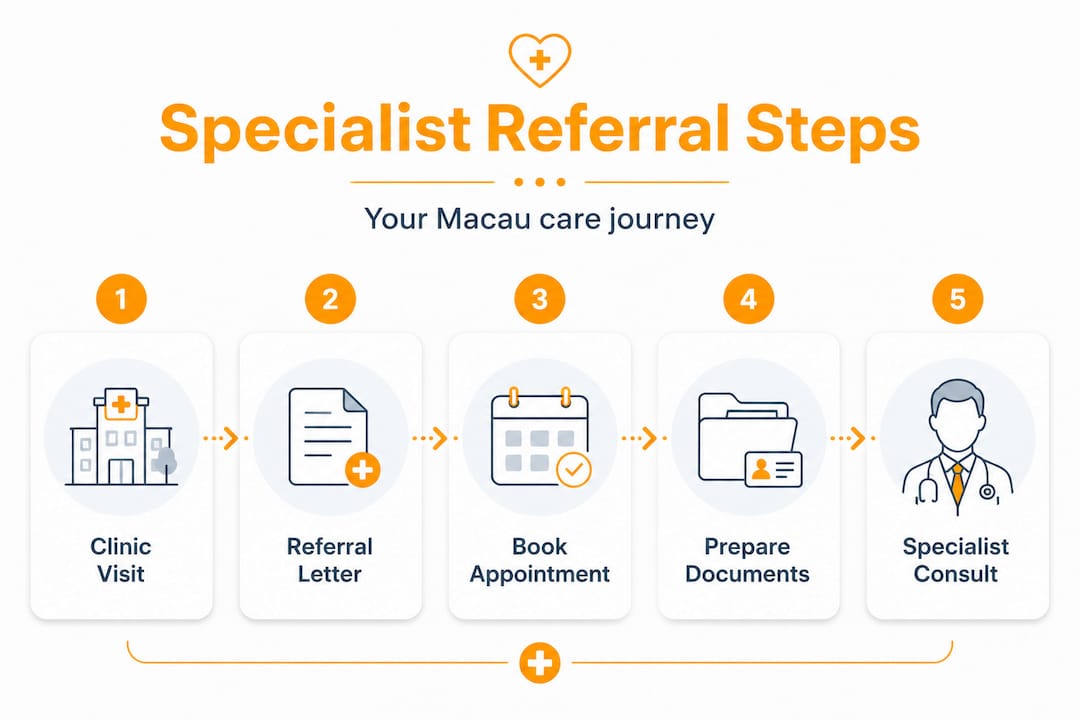
Step 2: Receive your referral letter. The referral letter names the specialty or specific specialist department you're being referred to. Read it carefully. Note the date it was issued and confirm the specialty listed matches what you discussed with your doctor. Mistakes here can cause problems later.
Step 3: Book your specialist appointment. You have three main channels for booking once you have a referral:
- Online via the Macao Health Bureau Information Kiosk app (requires a My Government Account and your Patient Card or Gold Card number)
- Online via the SSM website, using the same login credentials
- In person at your health center or at the CHCSJ Service Building registration office for Health Bureau referrals
- At the CHCSJ lobby registration desk for private institution referrals
Referral appointments can be made online via the app or SSM website, in person at health centers or CHCSJ, or for private referrals at the CHCSJ lobby. Each channel serves different patient needs, but the online app is the fastest option for most people once the account setup is complete.
Step 4: Watch the validity window. Your referral letter is not open-ended. It expires. Referral letters are valid for 180 days from the date of issue, and if you miss your appointment, you can rebook within that same window.
Step 5: Reschedule if needed. Life happens. If you miss your appointment, don't assume the referral is wasted. Contact the booking channel you used and arrange a new slot within the 180-day validity period. Private institution referrals require department head evaluation before rebooking, so don't leave rescheduling until the last week of your validity window.
| Booking channel | Who it's for | What you need |
|---|---|---|
| Kiosk app or SSM website | SSM public referral patients | My Government Account, Patient Card |
| CHCSJ Service Building | Public referral walk-ins | Referral letter, Patient Card, ID |
| CHCSJ lobby registration | Private referral patients | Private referral letter, ID |
Pro Tip: Set a phone reminder for 30 days and again at 150 days after your referral letter is issued. This prevents the most common and avoidable problem: letting a valid referral expire before booking.
For more detail on each stage, the outpatient appointment steps resource walks you through the booking interface and in-person options side by side.
Required documents and appointment day tips
Once you've booked your specialist appointment, proper preparation is key. Here's how to keep your visit on track and stress-free.
Walking into your specialist consultation without the right paperwork is one of the most frustrating things that can happen. In the best case, staff will ask you to come back. In the worst case, you lose your slot entirely and have to start the booking process over. Knowing exactly what to bring removes that risk completely.
Must-bring documents for your consultation:
- Patient Card (Gold Card): This is your primary identifier in Macau's healthcare system. Without it, most processes will stall.
- Referral letter: The original document issued by your health center or private clinic.
- Identity document: Your Macau Resident Identity Card, passport, or equivalent.
- Appointment slip: Printed or digital confirmation of your booked appointment.
Patients must present their Patient Card, referral letter, identity document, and appointment slip on consultation day. You can check your appointment status online through the SSM portal or via SMS notifications if you opted in during booking.
If you misplace your appointment slip, don't panic. Log into the app or SSM website to retrieve and reprint your confirmation before your visit date. If you forget your Gold Card at home, contact the facility's registration desk immediately on arrival and explain the situation. Outcomes vary, so it's always better to double-check your bag the night before.
Checking your appointment status 24 hours in advance is a smart habit. Departments occasionally reschedule due to staffing or emergencies. You'll receive an SMS notification if your appointment is moved, but proactively logging into the SSM portal to confirm gives you extra peace of mind.
A detailed medical checkup checklist is available for outpatients who want a printable guide to everything needed for public and private consultations in Macau.
Pro Tip: Keep a dedicated folder, either physical or digital, with scanned copies of your Gold Card, ID, and any referral letters you receive. Sending yourself a photo via a messaging app takes 30 seconds and can save you a wasted trip.
Tips for faster check-in:
- Arrive 15 minutes early and proceed directly to registration before waiting.
- Have your documents in hand before reaching the desk, not buried in a bag.
- If you're visiting a large facility like CHCSJ, check the specific building and floor for your department in advance. CHCSJ is a large campus and navigating it cold wastes time.
- Write down your doctor's name and department before the day of your appointment. Reception will direct you faster.
Wait times, challenges, and tips for faster access
With your documents ready, understanding the factors that affect access and wait times can further help you make smart decisions.
The good news: Macau's specialist wait times have improved substantially. Specialist wait times now average 1.6 weeks as of 2025, which compares favorably to many comparable healthcare systems in the region. For most routine referrals, that means you're looking at a real appointment within two weeks of booking.
| Specialty category | Typical wait range | Notes |
|---|---|---|
| General internal medicine | 1 to 2 weeks | Fastest moving category |
| Orthopedics and surgery | 2 to 4 weeks | Demand is high |
| Dermatology and ENT | 1 to 3 weeks | Seasonal variation |
| Oncology and cardiology | Variable | Urgency flags speed access |
Macau public healthcare provides free or subsidized access for residents via health centers and CHCSJ, which operates 476 beds across 29 specialties. Private options supplement this system for patients who want faster scheduling, greater choice, or more flexible appointment times.
Common bottlenecks to watch for:
- High-demand departments like orthopedics or oncology can stretch well beyond average wait times.
- Incomplete paperwork at the time of booking causes delays before you even get into the queue.
- Private referrals that require department head review add an extra layer of scheduling uncertainty.
- Public holidays and seasonal illness spikes in respiratory specialties can compress availability.
"The average 1.6-week wait tells you a lot about system efficiency, but it tells you nothing about your individual case. A patient being referred for a common dermatology concern will experience that average very differently from someone needing a complex cardiology consultation."
When should you consider a private clinic or cross-border option? A few scenarios make that calculation straightforward:
- Your condition is time-sensitive and the public queue doesn't match your urgency.
- You want to consult a specialist with a particular subspecialty focus not available in the public system.
- You're an international patient without immediate access to SSM health center registration.
- You prefer a consultation in a specific language or with extended appointment time.
If you're weighing these options, understanding how to streamline your referral journey with private outpatient support is worth exploring before committing to either route.
What most guides miss: Navigating without dedicated support
Beyond practical steps, it's essential to see how Macau's unique system places much of the navigation power, and the responsibility, squarely in your hands.
Most healthcare navigation guides assume that some infrastructure exists to guide patients through the process. A hospital social worker, a patient coordinator, a dedicated helpline. That assumption doesn't hold in Macau. No dedicated patient navigation programs exist in Macau's current model. Patients self-navigate via apps and websites, a sharp contrast to global oncology navigation pilots and coordinated care models seen elsewhere.
This isn't inherently a flaw. Macau's system is genuinely efficient by regional standards, and the 1.6-week average wait proves that. But efficiency for the system as a whole doesn't translate into ease for the individual patient who has never used the booking app, doesn't know which health center serves their district, or is visiting from abroad.
The gap isn't in the quality of care. It's in the assumption that every patient already knows the steps.
In our experience working with patients across different backgrounds, the ones who navigate this process smoothly have one thing in common: they treated it like a project. They gathered information before their first health center visit. They kept documents organized. They set reminders. They asked specific questions rather than waiting for volunteers to explain procedures. That proactive posture is the real navigation tool in a system without formal navigators.
This matters especially for international patients and medical tourists. Macau's outpatient appointment process guide is a useful starting point, but knowing that streamlining health navigation often means choosing a private outpatient pathway for your initial consultation can save weeks of uncertainty.
The advice we give patients consistently: don't wait to understand the system until you already need it urgently. Learn it now so when you do need specialist care, the process is familiar and fast.
How Globallmed supports your healthcare journey
For patients who want a faster, more guided experience outside the public referral queue, private outpatient options provide a meaningful alternative.
Globallmed is a private outpatient medical center in Macau offering specialist consultations, medical checkups, wellness services, and cosmetic treatments across a broad range of clinical departments. Our staff guides patients through scheduling from the first inquiry, so you're never left trying to decode a government portal on your own. Whether you're a Macau resident looking for a second opinion or an international patient visiting for a specific treatment, our Macau private outpatient services are designed to remove the friction from the process. If you're ready to explore what our medical clinic department offers, our team is available to match you with the right specialist quickly and transparently.
Frequently asked questions
How do I know if my referral letter is still valid?
Referral letters are valid for 180 days from the date they were issued. Check the issue date on the letter itself, or verify your status through the SSM portal or SMS notification service.
Can someone assist me with booking a specialist appointment in Macau?
No formal navigation program exists in Macau, so patients self-navigate through the app, SSM website, or in-person registration. Private clinics like Globallmed can provide direct guidance if you choose a private outpatient route.
What documents must I bring to a specialist consultation?
Bring your Patient Card (Gold Card), referral letter, identity document, and appointment slip to any public hospital specialist visit. Missing any of these items may result in delays or rescheduling.
How long are wait times to see a specialist in Macau?
The average specialist wait time is 1.6 weeks as of 2025, though high-demand departments like orthopedics or cardiology may run longer depending on case complexity and urgency.
Is a private clinic referral faster than a public referral in Macau?
Private referrals may offer faster initial access, but private institution referrals require department head evaluation at CHCSJ before an appointment is confirmed, which adds a review step not present for public SSM referrals.