

Accreditation badges and compliance certificates line the walls of hospitals worldwide, yet patient safety incidents still occur at alarming rates inside those very facilities. The disconnect is real: many administrators assume that holding a recognized standard automatically guarantees quality, when in practice the gap between certification and genuine performance can be significant. Understanding what ISO, WHO, and JCI actually require, and how those requirements translate into daily operations, is the clearest path from confusion to confident, measurable compliance. This article maps that path for you.
Table of Contents
-
The role of WHO: Guiding global healthcare quality and safety
-
A practical approach: What actually works in real-world compliance
Key Takeaways
| Point | Details |
|---|---|
| Core standards bodies | ISO, WHO, and JCI define the foundations for quality and safety in healthcare globally. |
| ISO frameworks differ | ISO 9001 improves hospital processes, while ISO 13485 is specific to medical devices and compliance. |
| JCI accreditation delivers results | Hospitals with JCI accreditation have notably fewer errors and infections according to published data. |
| WHO’s leadership role | WHO sets action plans and data-driven benchmarks for worldwide patient safety improvement. |
| Effective compliance needs context | Successful standards adoption relies on leadership, phased strategy, and adapting frameworks to local challenges. |
The landscape of international healthcare standards
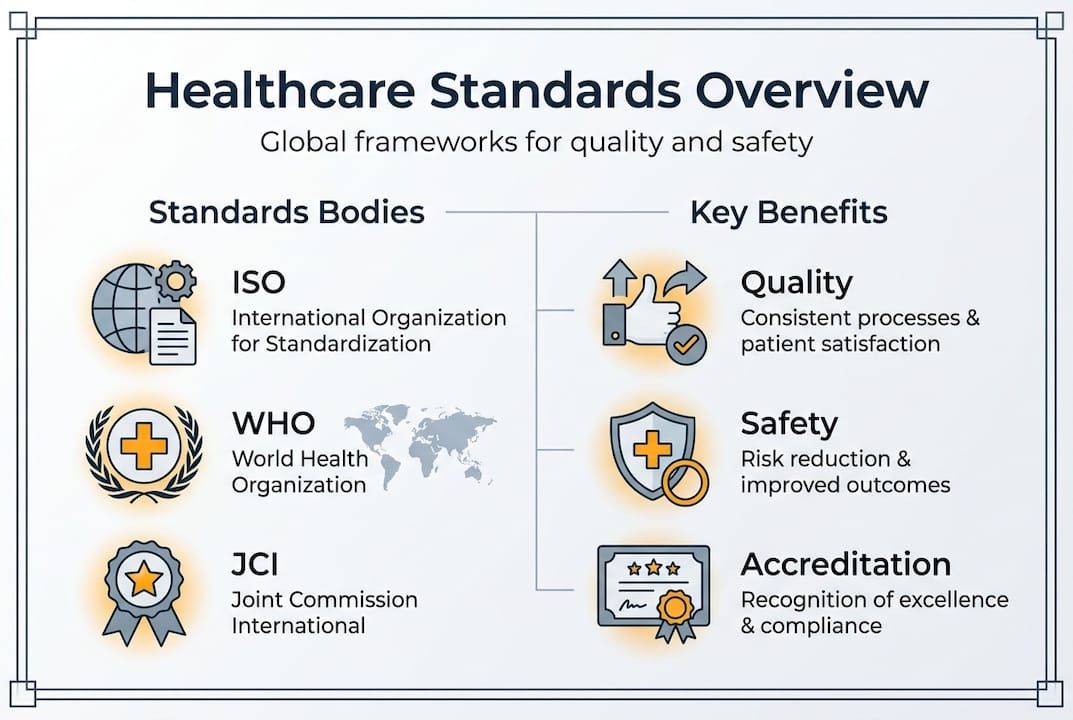
Three organizations dominate the conversation when it comes to setting the rules that healthcare facilities must follow. Each one operates differently, targets different aspects of care, and carries different weight depending on whether your facility is a small outpatient clinic or a large tertiary hospital.
International healthcare standards are primarily set by ISO, WHO, and JCI. Understanding what each body actually does prevents the common mistake of treating them as interchangeable.
ISO (International Organization for Standardization) focuses on quality management systems. It provides frameworks that help organizations document processes, identify inefficiencies, and build continuous improvement cycles. ISO standards are voluntary but widely adopted because they signal operational discipline to regulators and patients alike.
WHO (World Health Organization) operates at a normative global level. It publishes benchmarks, action plans, and technical guidelines that governments and health systems use to shape national policy. WHO standards carry moral and political weight, especially in areas like patient safety, maternal care, and infectious disease control.
JCI (Joint Commission International) focuses specifically on hospital accreditation. It conducts on-site evaluations and measures facilities against detailed patient-centered and organizational criteria. JCI accreditation is widely recognized as the gold standard for hospitals seeking to demonstrate world-class care to international patients.
Here is a quick breakdown of how these bodies differ in scope:
-
ISO: Quality management systems, device standards, process documentation
-
WHO: Global health policy, normative benchmarks, patient safety action plans
-
JCI: Hospital accreditation, on-site evaluation, patient-centered standards
-
Overlap: All three address patient safety, though from different angles and with different enforcement mechanisms
For administrators, the importance of medical standards becomes clearest when you realize that each framework fills a gap the others leave open. A facility can hold ISO certification without ever being evaluated by JCI. Understanding how these bodies complement each other is essential for building a truly robust compliance strategy. Facilities operating in specific regions, like standards in Macau outpatient care, also need to consider how global frameworks interact with local regulatory requirements. The WHO quality standards portal is a practical starting point for mapping those intersections.
ISO standards for healthcare: Frameworks and impact
ISO standards are not one-size-fits-all. Two standards dominate healthcare settings, and confusing them is a costly mistake.
ISO 9001 is the general quality management system standard. It applies across industries but is widely implemented in hospitals and clinics to formalize processes, reduce variation, and drive continuous improvement. When a hospital adopts ISO 9001, it commits to documenting workflows, training staff consistently, measuring outcomes, and reviewing performance at regular intervals.
ISO 13485 is device-specific. It governs the design, manufacture, and post-market surveillance of medical devices. For facilities that procure, maintain, or distribute medical equipment, ISO 13485 compliance is not optional in most regulated markets. It introduces a stronger regulatory focus and risk management discipline than ISO 9001 alone provides.

The differences between ISO 9001 and ISO 13485 matter enormously in practice. ISO 9001 asks: are your processes well-managed? ISO 13485 asks: are your devices safe and traceable throughout their lifecycle?
| Feature | ISO 9001 | ISO 13485 |
|---|---|---|
| Scope | General quality management | Medical device quality |
| Risk focus | Process risk | Device safety and regulatory risk |
| Applicability | All healthcare settings | Device manufacturers and users |
| Continuous improvement | Required | Encouraged but secondary to compliance |
| Regulatory alignment | Broad | Specific to device regulations |
ISO standards like ISO 9001 and ISO 13485 improve care quality; ISO 13485 is device-specific and carries a heavier regulatory burden. Meanwhile, ISO 9001 adoption is associated with measurable improvements in patient safety and operational efficiency across multiple healthcare settings.
For outpatient facilities, ISO implementation in outpatients often starts with ISO 9001 because it provides the broadest foundation for process discipline before layering in device-specific requirements.
Pro Tip: If your facility is new to ISO, start with a gap analysis against ISO 9001 before attempting full certification. Phased adoption, tackling documentation first, then staff training, then internal audits, reduces resistance and prevents the common failure of trying to implement everything at once.
Inside JCI accreditation: Process, standards, and benefits
JCI accreditation is the most rigorous external validation a hospital can pursue. The process is structured, demanding, and genuinely transformative when done with intent rather than just for the credential.
The JCI accreditation process involves multiple structured phases and a comprehensive on-site evaluation. Here is how the journey typically unfolds:
-
Self-assessment: The facility conducts an internal review against JCI standards, identifying gaps in documentation, clinical protocols, and governance.
-
Application and intent to survey: The hospital formally applies to JCI and commits to a survey timeline.
-
Pre-survey preparation: Policies are updated, staff are trained, and mock tracers are conducted to simulate the evaluation process.
-
On-site survey: JCI surveyors spend several days on-site, reviewing documents, interviewing staff, observing care delivery, and tracing individual patient journeys through the system.
-
Report and decision: Surveyors issue findings, and the hospital addresses any requirements for improvement before accreditation is granted.
-
Ongoing surveillance: Accreditation is not permanent. Facilities undergo re-evaluation every three years and must demonstrate continuous compliance.
JCI standards fall into two broad categories. Patient-Centered Standards cover areas like access to care, patient rights, clinical assessment, medication management, and infection prevention. Organization Management Standards address governance, staff qualifications, facility safety, and quality improvement programs. Both categories carry equal weight during evaluation.
The JCI standards document provides the full criteria used during evaluation and is essential reading for any facility preparing for accreditation.
The outcomes are compelling. JCI-accredited hospitals show 40% fewer medication errors and a 35% reduction in hospital-acquired infections compared to non-accredited peers.
Facilities that pursue JCI accreditation with genuine operational commitment, not just documentation compliance, consistently outperform peers on patient safety metrics that matter most to administrators and policymakers.
For administrators focused on qualified staff and safety, JCI’s emphasis on staff credentialing and competency verification is one of its most practical contributions to daily operations.
The role of WHO: Guiding global healthcare quality and safety
WHO does not accredit individual hospitals, but its influence on what quality looks like globally is profound. Its normative guidance shapes national health policy, clinical protocols, and the benchmarks that regulators use to evaluate facility performance.
WHO provides a global patient safety action plan that covers seven strategic objectives, from eliminating unsafe care to building a safety culture at every level of the health system. This action plan is not theoretical. It includes specific targets, measurable indicators, and timelines that health ministries and facility leaders can use to benchmark their own progress.
WHO’s specialized standards extend into critical care areas:
-
Maternal and newborn care: Evidence-based guidelines for antenatal visits, skilled birth attendance, and postnatal follow-up
-
Adolescent health: Standards for age-appropriate, confidential, and non-judgmental service delivery
-
Infection prevention and control: Protocols that directly reduce healthcare-associated infections across all facility types
-
Medication safety: The WHO Global Challenge on medication safety targets a 50% reduction in severe, avoidable medication harm
The maternal care standards published by WHO are particularly relevant for facilities serving diverse international populations, where cultural and clinical expectations vary widely.
For policymakers, WHO benchmarks offer something ISO and JCI cannot: a globally comparable baseline. When you want to know how your national health system performs relative to peers in other countries, WHO data is the reference point.
Pro Tip: Use WHO’s published benchmarks as a starting point for your facility’s quality dashboard. Mapping your current performance against WHO targets gives you a defensible, internationally recognized baseline that resonates with both regulators and international patients.
Integrating WHO guidance into your facility’s preventive healthcare strategies also strengthens your position with payers and accreditation bodies who increasingly expect evidence of proactive harm prevention.
A practical approach: What actually works in real-world compliance
Here is an uncomfortable truth most standards guides skip: the majority of compliance failures are not caused by ignorance of the standards. They happen because facilities rush implementation, over-focus on checklists, and neglect the quality of the data they are generating.
A facility can document every process required by ISO 9001 and still deliver poor care if the data feeding those processes is inaccurate or incomplete. JCI accreditation can be achieved and then quietly eroded if leadership treats the survey as a finish line rather than a starting point.
In resource-limited settings, ISO faces real barriers including funding constraints and staff resistance, and the evidence calls clearly for leadership-driven, phased implementation rather than wholesale adoption.
What consistently separates top-performing facilities is not which standard they chose. It is how they engaged frontline staff in the process. Nurses, technicians, and administrative teams who understand why a standard exists, not just what it requires, become its most effective enforcers.
Contextual adaptation also matters more than most guides admit. A standard designed for a 500-bed tertiary hospital does not translate directly to a 20-room outpatient clinic. The medical standards in practice that deliver lasting results are always shaped by the specific patient population, resource environment, and clinical scope of the facility applying them.
Improve your facility’s compliance with expert support
Moving from understanding standards to actually embedding them in daily operations is where most facilities need practical support. Expert-led programs that align clinical workflows with ISO, JCI, and WHO requirements can significantly shorten the implementation timeline and reduce the risk of costly compliance gaps.

At Globallmed, our medical clinic department operates within a framework built on international quality principles, giving you a working example of standards-aligned outpatient care in action. Our wellness and wellbeing services reflect the same commitment to evidence-based, patient-centered delivery. If you are evaluating how international standards translate into real facility operations, our team welcomes the conversation.
Frequently asked questions
What are the main international healthcare standards organizations?
ISO, WHO, and JCI are the three primary organizations, each addressing quality, global benchmarks, and hospital accreditation from distinct but complementary angles.
How does JCI accreditation benefit hospitals?
JCI-accredited hospitals show 40% fewer medication errors and a 35% reduction in hospital-acquired infections, making accreditation one of the most evidence-backed investments in patient safety available.
What is the difference between ISO 9001 and ISO 13485?
ISO 9001 vs ISO 13485 comes down to scope: ISO 9001 governs general quality management across health services, while ISO 13485 specifically addresses quality and regulatory compliance for medical devices.
How do resource-limited hospitals approach international standards?
A phased approach with strong leadership commitment is the most effective path, since ISO in resource-limited settings consistently faces barriers like funding gaps and staff resistance that require deliberate, incremental strategies to overcome.