
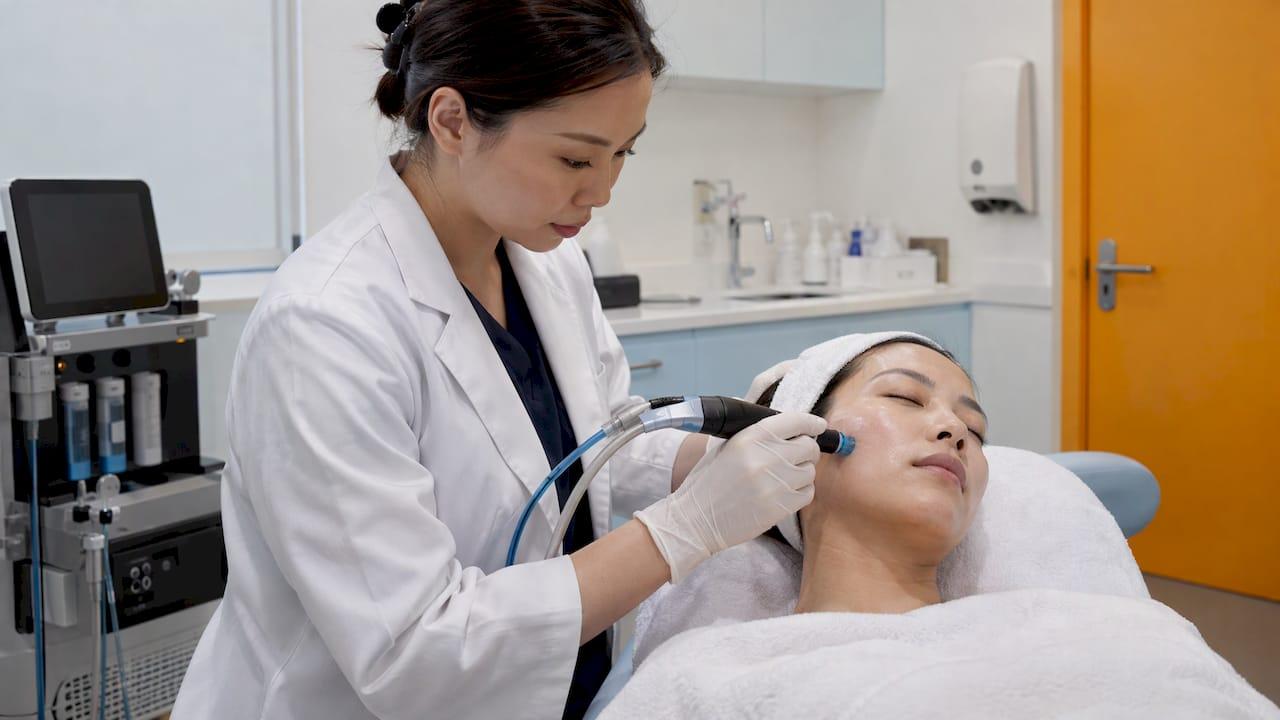
A Hydrafacial is a multi-step facial that cleanses, gently exfoliates, extracts congestion from pores and infuses the skin with hydrating or targeted serums in a single session. Its main benefits are smoother texture, cleaner-looking pores, better surface hydration and a more even, brighter appearance, with no downtime for most people. It is a superficial, cosmetic treatment, and the best results come when a qualified clinician first assesses your skin and matches the treatment to your goals. For patients in Macau, Hong Kong and the Greater Bay Area, our dermatology and aesthetic medicine team is the natural starting point for that assessment.
This guide explains what the treatment does, what the research can and cannot show, how it differs from a regular facial, how long results last, and what to check before you book.
Table of Contents
- What a Hydrafacial does
- The benefits, one by one
- Hydrafacial compared with a regular facial
- How long the results last
- Side effects and safety
- Who is it suitable for
- Is it worth it: how to decide
- Getting a skin assessment at Globallmed
- Frequently asked questions
What a Hydrafacial does
The treatment is often called hydradermabrasion. The name describes its mechanism: a handheld device with a disposable tip moves across the face, using a vortex-style suction and a liquid solution to work on the outermost layer of skin. Instead of a dry abrasive, such as crystals or a brush, the exfoliation is delivered together with fluid.
A session typically follows a fixed sequence:
- Cleansing and exfoliation. The surface is cleansed and the uppermost layer of dead skin cells is loosened and removed.
- Mild peel. A gentle acid-based solution is applied briefly to help dislodge debris and prepare the skin. The strength is chosen by the practitioner according to skin sensitivity.
- Extraction. Suction draws out oil, impurities and congestion from pores. This is the step that most people associate with the treatment.
- Hydration and serums. Humectant and antioxidant serums are applied to the freshly cleansed skin. Booster serums can be selected for dryness, dullness or uneven tone.
- Protection. The skin is finished with moisturizer and, in daytime, sunscreen.
A full session usually takes between 30 and 60 minutes, depending on whether additional steps are added. There is no anesthesia and no recovery period in the usual sense. Most people return to work or travel the same day.
The benefits, one by one
The advantages most often reported are surface-level improvements. That is precisely what the treatment is designed for, and it is why it suits a wide range of patients.
Smoother texture
Removing the outermost layer of dead cells makes the skin surface more even. In a small 2024 study published in Skin Research and Technology, researchers used line-field confocal optical coherence tomography, an imaging technique that shows the skin layers in near-microscopic detail. They examined eight volunteers before and after hydradermabrasion. The thickness of the stratum corneum, the outermost layer, decreased immediately after the procedure, and the surface irregularities measured in the skin also reduced. All eight participants noticed a difference in texture and smoothness when they touched their skin.
The same study measured the stratum corneum again two weeks later and found it had returned to its earlier thickness. That is normal: the skin renews itself continuously, and the outer layer rebuilds. It also explains why the benefit is described as a maintained routine rather than a permanent change.

Cleaner-looking pores
Pores look larger when they are filled with oil and dead cells. Extraction clears that content and temporarily reduces the appearance of congestion, particularly around the nose, chin and forehead. The treatment does not change pore structure, which is largely determined by genetics, age and sun exposure. What changes is how visible the pores are once they are clear.
Hydration and a fresher look
Because the serums are applied immediately after exfoliation, when the surface is clean and receptive, the skin looks more hydrated and plumper in the days that follow. This is an effect on appearance and surface moisture. It is most noticeable in people whose skin looks tired, dull or dry, for example after air-conditioned offices, flights or long days in Hong Kong's humid summers followed by dry, cooled interiors.
Brighter, more even tone
Shedding dull surface cells lets light reflect more evenly, so the complexion looks brighter. Antioxidant boosters can support this effect. For visible pigmentation such as melasma or sun spots, a surface facial alone is not a medical treatment, and a dermatologist should assess the cause first.
A softer appearance of fine lines
When the skin is well hydrated, fine, dehydration-related lines look less pronounced. This should be distinguished from structural change. In the 2024 study, no visible change in dermal collagen quality or quantity was found at two weeks. Hydrafacial is therefore best understood as improving how the skin looks and feels at the surface, not as a collagen-remodeling treatment. Patients seeking firmer skin or deeper wrinkle correction usually need a different approach, which a dermatologist or plastic surgeon can discuss with you.
Low irritation and no downtime
In the same small study, none of the participants reported acne breakouts, irritation, dryness or post-inflammatory hyperpigmentation. Redness after a stronger setting resolved within two to five days. A larger, completed Phase IV clinical trial registered in the United States evaluated three Hydrafacial treatments in healthy adults aged 30 to 55 across Fitzpatrick skin types I to VI, looking at skin quality, hydration and barrier function. The range of skin types included in that trial reflects the treatment's broad suitability.

Hydrafacial compared with a regular facial
Both are cleansing treatments, but they differ in method, consistency and what they can deliver.
| Feature | Hydrafacial | Regular facial |
|---|---|---|
| Exfoliation | Device-assisted, with fluid delivered and removed in one pass | Manual, with scrubs, brushes or steamed extraction |
| Pore extraction | Suction-based, standardized | Done by hand, technique varies with the therapist |
| Hydration step | Serums applied right after exfoliation | Masks and creams, often with massage |
| Customization | Chosen by peel strength and booster serums | Chosen by product and massage routine |
| Relaxation | Moderate, focused on skin results | High, with massage as a central element |
| Downtime | Usually none | Usually none, though manual extraction can leave temporary redness |
| Typical goal | Visible skin quality, texture and clarity | Relaxation and general skin maintenance |
The practical difference is predictability. A device-led protocol follows the same steps each time, so results are easier to compare from one session to the next. A traditional facial is more variable, which suits patients who value the massage and the personal touch. Neither replaces a medical consultation if you have acne, rosacea, eczema or pigmentation concerns.
How long the results last
The visible glow and hydration are most noticeable immediately after the session and in the days that follow. As the study above showed, the skin's outer layer returns to its baseline thickness within about two weeks, because that layer renews itself. In practice, patients usually plan sessions at intervals of several weeks, and the schedule is something to agree with your practitioner.
Several factors affect how long the effect is noticed:
- Daily sun protection. Ultraviolet exposure dulls the skin and can undo tone improvements. A broad-spectrum sunscreen is essential after any exfoliating treatment.
- Home routine. A gentle cleanser, moisturizer and, where suitable, an evening active recommended by your doctor help maintain results.
- Skin concern. Dehydration responds quickly to treatment, while oiliness and congestion return as the skin continues to produce sebum.
- Environment and lifestyle. Humidity, air-conditioning, sleep, smoking and travel all affect how the skin looks from week to week.
Side effects and safety
Hydrafacial is generally a gentle treatment, and the typical after-effects are short-lived:
- Mild redness, usually settling within hours to a few days.
- A feeling of tightness or sensitivity, particularly after a stronger peel.
- Temporary small marks in areas where extraction was concentrated.
To use the treatment safely, tell your practitioner before the session if any of the following applies:
- You are pregnant or breastfeeding.
- You have active skin infections, cold sores, open wounds, or an eczema or rosacea flare.
- You are using, or have recently used, oral isotretinoin or prescription topical retinoids.
- You have a recent sunburn or a recent cosmetic procedure on the face.
- You have a history of dark marks after skin irritation, or you know your skin is very reactive.
The depth of the treatment matters for safety. Hong Kong's Department of Health has stated in its public guidance on cosmetic procedures that exfoliation reaching below the epidermis should be performed only by registered medical practitioners, and that complications such as bleeding, pigmentation changes, infection and scarring become more likely the deeper the exfoliation goes. A surface treatment such as Hydrafacial is designed to stay in the outer layer, which is why an experienced, qualified provider and a proper skin assessment are so important. At Globallmed, our clinic is staffed by government-certified medical professionals, so your skin is assessed by a physician rather than screened informally.
Who is it suitable for
Hydrafacial is generally chosen by adults who want better skin quality without a recovery period. Typical candidates include people with:
- Dull or tired-looking skin.
- Dehydration and a rough surface texture.
- Congested pores or mild, non-inflamed blemishes.
- Early signs of aging at the surface level.
- A wish to prepare the skin before a special occasion or travel.
There is no single best age. Many people start in their late twenties or thirties for maintenance, and the clinical trial mentioned above included adults aged 30 to 55. Teenagers with acne, adults with persistent inflammatory acne, and anyone with a diagnosed skin condition should have a consultation first, because a medical treatment plan may serve them better than a cosmetic facial.
Is it worth it: how to decide
Five questions help you decide whether the expected benefits match what you want:
- What is your goal? If it is radiance, smoothness and hydration, the treatment is aligned with the evidence. If it is deep wrinkles, laxity or established pigmentation, a medical assessment will identify more suitable options.
- How is your skin today? Active inflammation, infection or irritation is a reason to treat the condition first.
- Are you prepared to maintain it? The visible effect is greatest when sessions are repeated at a sensible interval and supported by sun protection and a suitable home routine.
- Who will perform it? Look for a registered, qualified medical team in a licensed clinic, with a consultation before treatment.
- Can the plan be coordinated? Skin health is connected to hormones, diet, stress and sleep. A clinic offering dermatology, dietetics and psychology under one roof can look at the whole picture.
Getting a skin assessment at Globallmed
Globallmed is Macau's largest private outpatient clinic, serving patients of more than 60 nationalities with multilingual staff. Our Beauty, Wellness and Wellbeing department brings together dermatology, plastic surgery and dietetics, so a question about skin quality can be reviewed by a physician and, where appropriate, supported by nutritional guidance. For visitors from Hong Kong and the wider Greater Bay Area, as well as international patients, we offer online appointment booking, direct billing with major international insurers where coverage applies, and international patient support.
If you are also planning a broader review of your health, our executive and basic health check-ups can be arranged alongside a skin consultation. Our multi-therapy department and general medical clinic are available for related concerns.
Frequently asked questions
What does a Hydrafacial actually do?
It cleanses the skin, removes the outermost layer of dead cells, extracts congestion from pores and applies hydrating serums, all in one session. The result is smoother, clearer and better-hydrated skin. It works on the surface and is not a substitute for medical treatment of acne, pigmentation or deeper wrinkles.
Is a Hydrafacial better than a regular facial?
They serve different purposes. A Hydrafacial follows a standardized, device-assisted protocol aimed at visible skin quality, with extraction and hydration built in. A regular facial relies more on manual technique and massage, which suits patients who prioritize relaxation. A consultation can help you choose according to your skin and goals.
What are the side effects of a Hydrafacial?
The usual effects are mild and temporary: slight redness, tightness or sensitivity, normally settling within hours to a few days. Tell your practitioner beforehand if you are pregnant, using retinoids or isotretinoin, or have an active infection, eczema or rosacea flare. Apply sunscreen daily afterward.
How often should I have a Hydrafacial?
Because the skin's outer layer renews itself over a matter of weeks, many patients plan maintenance sessions at intervals agreed with their practitioner. The right schedule depends on your skin type, your goals and how your skin responds, and is best set at your consultation.
Is a Hydrafacial suitable for sensitive or darker skin?
A clinical trial registered in the United States included adults across Fitzpatrick skin types I to VI, and the peel strength can be adjusted for sensitivity. Even so, a physician should review sensitive skin, a tendency toward dark marks or any skin condition before treatment, so that the approach is chosen for you. You can book a dermatology consultation at Globallmed to have your skin assessed.