
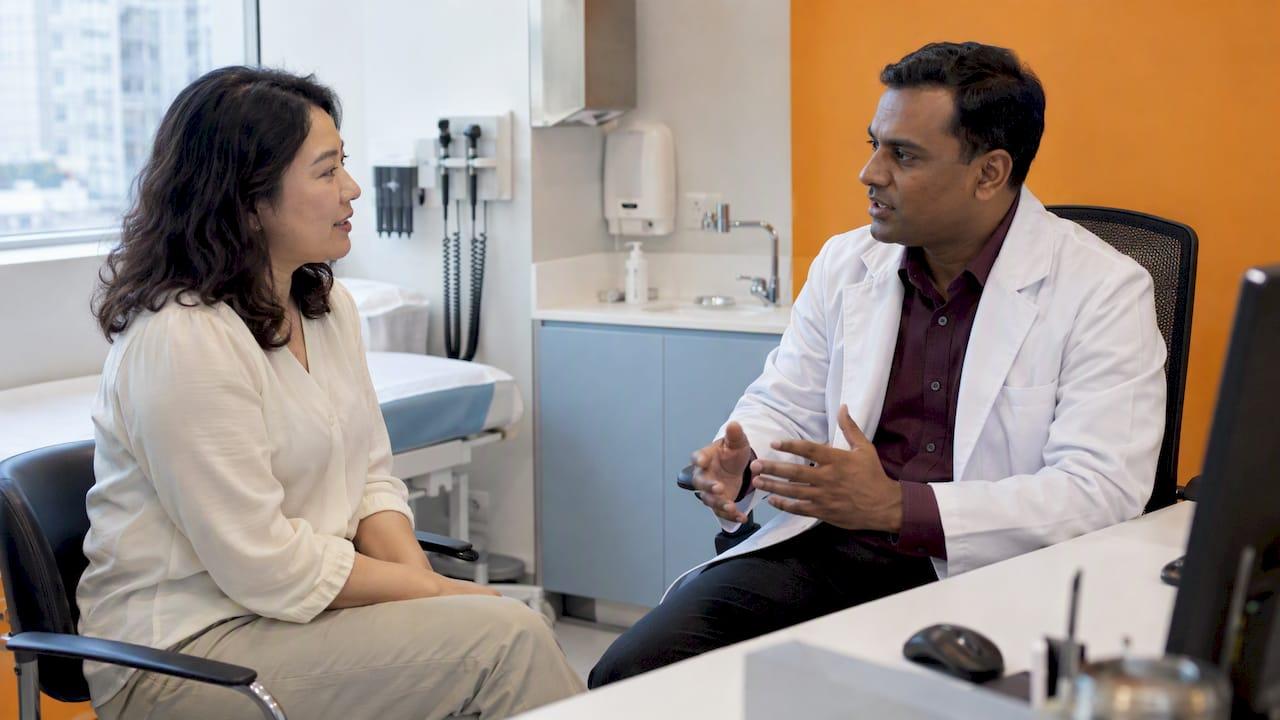
Macau offers outpatient care through three channels: government health centres, public and subsidised hospitals, and private clinics. Residents of Hong Kong, the Greater Bay Area and other countries are treated as non-residents. They can use all three, but they pay chargeable rates rather than receiving the free entitlements reserved for Macau residents. Private outpatient care is usually the fastest route for a visitor. It needs no referral slip or resident card, and appointments can be booked in advance.
This guide explains how the system is organized, what non-residents pay, how insurance and payment typically work, and what to prepare before you travel. It also sets out what to check before you choose a clinician. We are Globallmed, Macau's largest private outpatient clinic, and we describe where our services fit within the wider system.
Table of Contents
- How outpatient healthcare is organized in Macau
- Public and private routes compared
- What Hong Kong and Greater Bay Area residents should know
- Fees and what you can expect to pay
- Insurance, direct billing and payment
- Preparing before you travel to Macau
- Choosing a clinician: licensing, qualifications and safety
- Outpatient services at Globallmed
- Planning a visit step by step
- Frequently asked questions
How outpatient healthcare is organized in Macau
Macau's government describes its outpatient system as a mix of public and non-governmental providers. The public side includes 9 health centres and 3 health stations, which handle primary care. Specialist care is concentrated at Conde de São Januário Hospital and at Macao Union Hospital, which was formally opened on 16 September 2024.
Alongside the public network sit government-subsidised and other non-governmental institutions. The 2025 Macao Government Yearbook names Kiang Wu Hospital, the Workers' Clinic and Tung Sin Tong Clinics among them, together with private clinics and laboratories. It also describes cooperation between the government and non-profit institutions in several areas: specialist care, Chinese-medicine and dental outpatient care, rehabilitation, screening, home care and psychological counselling.
For a patient, this produces a layered structure:
- Primary care: health centres, government-subsidised clinics and private general practice.
- Specialist care: hospital outpatient departments and private specialist clinics.
- Allied and therapy services: rehabilitation, psychology, speech and occupational therapy, delivered by both non-profit and private providers.
- Screening and prevention: government programmes and private health check-ups.
Scale of the public hospital system
Conde de São Januário Hospital provides 73 types of specialist outpatient services across 29 specialist departments, together with 24-hour emergency care. Macao Union Hospital expanded to 52 specialty outpatient clinics according to an April 2025 government update, and offers regular, special-appointment and medical-aesthetic outpatient services. These figures show a system with real depth. They also explain why queues and referral requirements matter: public specialist care is designed first for residents.
Public and private routes compared
The practical differences for a visitor are access, cost and speed. The table summarizes them in general terms.
| Factor | Government health centre | Public hospital specialist clinic | Private outpatient clinic |
|---|---|---|---|
| Free for legal residents | Yes | Partly, depending on the hospital and eligibility | No, fee-for-service |
| Non-residents | Pay Health Bureau rates | Pay applicable chargeable rates | Pay the clinic's fees |
| Referral or registration documents | Registration at the centre | ID, Gold Card and appointment slip for residents | Booking by phone or online |
| Typical use | Primary care, vaccinations, routine follow-up | Complex or hospital-based specialist care | Fast access, multiple specialties in one place, multilingual service |
Public care is a strong, well-regulated foundation, particularly for residents with chronic conditions or those needing hospital-level services. Private outpatient care complements it by shortening the path from first symptom to consultation and by integrating several specialties under one roof.
What Hong Kong and Greater Bay Area residents should know
If you live in Hong Kong or elsewhere in the Greater Bay Area, Macau's rules classify you as a non-resident. According to the 2025 Government Yearbook, all legal Macau residents receive free Health Centre services, while non-residents pay according to Health Bureau rates. Conde de São Januário Hospital services are generally chargeable, and Macau residents receive a 30% reduction that you would not.
Long-term stayers are treated differently. At Macao Union Hospital, long-term non-Macau stayers holding specified permits pay normal fees. The April 2025 government update lists holders of Non-Resident Worker's Identification Cards, student visas and Special Stay Permits among those who may register for treatment. A short-term visitor from Hong Kong generally does not fall into that group, and international and private medical services are offered at the hospital for them.
Short trips and planned visits
Most Hong Kong patients cross the border for one of three reasons: a planned consultation, a health check-up combined with a day trip, or follow-up care that fits more easily into a weekend. For these, private outpatient care makes sense. Booking ahead lets you arrange the specialty, language and timing before travelling. Our health check-up programmes are designed for this kind of planned visit.
Insurance held in Hong Kong
Some Hong Kong insurers now extend outpatient benefits across the Greater Bay Area. AIA's GBA Health Connect outpatient plan, for example, covers face-to-face general-practitioner consultations in Macau through its medical network for insured members, subject to policy eligibility, network and benefit limits. The lesson applies to any policy: check whether your plan covers Macau at all, which providers are in network, and whether benefits are paid directly or reimbursed afterwards.
Fees and what you can expect to pay

The government's published fee structure shows how strongly Macau differentiates by residency. For specialist outpatient consultations at public facilities, the fee is MOP 42 for Macau residents, MOP 60 for non-resident workers and MOP 120 for non-Macau residents. Other medical services are charged at 70%, 100% and 200% of the base rate respectively.
Two points follow from this:
- A non-resident pays roughly three times the resident consultation fee at a public specialist clinic, and double the base rate for other services.
- These are public-sector rates. Private clinics set their own fees, which depend on the specialty, the length of the consultation and any tests or procedures.
Public-sector rates can look inexpensive, but they do not include the time cost of registration, referral and waiting, and they do not cover cosmetic or wellness treatments. Private care is priced differently and should be confirmed with the clinic before you attend. Our service pages do not publish fixed fees, so we recommend asking for a quotation when you book.
Insurance, direct billing and payment
International visitors should not assume that their home health system will pay for care in Macau. Australia's official travel advice, for example, notes that Australia has no agreement with Macau for free healthcare, and recommends comprehensive travel insurance that covers overseas medical costs, including evacuation. The same principle applies to most nationalities.
The same advice notes that private hospitals may ask for proof of travel insurance and may require a payment guarantee or an up-front deposit. Before an appointment, ask four questions:
- Does my policy cover outpatient care, or only emergencies and hospital stays?
- Is the provider on my insurer's network, and is direct billing available?
- What do I pay up front, and what documents do I need to claim reimbursement?
- Are pre-existing conditions, dental work or cosmetic procedures excluded?
Globallmed has direct billing arrangements with major international insurers. This means that, for eligible policies, you may not need to pay the full amount at the counter and claim it back later. Eligibility depends on your policy, so confirm with us and your insurer before the visit.
Preparing before you travel to Macau
Good preparation prevents most of the problems visitors report. The official guidance from health and travel authorities points to a short list.
Medication and documents
Confirm that your regular medications are legal in Macau. The US Centers for Disease Control and Prevention advises international travelers to verify this by contacting the destination's embassy before departure. Australian official advice adds that you should carry a copy of your prescription and a letter from your doctor. Bring medication in its original packaging.

Records and history
Take a concise summary of your medical history: diagnoses, allergies, current prescriptions and recent test results. Where possible, have it in English or Chinese. Our multilingual team can work with records in several languages, and this shortens the first consultation.
Identification and insurance papers
Carry your passport or travel permit, your insurance card and your policy number. Clinics, particularly private ones, will ask for proof of coverage if you plan to use it.
Quality of care
Australia's official advice describes medical facilities in Macau as adequate. That is a sensible expectation for routine and planned outpatient care, and it is a reason to arrange insurance with evacuation cover for anything more serious.
Choosing a clinician: licensing, qualifications and safety
This is the area where patients, and particularly medical and cosmetic tourists, should be most careful. Before you commit to any treatment in Macau, ask the clinic the following:
- Is the doctor licensed to practice in Macau in this specialty? A licensed professional should be able to state their registration without hesitation.
- Who will perform the procedure? For surgery and cosmetic treatments, ask for the name and specialty of the practitioner, not only of the clinic.
- Where will the procedure take place, and what happens if there is a complication? A clinic should explain follow-up care and who is responsible for it.
- What are the risks, alternatives and costs in writing? You should be able to review these before consenting.
Be cautious of any provider that offers medical or cosmetic treatments without a clear explanation of who performs them, or that pressures you to decide on the day. For specific concerns about a condition, see a qualified doctor in the relevant specialty, such as a dermatologist for skin changes or a urologist for urinary symptoms, rather than relying on general information.
At Globallmed, our clinical team consists of government-certified medical professionals, and our integrated model means that your general practitioner, specialist and therapist work within one centre. The center has also received recognition through the EFQM Excellence Award, which reflects an international standard of organizational quality.
Outpatient services at Globallmed
If you are planning outpatient care in Macau, we offer a broad range of specialties within a single clinic. We serve patients of more than 60 nationalities, with multilingual staff and online appointment booking.
Medical clinic
Our medical clinic department covers general practice, general surgery, obstetrics and gynecology, otolaryngology (ENT), dental care, urology and pediatrics. It is the usual starting point for undiagnosed symptoms, and a general practitioner can coordinate referral to the relevant specialist within the center.
Beauty, wellness and wellbeing
The beauty, wellness and wellbeing department includes dietetics, dermatology and plastic surgery. Dermatology is clinical as well as cosmetic, so a skin concern can be assessed medically before any aesthetic treatment is considered.
Therapy services
Our multi-therapy department provides psychology, speech therapy, physiotherapy and occupational therapy. These services suit patients recovering from injury or surgery, children with developmental needs, and adults seeking psychological support.
Health check-ups
Check-up programmes are a common reason for cross-border visits. We offer Basic 1, 2 and 3 check-ups, a Women & Child programme, and executive programmes for women and men. Which one fits depends on your age, family history and existing conditions, and a doctor can advise on this at booking.
Planning a visit step by step
- Define the need. Decide whether it is a symptom to investigate, a check-up, ongoing therapy or an aesthetic treatment.
- Check your insurance. Ask whether Macau outpatient care is covered and whether direct billing applies.
- Book in advance. Use the online appointment form and state your language preference, specialty and travel dates.
- Prepare documents and medication. Passport, insurance details, medical summary, prescriptions and a doctor's letter where relevant.
- Confirm costs. Ask for an estimate for consultations, tests and any procedure before attending.
- Plan follow-up. Agree how results, prescriptions and further visits will be handled once you return home.
To begin, view our full list of services and book an appointment through the website.
Frequently asked questions
Can a Hong Kong resident use public healthcare in Macau?
Yes. Non-residents can use public outpatient and hospital services, but they pay the applicable Health Bureau or hospital rates instead of receiving the free resident entitlement. At a public specialist clinic the consultation fee for a non-Macau resident is MOP 120. Registration and referral procedures are designed mainly for residents, so many visitors choose private care for planned visits.
Do I need a referral to see a specialist in Macau?
At public facilities, specialist outpatient care generally follows a registration and referral process, and residents present their ID, Gold Card and an appointment slip. Private clinics typically allow you to book a specialist directly. At Globallmed you can book through the website, and our general practitioners can help direct you to the right department.
Will my Hong Kong or international insurance cover outpatient care in Macau?
It depends on the policy. Some plans extend outpatient benefits to Macau through a network, subject to eligibility and benefit limits, while many travel policies cover only emergencies. Globallmed has direct billing arrangements with major international insurers, so check your policy and contact us before your visit to confirm.
What should I bring to my first appointment?
Bring your passport or travel permit, insurance card, a summary of your medical history and a list of current medications. If you take prescription medication, carry the original packaging, a copy of the prescription and a doctor's letter. Confirm beforehand that your medication is legal in Macau.
Can I combine a health check-up with other treatments in one visit?
Often yes, because our specialties operate within one center. A check-up can be followed by a consultation with a specialist such as a dermatologist or a urologist if the results call for it. Tell us at booking what you would like to cover so that we can schedule the appointments sensibly.