

A general practitioner (also called a primary care physician, or PCP) handles broad, continuous care across your entire health picture. A specialist provides focused, advanced care for a specific organ system or disease. For most new symptoms, start with your GP. Go directly to a specialist when you have a known specialist-managed condition, a clear organ-specific problem, or a red flag that cannot wait.
One practical note before you read further: your insurance plan may require a referral from your GP before a specialist will see you, and skipping that step can raise your out-of-pocket costs significantly. That process is covered in detail below.
Table of Contents
- What is the difference between a GP and a specialist?
- What does a general practitioner actually do?
- What is a medical specialist and what do they treat?
- How does medical training differ between GPs and specialists?
- When should you see your GP first, and when should you go directly to a specialist?
- How do U.S. insurance plans, referrals, and prior authorization affect specialist access?
- What should you expect at a GP visit versus a specialist visit?
- How do GPs and specialists work together to coordinate your care?
- Key Takeaways
- Why coordination between your GP and specialist matters more than most patients realize
- Useful sources and editorial notes
- Integrated outpatient care at GLOBALLMED Medical Center
What is the difference between a GP and a specialist?
| Dimension | General Practitioner (PCP) | Medical Specialist |
|---|---|---|
| Scope of practice | Whole-person, across all organ systems | One organ system, disease type, or procedure |
| Typical training | Medical school + 3-year residency (family or internal medicine) | Medical school + residency + 1–3 year fellowship |
| Board certification | Family Medicine or Internal Medicine boards | Specialty-specific boards (e.g., cardiology, dermatology) |
| When to consult | New symptoms, preventive care, chronic monitoring, medication questions | Complex diagnosis, specialist-managed chronic condition, red flags, post-referral |
| Referral/insurance | Usually the referral source; may require prior authorization for specialist access | Often requires GP referral or prior authorization under HMO and some Medicare Advantage plans |
| Visit expectations | History, physical, basic labs, preventive counseling, care coordination | Targeted exam, advanced diagnostics, procedures, surgical evaluation |
Fastest decision rules:
- See your GP first for anything new, routine, or unclear.
- See a specialist directly for a known condition already under specialist management.
- Call 911 or go to the ER for chest pain, sudden neurological changes, or major trauma.
- Check your insurance before booking a specialist to confirm referral and prior authorization requirements.
What does a general practitioner actually do?
A GP, or primary care physician, is your first point of contact with the medical system and, ideally, your longest-standing clinical relationship. PCPs handle the majority of medical consultations in the U.S., including acute illness, preventive care, and annual check-ups. That breadth is the point: a GP who has seen you for five years knows your medication list, your family history, and the pattern of your lab results in a way no specialist can replicate from a single visit.
The most common PCP types in the U.S. are family medicine physicians (who treat patients of all ages), internal medicine physicians (who focus on adults), and pediatricians (who specialize in children). Some older practices still use the term "general practitioner," though in the U.S. that usually means a family medicine physician without subspecialty fellowship training.
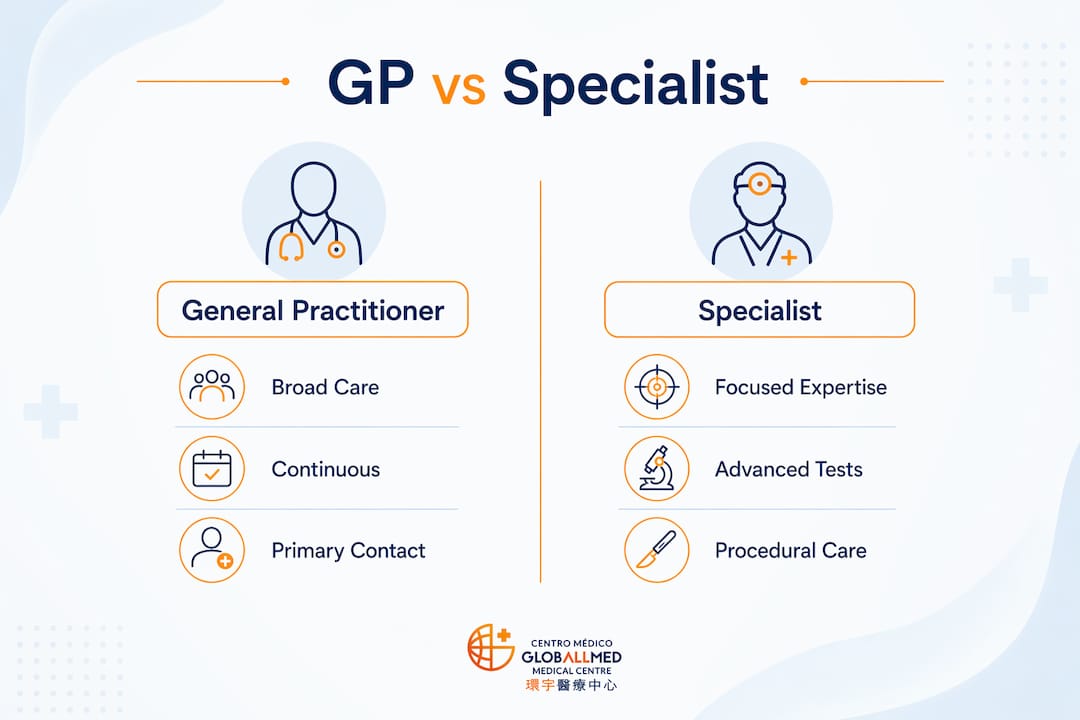
Everyday GP services include wellness visits and annual physicals, vaccinations, basic diagnostics (blood panels, urinalysis, EKGs), medication management, and referrals to specialists when needed. That last function matters more than most patients realize. A GP who consolidates your medication list, prior test results, and symptom timeline before writing a referral substantially reduces the risk of duplicate testing and diagnostic error. Bring those materials to every visit.
Pro Tip: Keep a running document on your phone with your current medications (name, dose, frequency), known allergies, and the dates of any recent imaging or lab work. Handing that to your GP at the start of a visit saves time and improves the quality of any referral they write.
What is a medical specialist and what do they treat?
A specialist is a physician who completed advanced, targeted training in a specific discipline after residency, then earned board certification in that field. Where a GP sees the whole patient, a specialist sees one system or problem in depth. That focus is what makes them the right choice for complex diagnoses, procedural interventions, and conditions that require expertise a generalist cannot reasonably maintain.
Common specialties and what they cover:
- Cardiology: Heart and vascular system; manages arrhythmias, heart failure, coronary artery disease.
- Dermatology: Skin, hair, and nails; evaluates lesions, chronic skin conditions, and skin cancers.
- Endocrinology: Hormonal disorders; manages diabetes, thyroid disease, adrenal conditions.
- Neurology: Brain and nervous system; evaluates seizures, stroke, multiple sclerosis, neuropathy.
- Orthopedics: Musculoskeletal system; manages fractures, joint replacement, sports injuries.
- Oncology: Cancer diagnosis and treatment; coordinates chemotherapy, immunotherapy, and radiation.
- Pulmonology: Lungs and respiratory system; manages asthma, COPD, and sleep-disordered breathing. For a closer look at what a pulmonologist does in an outpatient setting, see the role of a pulmonologist in outpatient care.
- Urology: Urinary tract and male reproductive system; manages kidney stones, prostate conditions, and bladder disorders.
Specialist visits typically involve advanced diagnostics (MRI, echocardiogram, biopsy, endoscopy), procedural interventions, surgical evaluation, and complex disease management protocols that go beyond a GP's scope. Patients with established chronic conditions, such as heart failure or rheumatoid arthritis, often maintain a standing relationship with a specialist for ongoing management alongside their GP.
How does medical training differ between GPs and specialists?

Both paths start the same way: four years of medical school, followed by the United States Medical Licensing Examination (USMLE) steps. After that, the timelines diverge.
A GP completing a family medicine or internal medicine residency spends three years in supervised clinical training across a broad range of conditions. After residency, they sit for board certification through the American Board of Family Medicine or the American Board of Internal Medicine. Recertification is required periodically, which keeps clinical knowledge current.
A specialist follows the same medical school and residency path, then adds a fellowship: one to three additional years of focused training in their chosen discipline. A cardiologist, for example, completes a three-year internal medicine residency and then a three-year cardiology fellowship before sitting for cardiology boards. A surgical subspecialist may train for even longer. Board certification in a specialty signals that the physician has met a defined competency standard for that discipline, and hospital privileges are typically granted on that basis.
One nuance worth knowing: in many countries, and increasingly in U.S. academic circles, general practice is formally recognized as a specialty in its own right. GPs are expert generalists, trained to manage complexity across systems rather than depth in one. That distinction matters when patients assume a specialist is automatically "more qualified." For a specific problem within a specialist's domain, they are. For the whole patient, the GP's longitudinal view is often what catches what a specialist would miss.
When should you see your GP first, and when should you go directly to a specialist?
The general rule is straightforward: see your GP first for anything new, unclear, or non-urgent. GPs handle roughly 80% of patient problems without specialist involvement, and starting there is usually faster, less expensive, and more efficient. GPs often rule out common causes with lower-cost diagnostics before specialist-level tests are ordered.
See your GP first when:
- You have a new symptom you cannot explain (fatigue, pain, rash, weight change).
- You need preventive care, vaccinations, or a routine physical.
- You have a question about a medication or a new prescription.
- You are managing a chronic condition like hypertension or type 2 diabetes and need routine monitoring.
Consider going directly to a specialist when:
- You have a known condition already managed by that specialist (e.g., established rheumatology patient).
- Your GP has already referred you and the appointment is scheduled.
- A symptom is clearly organ-specific and you know the relevant specialty (e.g., a suspicious skin lesion you want a dermatologist to evaluate).
Red flags that need urgent or emergency attention:
- Chest pain or pressure, especially with shortness of breath or arm pain.
- Sudden weakness, numbness, slurred speech, or facial drooping (stroke signs).
- Severe difficulty breathing.
- Sudden vision loss in one or both eyes.
- Major trauma or uncontrolled bleeding.
For red flags, do not call your GP's office. Go to the emergency room or call 911.
A practical contrast: A patient with three weeks of fatigue and mild joint pain should start with their GP, who can order a basic metabolic panel, thyroid function tests, and an inflammatory marker before deciding whether rheumatology is warranted. A patient with an established rheumatoid arthritis diagnosis who develops a new joint flare can call their rheumatologist directly. The difference is whether the problem is defined or still being worked up.
Pro Tip: Before any appointment, write a one-page symptom timeline: when it started, what makes it better or worse, what you have already tried, and any relevant family history. Patients who bring this document get faster, more accurate referrals and reduce the chance of duplicate testing when they transition to specialist care.
How do U.S. insurance plans, referrals, and prior authorization affect specialist access?
Insurance structure is one of the most practical factors in the GP-versus-specialist decision, and it catches many patients off guard.
Under HMO (Health Maintenance Organization) plans, you are typically required to see your PCP first and obtain a formal referral before a specialist will be covered. Skipping that step means the specialist visit may not be covered at all. PPO (Preferred Provider Organization) plans are more flexible: you can usually see a specialist without a referral, though staying in-network still matters for cost.
Medicare works differently depending on which version you have. Original Medicare (Parts A and B) covers specialist visits under Part B, subject to the annual deductible and 20% coinsurance, without requiring a PCP referral. Medicare Advantage plans, however, are run by private insurers and often impose HMO-style referral requirements and network restrictions. If you are on Medicare Advantage, check your plan's rules before booking a specialist.
Prior authorization is a separate issue. Even when a referral is in place, many plans require the specialist or your GP to obtain advance approval before certain tests, procedures, or treatments are covered. Missing prior authorization can shift a significant portion of the cost to you. Your GP's office can often manage this process, but you should confirm it has been completed before your specialist appointment.
Action checklist before seeing a specialist:
- Confirm the specialist is in-network with your plan.
- Ask your GP's office whether prior authorization is required for the visit or any anticipated tests.
- Request a copy of the referral letter to bring to the appointment.
- Ask the specialist's office for an estimate of expected costs, including any procedures.
- If you are on Medicare Advantage, verify referral requirements with your plan directly.
For a deeper look at how specialist networks and in-network versus out-of-network status affect your costs, the medical specialist network guide covers the key concepts clearly.
What should you expect at a GP visit versus a specialist visit?
GP visits and specialist visits are structured differently, and knowing what to expect helps you prepare.
A typical GP visit runs 15–30 minutes and covers a lot of ground: reviewing your medication list, updating your health history, addressing the presenting concern, ordering basic labs or imaging if needed, and discussing preventive care. The GP is building and maintaining a complete picture of your health. Bring your insurance card, a current medication list, and any recent test results.
A specialist visit is narrower and often longer for the initial consultation. The specialist focuses on one system or problem, may perform a targeted physical exam, and typically orders advanced diagnostics specific to their field. An initial cardiology visit, for example, might include an EKG, an echocardiogram order, and a Holter monitor prescription, all in the same appointment. Follow-up visits are usually shorter and focused on results and treatment adjustments.
Pre-visit checklist (for both GP and specialist):
- Current medication list (name, dose, frequency, prescribing physician).
- Insurance card and referral documentation (if required).
- Prior test results, imaging reports, and relevant specialist notes.
- Written symptom timeline (onset, triggers, severity, what helps or worsens it).
- List of questions you want answered before you leave.
Questions to ask your GP:
- What is the most likely cause of my symptoms?
- Do I need any tests before seeing a specialist?
- Which specialist do you recommend, and will you send a referral note?
Questions to ask your specialist:
- What does my diagnosis mean for my daily life?
- What are my treatment options, and what are the risks of each?
- Will you send your notes and test results back to my GP?
- When do I need to follow up, and with whom?
Pro Tip: At the end of every specialist visit, ask the office to send a copy of the visit notes and any test results directly to your GP. Do not assume this happens automatically. Keeping your GP informed prevents gaps in your care and avoids duplicate testing at your next primary care visit. For a prepared list of questions to bring to your next consultation, the specialist consultation questions list is a practical starting point.
How do GPs and specialists work together to coordinate your care?
The GP-specialist relationship works best as a collaboration, not a handoff. The GP acts as the longitudinal lead: the clinician who knows your full history, manages your medications, and monitors your overall health over time. The specialist acts as a consultant for a focused, often time-limited problem. When that division of labor works well, patients get both depth and continuity.
Information exchange is the practical mechanism. A well-written referral note from your GP should include the problem statement, the work-up already completed, and a specific clinical question for the specialist ("assess for structural heart disease" is more useful than "evaluate chest pain"). After the specialist visit, a summary letter or shared electronic health record (EHR) note returns the findings and recommendations to the GP. In practice, this loop does not always close automatically, which is why patients play an important role in keeping both sides informed.

Your job in this process: bring your records, confirm that your GP received the specialist's notes after your visit, and clarify the follow-up plan before you leave the specialist's office. Who is managing which medication? Who do you call if symptoms change? Those questions are worth asking explicitly.
A concrete example: a patient with new-onset palpitations sees their GP, who orders an EKG and basic labs, then refers to cardiology with a note documenting the findings. The cardiologist performs an echocardiogram and a Holter monitor study, diagnoses paroxysmal atrial fibrillation, initiates anticoagulation, and sends a detailed summary back to the GP. The GP then takes over ongoing monitoring of the anticoagulant, manages any comorbidities, and coordinates follow-up. The specialist fixed the technical problem; the GP maintains the longitudinal view. For patients managing long-term conditions through this kind of shared model, the chronic disease management guide covers the coordination process in detail.
Key Takeaways
The most effective approach to navigating GP versus specialist care is to start with your GP for most concerns, prepare thoroughly for every visit, and confirm insurance and referral requirements before booking a specialist.
| Point | Details |
|---|---|
| See your GP first | For new, unclear, or non-urgent symptoms, your GP is the right first call in most cases. |
| Know the red flags | Chest pain, sudden neurological changes, and severe breathing difficulty require emergency care, not a GP appointment. |
| Check insurance before booking | HMO plans and many Medicare Advantage plans require a GP referral and prior authorization before specialist visits are covered. |
| Prepare for every visit | Bring your medication list, symptom timeline, prior test results, and a written list of questions to both GP and specialist appointments. |
| GLOBALLMED Medical Center | Offers integrated outpatient specialist care with coordinated referral support for patients seeking high-quality clinical services. |
Why coordination between your GP and specialist matters more than most patients realize
The conventional wisdom frames the GP-versus-specialist question as a choice: which one do you need? The more useful frame is which one leads, and when. Patients who treat their GP and specialist as separate, parallel relationships, rather than as a coordinated team, tend to end up with fragmented records, duplicate testing, and medication lists that no single clinician fully owns.
What gets underestimated is the GP's diagnostic value in complex cases. Specialists are trained to look deeply at one system. That focus is their strength, and it is also a structural limitation. A cardiologist evaluating chest pain may not weigh your recent thyroid result or your anxiety history the same way your GP would. The GP's comprehensive history and continuity can identify patterns that a specialist, seeing you for the first time, is not positioned to catch.
The practical implication: do not treat your GP as just a referral gateway. Use them as the clinician who holds the full picture, before and after specialist involvement. A GP who receives a detailed post-specialist summary and actively incorporates it into your ongoing care is doing exactly what the system is designed to do. When that loop closes, outcomes improve and unnecessary testing drops. When it does not, patients pay the difference in both cost and continuity.
Useful sources and editorial notes
This article draws on guidance from the Centers for Medicare and Medicaid Services (CMS) on primary care roles and referral requirements, the University of Pennsylvania's published framework on the role of primary care in coordinated care models, and AdventHealth's patient-facing explainer on PCP versus specialist distinctions. Training and certification information reflects standard U.S. medical education pathways as recognized by the American Board of Medical Specialties (ABMS).
Editorial notes for reviewers: All insurance and referral guidance in this article applies to U.S. plans. Medicare Advantage rules vary by plan; readers should verify current plan-specific requirements directly with their insurer. Internal links to GLOBALLMED Medical Center service pages are placed in the promo section and within contextually relevant body references. Author credentials and any institutional trust signals specific to GLOBALLMED Medical Center should be added to the perspective section before publication. The 32% GP-specialist income gap figure cited in the research pool was not used in the body because the article's focus is patient-facing guidance, not physician compensation; it may be added to a future FAQ section if warranted.
Integrated outpatient care at GLOBALLMED Medical Center
Patients who want coordinated access to both primary care and specialist services in a single outpatient setting have a concrete option at GLOBALLMED Medical Center, Macau's largest private outpatient clinic. Rather than managing separate GP and specialist relationships across different systems, GLOBALLMED Medical Center brings both under one roof, with a clinical team that communicates directly and a referral process designed to avoid the gaps that fragment care elsewhere.

The center's outpatient medical services cover a broad range of specialties, and the integrated model means your GP's notes, test results, and referral documentation move with you rather than getting lost between offices. For patients navigating a new diagnosis, a chronic condition, or a specialist referral for the first time, that continuity is a practical advantage. Visit the GLOBALLMED Medical Center services page to review available specialties and book an appointment with the clinical team.
This article provides general health information for educational purposes only and is not a substitute for professional medical advice. Consult a qualified healthcare provider or your insurance plan directly to confirm what applies to your specific situation.