

For a diagnosed medical condition, hospital care, or complex nutrition needs, a registered dietitian is the right professional to see, since that title carries accredited clinical training and, in many jurisdictions, legal registration. For general wellness goals like weight management or eating habits, a credentialed nutritionist can be a suitable choice, though training standards for that title vary far more widely. The safest rule: check credentials before you check convenience.
Table of Contents
- Dietitian or Nutritionist Difference at a Glance
- What Education Do Dietitians and Nutritionists Actually Complete?
- Who Can Treat Medical Conditions: Scope of Practice Explained
- How Do You Choose Between a Dietitian and a Nutritionist?
- How to Verify a Dietitian's or Nutritionist's Credentials
- Common Confusions: Dietitian, Dietician, and Nutritionist Explained
- How Outpatient Clinics Integrate Dietitians into Clinical Care
- Book a Clinical Dietetics Consult With Confidence
- Where to Verify Credentials and Learn More
- FAQ
Dietitian or Nutritionist Difference at a Glance
The fastest way to grasp the difference between a dietitian and a nutritionist is to look at where each one trained, where each one works, and what letters follow their name.
Dietitians typically hold an accredited degree in dietetics or clinical nutrition, complete supervised practice hours under a preceptor, pass a national exam, and then register with a governing body. That process is why the title "dietitian" is legally protected in a number of countries. Nutritionists, by contrast, occupy a much broader category: some hold master's or doctoral degrees and voluntary credentials, while others complete a short online certificate with no supervised practice at all.
Here is how the two roles typically compare:
- Education path: Dietitians complete an accredited degree plus supervised clinical practice; nutritionists range from certificate programs to full graduate degrees.
- Regulation: Dietitians are often licensed or statutorily registered; nutritionist regulation varies from strict (voluntary registers like the UK's UKVRN) to nonexistent.
- Typical settings: Dietitians work in hospitals, clinics, and rehabilitation centers; nutritionists more often work in public health, food industry, research, or private wellness coaching.
- Post-nominals: Look for RD or RDN (Registered Dietitian/Registered Dietitian Nutritionist) or RNutr (Registered Nutritionist) after a practitioner's name, and verify what each credential requires in your own country.
Local registration matters more than the title itself. A dietitian license earned in one country does not automatically transfer to another, and a nutritionist calling themselves "registered" may mean something different depending on which register they joined.
What Education Do Dietitians and Nutritionists Actually Complete?
The qualifications of dietitians follow a fairly standardized path across most regulated markets, while nutritionist training can mean almost anything depending on the country and the individual.
- Dietitians generally complete an accredited bachelor's or master's degree in dietetics, nutrition science, or a related clinical field, followed by a supervised practice internship that often runs several hundred to over a thousand hours under a licensed preceptor. After that, candidates sit a national credentialing exam and register with a professional regulator, such as the body that oversees the Registered Dietitian Nutritionist (RDN) credential.
- Nutritionists span a much wider range. Some complete rigorous graduate-level nutrition science programs and pursue a voluntary credential like Registered Nutritionist (RNutr) through bodies such as the Association for Nutrition, which requires an accredited degree and evidence of competency. Others complete a weekend course with no accreditation body behind it at all.
- Ongoing education is expected of both, but it is enforced more consistently for dietitians. Registered dietitians usually must log continuing professional development hours to maintain licensure; nutritionists on voluntary registers face similar requirements, but unregistered nutritionists face none.
Some accreditation systems have also raised the bar recently, now requiring a graduate degree as the minimum entry point for new RDN candidates rather than a bachelor's degree alone. That shift reflects a broader trend toward more formal education requirements for the dietitian title, even as the nutritionist title remains largely undefined in many places.
Who Can Treat Medical Conditions: Scope of Practice Explained
Scope of practice is where the registered dietitian vs nutritionist distinction stops being academic and starts affecting patient safety.
Registered dietitians are trained and, in many jurisdictions, legally authorized to deliver medical nutrition therapy (MNT), which means they can design nutrition interventions for diagnosed diseases such as diabetes, chronic kidney disease, or cancer, and adjust those interventions as lab values and medications change. In hospital and clinical settings, dietitians often manage enteral and parenteral nutrition (tube and IV feeding), work directly inside a physician-led care team, and in jurisdictions with licensure, can bill insurance for that clinical work the way other allied health professionals do.
Nutritionists typically occupy a different lane:
- Public health nutrition programs, where the focus is population-level dietary guidance rather than individual treatment.
- Food industry and product development roles, applying nutrition science to formulation and labeling.
- Research positions studying diet patterns, nutrients, or population health outcomes.
- Wellness coaching and general nutrition education for clients without a diagnosed condition requiring medical management.
That division exists for a safety reason: someone managing a complex condition on multiple medications needs a practitioner trained to catch drug-nutrient interactions and adjust care as their diagnosis evolves, not general advice on eating better.
How Do You Choose Between a Dietitian and a Nutritionist?
Deciding whether you need a dietitian or nutritionist gets much easier once you separate the question into two parts: what is the actual health situation, and what does this specific practitioner's paperwork say?
- Start with your situation. If you have a diagnosed disease, take multiple medications, are managing a condition through a hospital or clinic, or need coordination with a physician, a registered dietitian is the appropriate choice. If your goal is general wellness, weight management, or building better habits with no underlying diagnosis, a credentialed nutritionist may be enough.
- Ask direct questions before booking. What is your degree in, and is it accredited? Do you hold a registration number, and with which body? How many supervised practice hours did you complete? Have you treated my specific condition before? Do you communicate with physicians when needed?
- Watch for red flags. Be cautious of anyone who promises a guaranteed cure, sells expensive supplement packages as a mandatory part of treatment, or cannot produce a registration number when asked directly.
Pro Tip: Ask for the registration number first, before discussing price or availability. A legitimate dietitian or registered nutritionist will give you that number without hesitation, since it is a matter of public record.
How to Verify a Dietitian's or Nutritionist's Credentials
Verification takes minutes and removes almost all of the guesswork from choosing between a dietitian or nutritionist.
- Search the practitioner's name in your country's professional register or regulatory database, since most licensing bodies maintain a public, searchable list.
- Ask for documentation of supervised practice hours and the accredited institution where the degree was earned, rather than accepting a diploma photo at face value.
- Confirm what post-nominals actually mean: RD and RDN both indicate a registered dietitian, while RNutr indicates a nutritionist on a voluntary but accredited register.
- If your country has no formal nutritionist register, ask the practitioner directly for proof of coursework, transcripts, or a certificate from a named accredited program, and treat vague answers as a warning sign.
Supervised-practice evidence, meaning documented internship hours under a qualified preceptor, tends to be a more reliable single marker of clinical competence than any branded certificate earned without oversight.
Common Confusions: Dietitian, Dietician, and Nutritionist Explained
Spelling and terminology cause more confusion here than almost anywhere else in health care.
- "Dietitian" is the correct, standard spelling tied to the regulated profession; "dietician" is a widely used variant spelling, not a separate credential or a different job.
- Not every nutritionist lacks qualifications. Many hold graduate degrees and voluntary registrations that rival a dietitian's training. The deciding factor is always the specific credential, not the job title alone.
- Titles can mislead simply because "nutritionist" is unregulated in many places, meaning someone can use it after a single online course or after a doctoral degree. Verification is what separates the two, not the title itself.
- The public frequently uses "dietitian" and "nutritionist" interchangeably even though their regulatory status can differ enormously, which is exactly why checking a specific credential matters more than trusting the title on a business card.
How Outpatient Clinics Integrate Dietitians into Clinical Care
Inside a multidisciplinary outpatient setting, a dietitian rarely works in isolation. Clinical nutrition decisions get coordinated with physicians, nurses, and sometimes physiotherapists or psychologists, particularly for patients managing chronic conditions or recovering from surgery.
GLOBALLMED Medical Center structures its dietetics service around that same collaborative model, positioning nutrition care alongside other clinical specialties rather than as a standalone consultation.
- Dietetics consults are coordinated with the center's broader medical center team when a patient's condition requires input from other specialists.
- Patients with needs spanning nutrition and rehabilitation can be referred across the multi-therapy department for coordinated care.
- Before your first visit, expect a review of your medical history, current medications, and any existing diagnoses, since that information shapes the nutrition plan from day one.
Book a Clinical Dietetics Consult With Confidence
If you have weighed the dietitian vs nutritionist question and landed on needing clinical-grade nutrition support, a regulated outpatient setting is where that care belongs, not a general wellness coach working outside a medical framework. GLOBALLMED Medical Center offers dietetics consultations as part of its beauty, wellness, and wellbeing services, giving patients access to clinical nutrition guidance alongside dermatology and other integrated specialties under one roof, with multilingual staff supporting both local residents and international patients. Rather than researching credentials on your own and hoping a claim checks out, you can request credential details directly when booking. To take the next step, visit the dietetics and wellness page to review the service and submit an appointment request, or browse the full range of outpatient services if your needs span more than nutrition alone.
Where to Verify Credentials and Learn More
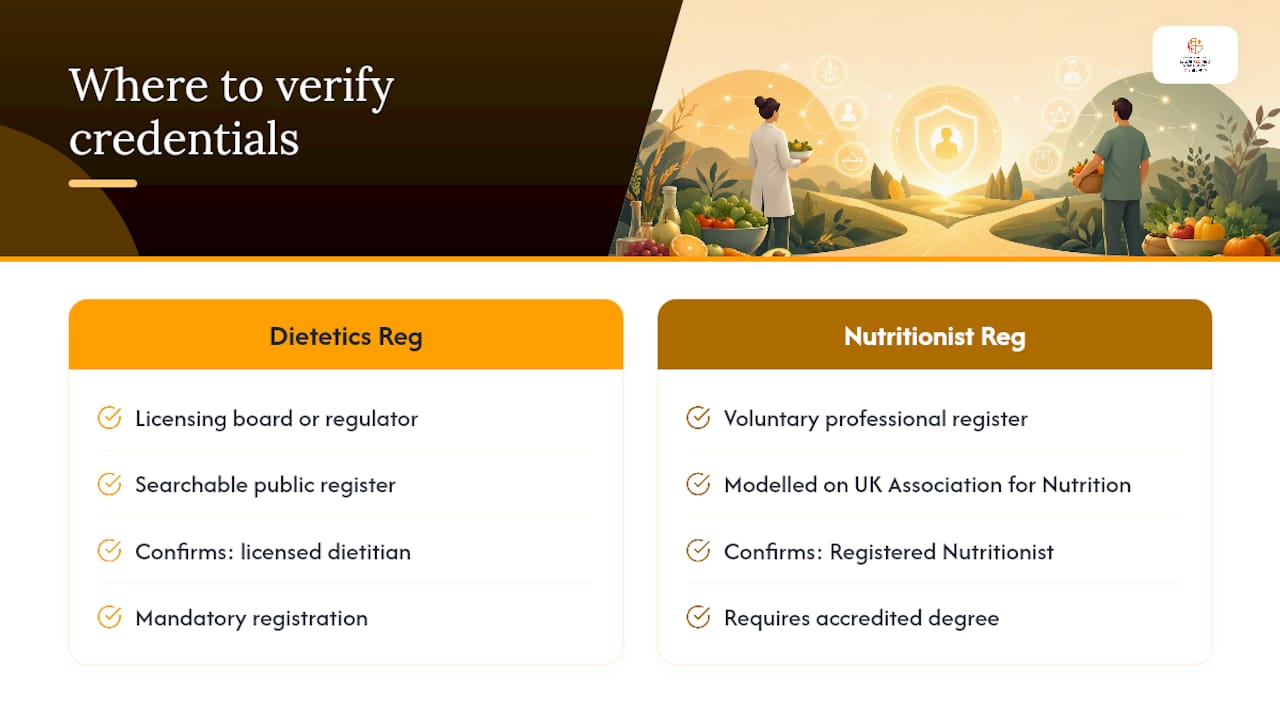
To confirm a practitioner's status yourself, check your country's dietetics regulatory body or licensing board, since most maintain a searchable public register. For nutritionists, look for a voluntary professional register in your country, such as one modeled on the UK's Association for Nutrition system, which lists Registered Nutritionists (RNutr) who have met accredited degree and competency standards.
This article is general information, not a substitute for advice from a qualified doctor. Consult a qualified healthcare professional about your own circumstances before acting on anything here.
FAQ
Is It Better to See a Dietitian or a Nutritionist?
It depends on your health situation. For a diagnosed medical condition, medication management, or hospital-level care, a registered dietitian is the better and often the only appropriate choice; for general wellness goals, a credentialed nutritionist can work well.
What Can a Dietitian Do That a Nutritionist Cannot?
In jurisdictions with licensure, dietitians can deliver medical nutrition therapy, manage tube and IV feeding, and bill insurance for clinical nutrition care, since their accredited training and registration authorize that scope. Most nutritionists, unless separately licensed, cannot perform these same clinical interventions.
Do Dietitians Give You Meal Plans?
Yes, dietitians commonly create individualized meal plans, but the plan is typically built around a specific medical need, such as managing diabetes or kidney disease, rather than a generic template. You can request a clinical dietetics consult through GLOBALLMED's dietetics service for a plan tailored to a diagnosed condition.
What Is the Difference Between a Dietitian and a Nutritionist?
A dietitian holds an accredited degree, completes supervised clinical practice, and in many places must register with a legal regulator to use the title. A nutritionist's training varies widely, from short certificates to advanced degrees, and the title itself is often unregulated, so verifying the specific credential matters more than the label.
How Much Does Seeing a Dietitian Cost?
Pricing for a clinical dietetics consultation depends on the type of visit and any accompanying health check-up package. Current pricing details for GLOBALLMED's dietetics and wellness services are available on the site, and you can request a quote when booking an appointment.