
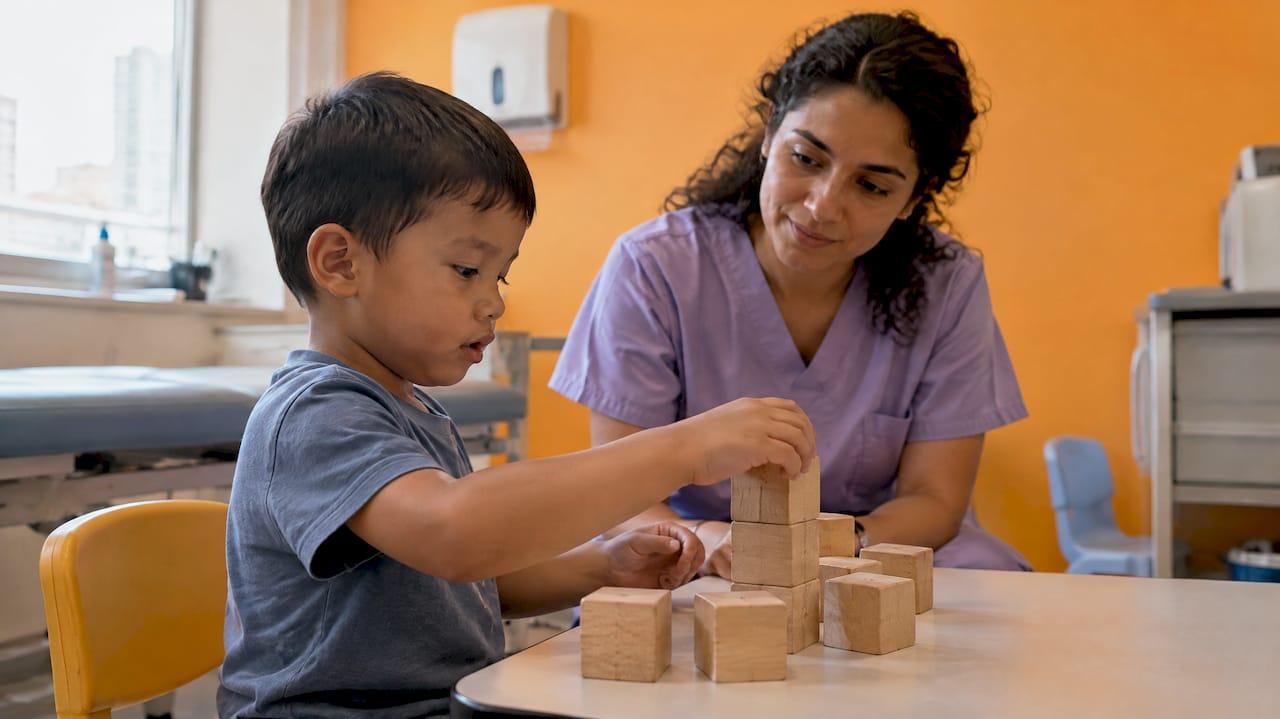
A developmental assessment in Macau is a structured evaluation of how a child is progressing in movement, language, thinking and social-emotional skills, carried out by trained clinicians and compared against what is expected for the child's age. If your toddler is slow to talk, repeats sounds, or is behind other children in play, the assessment tells you whether the difference is within normal variation or needs support. At Globallmed's multi-therapy department, speech therapy, psychology, occupational therapy and physiotherapy are available in one outpatient center in Macau, so a family can move from the first concern to a clinical answer without crossing between unrelated clinics.
This guide explains what an assessment evaluates, the signs that justify one, how the public referral route in Macau is organized, how speech delay and stuttering are treated in young children, and what Hong Kong, Greater Bay Area and international families should prepare before they come.
Table of Contents
- What a developmental assessment evaluates
- Signs that a child may need an assessment
- How the public referral route works in Macau
- Private developmental and speech assessment at Globallmed
- Speech delay in toddlers: what therapy involves
- Stuttering in young children
- Hong Kong, Greater Bay Area and international families
- How to prepare for the appointment
- When to seek an assessment without waiting
- FAQ
What a developmental assessment evaluates
Child development is usually divided into domains. A comprehensive assessment looks at each of them, because a delay in one area often affects another.
| Domain | What is examined | Example in a toddler |
|---|---|---|
| Gross and fine motor | Coordination, balance, hand control | Walking, stacking blocks, holding a crayon |
| Language and communication | Understanding, expression, speech clarity, social use of language | Following simple instructions, using words and word combinations |
| Cognitive | Problem solving, attention, play | Matching shapes, pretend play |
| Social and emotional | Interaction, emotional regulation, adaptation | Turn-taking, response to other children |
| Hearing and vision | Sensory function that supports all other skills | Response to sounds, tracking objects |
Macau's government-run Children Comprehensive Evaluation Centre follows the same logic: its functional evaluation covers motor coordination, language and communication, cognitive functions, and social, psychological and emotional adjustment, together with hearing and vision examinations. The reasoning is practical. A child who appears not to listen may have a hearing problem, and a child who does not talk may understand a great deal. Looking at all domains prevents a wrong label.
How a developmental assessment differs from a speech and language assessment
A developmental assessment is broad. A speech and language assessment is a focused evaluation by a speech therapist of how a child understands language, uses words and grammar, produces speech sounds, speaks fluently and communicates socially. It is usually one part of a wider developmental evaluation, and it is often the first step when the only concern is late talking.
In practice, the question determines the starting point:
- Only speech is a concern (few words, unclear speech, stuttering): begin with a speech and language assessment, and add other disciplines if the findings suggest a wider pattern.
- Several areas are a concern (language, play, motor skills, behavior): begin with a paediatric consultation and a multidisciplinary developmental assessment.
- A nursery or kindergarten has raised a concern: a developmental assessment gives the school a clear picture of the child's strengths and needs.
Signs that a child may need an assessment
Children develop at different speeds, and a slightly late talker is not necessarily delayed. Professional speech and hearing bodies publish milestone guides that parents can use as a reference. The commonly cited speech and language signs for concern include:
- By about 4 to 7 months: the baby does not babble.
- At 12 to 18 months: the child says only a few words.
- At 1½ to 2 years: the child does not combine two words, such as "more milk".
- At age 2: the child uses fewer than about 50 words.
- At 2 to 3 years: the child has difficulty playing and talking with other children.
Signs that may point to stuttering, typically seen between 2½ and 3 years, include repeating the first sound of words, long pauses before speaking and stretching sounds. Other reasons to ask for an evaluation at any age are loss of skills the child once had, no response to their name or to sounds, little eye contact, and a persistent difference in how the child plays compared with peers of the same age.
US public health guidance recommends that a parent who notices a possible delay ask the child's doctor or nurse for developmental screening, and then request a specialist referral if the concern persists. The same sequence works in Macau: raise the concern with a pediatrician, obtain a screening opinion, and proceed to a full assessment when the concern remains. Waiting to see whether a child will catch up is the most common cause of late identification, and early support generally makes intervention simpler.
How the public referral route works in Macau
Macau has a coordinated public system for young children. It is useful to understand it, because it explains the terms you will hear and the documents you may be asked for.
- Preliminary evaluation at a health center. Children aged 6 or below with suspected developmental delay are first seen at the health center serving their area of residence.
- Referral to the Children Comprehensive Evaluation Centre (CAC). The health center may refer the child to this multi-agency center, which is operated jointly by the Health Bureau, the Education and Youth Development Bureau and the Social Welfare Bureau. It provides a one-stop developmental assessment for suspected language development disorders, autism, ADHD, learning difficulties and sensory impairments.
- A multidisciplinary team. The team includes pediatricians, physiatrists (rehabilitation physicians), physiotherapists, speech therapists, occupational therapists, clinical psychologists, nurses, educational assessment staff and social workers.
- Referral for intervention. After assessment, the child may be directed to therapy units of the Health Bureau, to early-therapy facilities funded by the Social Welfare Bureau, or to therapy or training arranged by the education authority.
The system follows a principle of early detection, early diagnosis and early treatment, and the CAC brings assessments arranged by several departments to one location in order to shorten waiting times. Macau's authorities set up a cross-departmental coordination group in 2015 and established the evaluation center in 2016 and a children's rehabilitation therapy center in 2017.
For older children, the education authority offers separate services. Therapeutic assessment is available to students aged 7 to 21 with suspected speech and language, writing, visual perception, sensory processing or motor difficulties that affect school performance, and an educational placement assessment is available from age 3 for students with suspected permanent developmental impairment, learning difficulties or emotional and behavioral problems. These routes are primarily for school planning. Parents should confirm eligibility, documents and waiting times with the relevant government office.
The public route is the correct starting point for many Macau residents. Some families also choose a private outpatient assessment, for reasons of scheduling, language, insurance or because they live outside Macau and need a clinical opinion during a short visit.
Private developmental and speech assessment at Globallmed
Globallmed is Macau's largest private outpatient clinic, with an integrated care model serving more than 60 nationalities, multilingual staff and government-certified medical professionals. Our multi-therapy department covers psychology, speech therapy, physiotherapy and occupational therapy, the disciplines that make up a child developmental team. Our medical clinic department includes pediatrics and general practice, which is where most families begin when they are not sure which specialist the child needs.
What this means for a parent:
- One center for the main disciplines. A concern that begins as late talking can be reviewed by a pediatrician and, where appropriate, by a speech therapist, a psychologist or an occupational therapist at the same location.
- Multilingual communication. International families can explain the child's history in the language they are most comfortable with, which matters when the clinician is asking about early words and daily routines.
- Insurance direct billing. We have direct billing arrangements with major international insurers for patients who use insurance. Coverage for child development services differs by policy, so confirm the terms of your plan.
- Online appointment booking. The appointment form on our website is available to local and international patients.
To start, book through the multi-therapy department page or the clinic's main site and describe your child's age and your concern. Prices for services are not published on our site, so the center confirms details when you make an appointment.
Speech delay in toddlers: what therapy involves
Speech delay is a broad label. It can mean that a child says fewer words than expected, that the child understands less than expected, or that speech is difficult for others to understand. The assessment separates these, because the therapy is different for each.

Speech therapy for toddlers is built around goals that are developmentally appropriate and likely to improve the child's communication, and later school and social success. According to the Hong Kong Department of Health's information on developmental language disorder, therapists also decide the format (individual or group), who delivers the sessions (clinician, parent or school), how often, and when to start. Parental involvement is described as essential.
A typical early program includes:
- Play-based sessions. At this age, therapy happens through play, books, songs and routines, not drills.
- Modeling language. The therapist shows how to describe what the child is doing, expand single words into short phrases and give the child time to respond.
- Parent coaching. Parents learn techniques to use at home during meals, bathing and play, since daily practice produces more exposure than weekly sessions can.
- Review of progress. Goals are revisited as the child develops, and the plan is adjusted.
If the assessment finds that the difficulty is wider than speech, such as delayed fine-motor skills, sensory sensitivities or attention concerns, the speech therapist can work alongside an occupational therapist or physiotherapist so that goals are consistent across disciplines.
Bilingual and multilingual children
Many children in Macau grow up with Cantonese, Portuguese, Mandarin, English or Filipino languages at home. Hearing several languages does not cause speech delay. In an assessment, the therapist considers all the languages the child hears, so that a child is not judged only on one of them. Tell the clinician which languages are spoken, by whom and how often. Our multilingual staff are able to take this history in the family's own language.
Stuttering in young children
Developmental stuttering usually appears in early childhood, often between ages 3 and 4. Its exact causes are not fully known, and professional bodies describe it as related to a combination of environmental factors and differences in brain structure and function. It is not caused by parenting style, and it is not caused by nervousness alone.
A speech therapist assessing stuttering usually measures:
- the frequency, type and duration of disfluencies (repetitions, prolongations, blocks);
- secondary behaviors, such as blinking or tension in the face;
- speech rate and how easily the child can be understood;
- how stuttering changes in different settings, for example at home and at school;
- the effect on the child's daily life and confidence.
Intervention generally has two parts. Direct treatment works on the child's speech, for example by modifying speaking style and giving fluency feedback. Indirect treatment changes the environment to reduce situations that trigger stuttering. Early-years evidence reviews recommend referral to a speech and language therapist where the family is concerned or the stutter affects the child's confidence or participation, and they emphasize accepting environments in which adults avoid corrective feedback.
At home, the following habits are widely recommended by speech therapy associations:
- Let the child finish sentences and do not interrupt.
- Allow time to speak, and keep your own pace relaxed.
- Do not over-correct or ask the child to start again.
- Give positive feedback for communication, including when the child stutters.
Because young children can stutter for a period and then recover, a professional assessment helps decide whether to monitor the child, to coach parents or to start direct therapy. Our speech therapy service can provide that assessment.
Hong Kong, Greater Bay Area and international families
Families who travel to Macau for a child's assessment should plan for three practical points.
Language norms. Standardized speech tests are language-specific. In Hong Kong, the Department of Health's Child Assessment Service introduced a Cantonese preschool oral language test (TOPOL) in 2019 for children aged 2 years 6 months to 5 years 11 months. It measures grammar, story comprehension and vocabulary and is given by qualified speech therapists. If your child has been tested in Hong Kong, bring the report, because the clinician in Macau can use its results to see what has already been measured and avoid repeating it unnecessarily.
Different public systems. Hong Kong and Macau each have their own public pathway, eligibility rules and waiting lists. A referral issued in one place is not automatically a place in the other's public services. Hong Kong residents seeking private care in Macau are in a different position: they can book an outpatient appointment directly.
Travel logistics. A thorough assessment can involve more than one visit, and follow-up therapy is usually weekly or fortnightly. Families from the Greater Bay Area or abroad should discuss the plan at the first appointment, including how sessions and parent coaching can be arranged around travel. Our medical tourism support is multilingual and includes help for international patients.
How to prepare for the appointment
A well-prepared visit saves time and gives a more accurate result.
- Write down your concerns. Note examples: what words the child says, what they understand, when you first noticed a difference.
- Bring records. Vaccination and growth records, earlier hearing or vision tests, nursery or kindergarten reports, and any previous assessment.
- Record short videos. A clip of the child playing or talking at home shows behavior that a child may not display in a new clinic.
- List the languages. Which languages the child hears, from whom, and in which situations.
- Note the family history. Late talking, stuttering, hearing loss or learning difficulties in close relatives are relevant.
- Keep the child well rested and fed. A tired child performs below their real level.
A parent may be asked to stay in the room and to take part in play-based tasks. After the assessment, the clinician explains the findings in plain language, states whether support is recommended and describes the next steps. Early identification does not label a child; it gives the family a plan.
Routine health review
A developmental concern is often a good moment for a wider review. Our Women & Child check-up and the general check-up programs provide a structured health review, and the pediatrics team can evaluate general health, growth and any medical cause that may need attention alongside a developmental concern.
When to seek an assessment without waiting
Seek a medical opinion promptly, and do not wait for a scheduled check, if a child loses words or skills previously acquired, does not respond to sound, has no babbling or gestures by the ages listed above, or shows a sudden change in behavior or movement. A pediatrician is the right first contact in these cases, and the pediatrics team at Globallmed can see the child and arrange the appropriate therapy assessment.
FAQ
At what age can a child have a developmental assessment in Macau?
There is no minimum age, and assessment can begin in infancy when a concern is identified. The public system serves children aged 6 or below through health centers and the Children Comprehensive Evaluation Centre. Privately, a pediatrician can see an infant or toddler and arrange a developmental or speech assessment at any point.
Is a late-talking toddler always delayed?
No. Some toddlers begin to speak later and catch up without difficulty. An assessment is how this is confirmed. If a child has few words at age 2, does not combine words, or understands less than expected, a speech assessment is recommended instead of waiting.
Will my child outgrow stuttering?
Many young children who stutter recover, but it is not possible to predict which will. A speech therapist can measure the stutter, advise on how to respond at home and decide whether direct treatment is needed. Early advice is useful whether or not the stutter persists.
Can international insurance cover the assessment?
Globallmed has direct billing agreements with major international insurers for patients who use insurance. Coverage for child development and therapy services depends on your policy, so check the terms of your plan and our team can advise on the booking process.
Do we need a referral to book a private appointment?
Private outpatient care can be booked directly through the appointment form on our website. If your child has an earlier report from a pediatrician, school or other assessment, bring it to the first visit so that the clinician can build on it.