

Nearly half of all American adults live with at least one chronic condition, yet most people think disease management means little more than refilling prescriptions and showing up for annual checkups. That misunderstanding leads to preventable hospitalizations, worsening symptoms, and a quality of life that never reaches its full potential. True chronic disease management is an integrated, patient-centered approach built around screenings, continuous monitoring, education, and coordinated care across multiple providers. This guide walks you through every layer of that process, from proven frameworks to real-world barriers, so you can finally take full control of your long-term health.
Table of Contents
- What is chronic disease management?
- Core methodologies and frameworks
- Self-management programs and patient empowerment
- Challenges, nuances, and barriers to effective CDM
- Our perspective: Lessons learned and what most guides miss
- Explore comprehensive chronic care solutions
- Frequently asked questions
Key Takeaways
| Point | Details |
|---|---|
| Integrated care is essential | Chronic disease management works best when care teams coordinate screenings, education, and treatment for long-term conditions. |
| Patient empowerment improves outcomes | Self-management programs like CDSMP lower hospital visits and help patients better manage their conditions. |
| Challenges need tailored solutions | Barriers such as multimorbidity, fragmented systems, and disparities require individualized approaches and smarter team coordination. |
| Frameworks guide better practice | Models like the Wagner Chronic Care Model and WHO frameworks inform effective care for chronic illnesses. |
What is chronic disease management?
Chronic disease management, often abbreviated as CDM, is not a single appointment or a single medication. It is an ongoing, structured system designed to help patients with long-term conditions, such as diabetes, heart disease, COPD, and arthritis, live better lives while reducing the risk of serious complications.
At its core, CDM combines screenings, treatment coordination, patient education, self-management support, and multidisciplinary care teams. The goal is not just to treat symptoms but to prevent them from escalating into emergencies. When done well, this approach keeps patients out of emergency rooms and reduces the overall burden on the healthcare system.
Why does this matter so much? Consider the financial reality. A well-structured chronic disease management program can reduce ER visits and hospitalizations by roughly $700 per participant annually, and scaling that nationally could represent savings of $6.6 billion. These are not small numbers. They reflect the enormous gap between reactive care, where you only see a doctor when something goes wrong, and proactive care, where a coordinated team works continuously to keep your health stable.
Understanding what CDM actually covers helps clarify its value. You can learn more about one of its central pillars by reading about the importance of health screening and how it functions as an early warning system for long-term conditions.
Here is a breakdown of the main components and what each one delivers:
| CDM component | What it involves | Patient benefit |
|---|---|---|
| Regular screenings | Lab work, imaging, vital monitoring | Early detection of complications |
| Treatment coordination | Multiple providers sharing one care plan | Fewer gaps and duplications in care |
| Patient education | Disease-specific skill building | Better self-management |
| Self-management support | Goal setting, behavior coaching | Improved confidence and adherence |
| Care team collaboration | Physicians, nurses, dietitians, therapists | Whole-person perspective |
| Health information systems | Electronic records, shared data platforms | Faster, safer decision-making |
Key areas where CDM creates measurable improvements include:
- Reduction in preventable hospitalizations and readmissions
- Better control of blood sugar, blood pressure, and cholesterol
- Improved mental health and emotional resilience
- Greater patient satisfaction and sense of control
- Lower long-term healthcare costs for individuals and systems
If you want to understand how personalized care fits within this framework, the personalized healthcare guide is a strong starting point for seeing how individual needs shape every part of a well-designed CDM plan.
Core methodologies and frameworks
Knowing what CDM is only takes you so far. The real power lies in understanding how effective programs are structured. Several proven frameworks guide clinicians and health systems in building care models that actually work.
The most widely cited is the Wagner Chronic Care Model, developed in the late 1990s and still considered the gold standard. The Wagner model includes six core elements: self-management support, decision support for clinicians, delivery system redesign, clinical information systems, organizational backing, and community resources. These six pillars work together to create an environment where informed, activated patients interact with prepared, proactive care teams.

The WHO Integrated People-Centred Health Services (IPCHS) framework takes a broader global view, emphasizing continuity across life stages, coordination between primary and specialty care, and the removal of barriers that prevent people from getting consistent help.
Here is how the two major frameworks compare:
| Feature | Wagner Chronic Care Model | WHO IPCHS Framework |
|---|---|---|
| Primary focus | Practice and system redesign | System-wide integration |
| Patient role | Active self-manager | Rights-based partner |
| Community involvement | Yes, explicitly | Yes, with equity focus |
| Care team structure | Multidisciplinary | Intersectoral |
| Information systems | Central to the model | Supportive element |
| Evidence base | Strong in primary care | Broad, global application |
Beyond these frameworks, structured care pathways add a practical layer to daily operations. These pathways typically include:
- Risk stratification: Identifying patients by risk level so high-need individuals receive more intensive support.
- Team-based care models: Assigning roles clearly across physicians, nurses, pharmacists, and social workers.
- Self-management protocols: Giving patients specific skills and tools to manage their conditions between appointments.
- Closed-loop monitoring: Regular check-ins and feedback cycles that catch problems before they escalate.
These steps form an interconnected cycle. When one breaks down, the whole system feels it. That is why strong CDM programs invest heavily in communication tools, staff training, and patient follow-up systems. Reading about preventive healthcare can help you see how these structured approaches dovetail with prevention strategies at every care level.
Pro Tip: When evaluating any chronic care program, ask whether your care team meets regularly to discuss your case. If your primary doctor, specialist, and dietitian are not talking to each other, you are getting siloed care, not coordinated care. That distinction matters more than any individual treatment decision.
Self-management programs and patient empowerment
Frameworks and clinical teams create the conditions for good care. But lasting health improvements happen when you are an active participant in your own management. Self-management is not just a buzzword. It is a clinically validated approach with measurable outcomes.
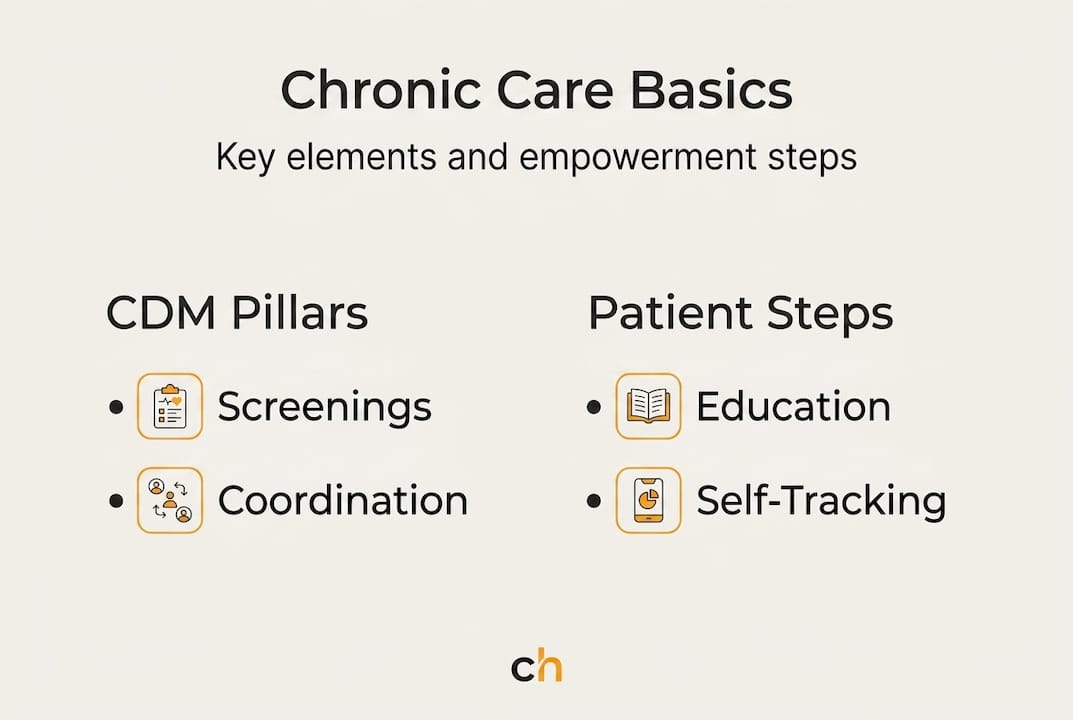
The most well-researched program is the Stanford Chronic Disease Self-Management Program (CDSMP). Developed at Stanford University and now delivered through community organizations and health systems globally, CDSMP is a six-week group workshop that teaches participants practical skills for living with chronic illness.
The CDSMP reduces ER visits and hospitalizations by approximately $700 per participant, and if scaled nationally, could enable $6.6 billion in savings. These numbers reflect real behavior change, not just educational exposure.
What skills does CDSMP actually teach? Participants work on:
- Pain and fatigue management techniques
- Healthy eating and physical activity planning
- Safe and effective medication use
- Emotional management, including handling frustration and depression
- Communicating clearly with doctors and care team members
- Problem-solving for real-life chronic disease challenges
The evidence is consistent. CDSMP improves health status, reduces unhealthy days, increases physical activity, and measurably improves self-rated health, cognitive functioning, and emotional management. Participants report feeling more in control, which itself improves adherence to treatment plans.
"The single most powerful shift in chronic illness management is moving patients from passive recipients of care to active co-managers of their health. That change in mindset alters clinical outcomes more reliably than any single medication adjustment."
Practical strategies you can start applying right now:
- Keep a daily symptom journal to identify patterns over time
- Set one small, specific health goal per week and track your progress
- Prepare a written list of questions before every medical appointment
- Use a medication tracker app to avoid missed doses
- Build a personal support network that includes at least one healthcare contact
Digital tools are accelerating this shift. Telemedicine in chronic care now allows patients to stay connected with their care team between office visits, which fills the gaps where most health setbacks occur. When self-management skills are paired with accessible technology, the results compound.
Pro Tip: Do not wait for your healthcare provider to initiate self-management support. Ask directly: "Is there a structured program I can join?" Many hospitals and community organizations offer CDSMP and similar workshops at low or no cost, and the long-term returns on your health are enormous. The evidence from wellness program benefits confirms that even modest structured engagement produces significant health gains.
Challenges, nuances, and barriers to effective CDM
If chronic disease management is so effective, why do millions of patients still struggle with uncontrolled conditions? The answer lies in a set of real-world barriers that even the best frameworks cannot fully eliminate without deliberate effort.
Multimorbidity is perhaps the biggest clinical challenge. Most CDM programs were originally designed around a single disease. But the reality is that multimorbidity demands integrated care, and a large proportion of patients over 60 have two or more chronic conditions. Managing type 2 diabetes alongside hypertension and chronic kidney disease requires a care plan that accounts for all three simultaneously. Without integration, patients receive conflicting advice, redundant tests, and medications that interact poorly.
Common barriers that undermine CDM programs in practice include:
- Fragmented care delivery: Specialists operate in isolation from primary care providers, leaving patients to navigate the gaps themselves
- Socioeconomic disparities: Lower income patients face transportation challenges, food insecurity, and limited health literacy, all of which weaken self-management
- Access gaps: Rural and underserved populations have fewer options for structured programs and care team support
- Workforce shortages: Demand for care coordinators, health educators, and behavioral health specialists consistently outpaces supply
- Low self-efficacy: When patients do not believe they can influence their own health outcomes, engagement with any program drops sharply
"Integrated care models consistently outperform siloed approaches in patient outcomes, but the evidence is mixed when it comes to cost in the short term. Initial investment is real, but team-based CDM typically reduces readmissions and high-cost utilization over a 12 to 24 month window."
These nuances matter because they expose a gap between what CDM can do in ideal conditions and what it actually delivers in fragmented healthcare systems. The effectiveness of any CDM program is also shaped by patient age, literacy level, cultural background, and the specific diseases being managed. A program that works beautifully for a 55-year-old with diabetes may be poorly suited for a 30-year-old managing lupus and anxiety simultaneously.
Closing these gaps requires more than clinical effort. It takes policy changes, community investment, and healthcare systems willing to work through the multi therapy department model that brings multiple disciplines under one coordinated roof. When holistic care and prevention are built into the same institution, the structural barriers shrink significantly.
Our perspective: Lessons learned and what most guides miss
Most articles on chronic disease management focus almost entirely on what good CDM looks like in controlled settings. What they skip is the harder, messier truth: the vast majority of patients experience something far less organized than a textbook care model.
In our experience, the biggest predictor of long-term success is not which framework a clinic uses. It is whether the patient ever feels genuinely known by their care team. Fragmented care is not just a logistical problem. It erodes trust. When a patient has to repeat their medical history to a third specialist in six months, they stop engaging with the system. That dropout is where health outcomes collapse.
We also see consistent underinvestment in younger patients with multimorbidity. The assumption that complex chronic disease is an older person's problem leads to delayed diagnosis and under-resourced care plans for people in their 30s and 40s managing multiple conditions simultaneously. Tailored interventions that account for life stage, work demands, and family responsibilities make a measurable difference for this group.
The practical lesson? Small, consistent actions outperform dramatic interventions every time. Tracking your symptoms weekly, attending regular care team check-ins, and communicating your goals clearly build a data trail that enables smarter, faster clinical decisions. Reviewing what top outpatient services look like in a truly integrated setting can help you benchmark your own care and ask better questions of your providers.
Explore comprehensive chronic care solutions
Living with a chronic condition means your healthcare needs do not fit neatly into one specialty or one visit. You need a system that moves with you.
At Globallmed, our approach to chronic care is built around exactly that principle. Our medical clinic department offers coordinated, physician-led care for patients managing long-term conditions, with access to monitoring, screening, and specialist consultation under one roof. For patients who need broader therapeutic support, our multi therapy department brings together multiple disciplines to address the physical, functional, and emotional dimensions of chronic illness. Whether you are newly diagnosed or managing a condition that has evolved over years, our team is ready to build a plan that fits your life. Reach out today to schedule a consultation.
Frequently asked questions
How does chronic disease management differ from regular medical care?
CDM is an integrated, long-term approach involving coordinated screenings, continuous monitoring, patient education, and multidisciplinary team involvement, unlike routine check-ups that address immediate concerns without long-term planning.
What are the main benefits of patient self-management programs?
Programs like CDSMP reduce hospitalizations, improve overall health status, and give patients concrete skills to manage pain, medication, and emotions between clinical visits.
Why is integrated care important for patients with multiple chronic conditions?
Multimorbidity needs integrated care because managing two or more conditions with separate, disconnected providers leads to conflicting treatments, missed signals, and poorer health outcomes than a unified, team-based plan.
Can chronic disease management reduce healthcare costs?
Yes. CDSMP reduces ER visits and hospitalizations by approximately $700 per participant annually, with potential national savings reaching $6.6 billion, demonstrating that proactive CDM is a sound long-term investment despite higher upfront costs.