
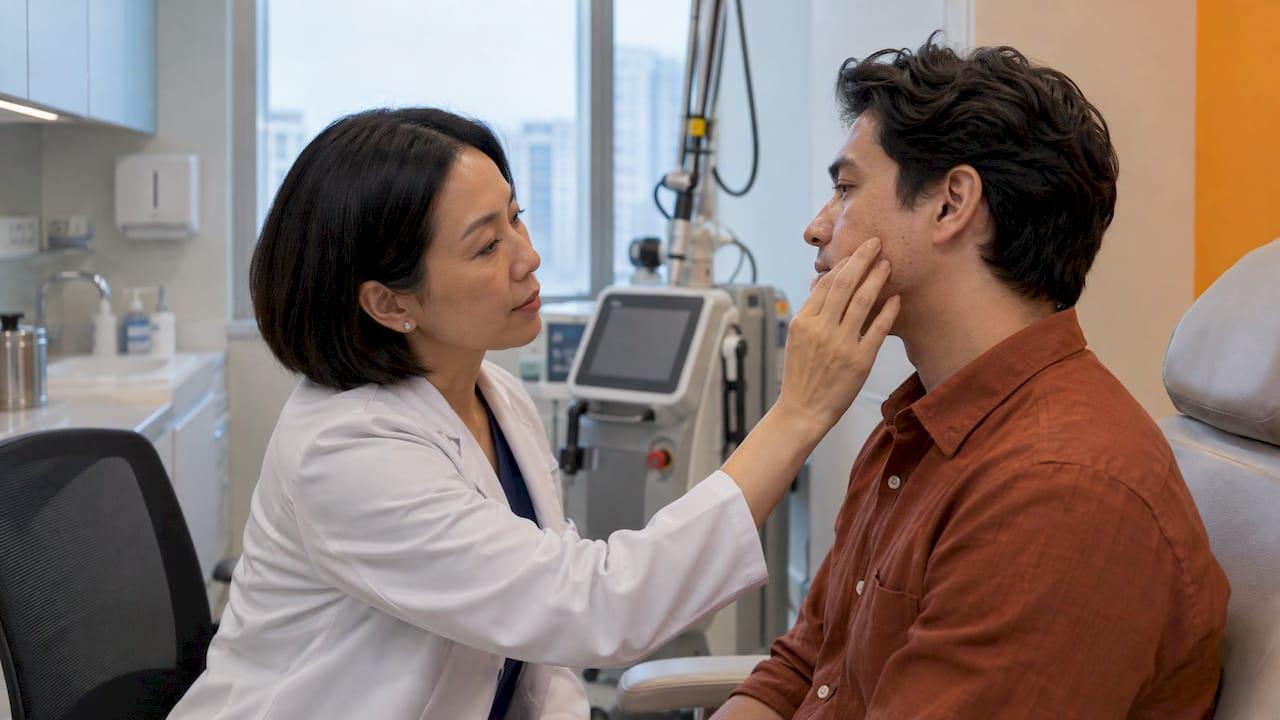
Neither treatment is better in every case. A chemical peel is generally the more suitable option for surface concerns such as uneven tone, mild pigmentation, congested skin and fine texture irregularity. Laser resurfacing is generally preferred when the concern lies deeper, as with acne scars, established wrinkles, enlarged pores or marked sun damage, and when a more precisely controlled depth of treatment is required. The correct choice depends on your skin concern, your skin type, the downtime you can accept and the number of sessions you are prepared to commit to. This guide sets out how each treatment works, where they differ, and what to settle with a physician before you decide.
It is written for patients in Hong Kong, Macau and the Greater Bay Area who are weighing the two procedures, and for international patients considering treatment in Macau.
Table of Contents
- The short answer: which one suits which concern
- How chemical peels work
- How laser resurfacing works
- Chemical peel and laser resurfacing compared
- Matching the treatment to your concern
- Skin type matters more than most patients expect
- Downtime and recovery in practice
- Risks to understand before you decide
- Cost in Macau: what determines the price
- Can the two treatments be combined?
- What to settle at your consultation
- Assessment at Globallmed
- Frequently asked questions
The short answer: which one suits which concern
The most practical way to begin is with the concern, not the device.
- Uneven tone, dullness, mild sun spots, mild acne: a superficial chemical peel is usually the first option considered.
- Fine lines and shallow texture changes: a superficial or medium peel, or a gentle non-ablative laser, depending on how much downtime is acceptable.
- Acne scars, deeper wrinkles, visible pores, significant photodamage: laser resurfacing, most often in a fractional form, is commonly the more effective route.
- Dark skin tones (Fitzpatrick types IV to VI): both treatments are possible, but the choice of peel depth and laser type becomes a matter of risk management, discussed below.
These are general patterns, not a prescription. A diagnosis is made in person, because a patch that looks like simple sun pigmentation may be melasma, which behaves differently and is easily aggravated by the wrong treatment.
How chemical peels work
A chemical peel applies an acid solution to the skin to produce a controlled, intentional injury. The solution loosens and dissolves the bonds between dead cells and, at greater depths, denatures proteins in the skin. The treated layers then shed, and the skin regenerates with a smoother, more even surface. Peels are classified by how deep the effect reaches.
Superficial peels
Superficial peels, typically using alpha-hydroxy acids such as glycolic acid or beta-hydroxy acid such as salicylic acid, act on the outermost layer of the epidermis. They are used for mild discoloration, dull or rough texture, acne and a sun-affected complexion. Most patients experience mild redness and light flaking for a few days. Because the effect is modest, a course of several sessions at intervals of a few weeks is normal, and maintenance is often needed to keep the result.
Medium-depth peels
Medium peels reach the upper dermis. They are considered for moderate pigment irregularity, fine lines and shallow acne scars. Recovery is longer: expect marked redness, swelling and peeling over roughly a week or more, and strict sun avoidance afterward.
Deep peels
Deep peels reach the mid-dermis and are reserved for coarse wrinkles, deeper scarring and significant photodamage. They carry the greatest risk and the longest recovery, and they are rarely suitable for darker skin because of the risk of permanent pigment change. In contemporary practice, many of the indications once handled by deep peels are now treated with lasers, which offer finer control of depth.
How laser resurfacing works
Laser resurfacing uses concentrated light energy that is absorbed by the skin and converted into heat. Depending on the settings and the type of laser, that heat can remove damaged tissue, stimulate collagen remodeling in the dermis, or target pigment and blood vessels. The Hong Kong Department of Health describes optical cosmetic procedures in these terms, and notes that the effects can include reduced wrinkles, pigmentation and acne scars. Lasers fall into four broad groups.
- Ablative lasers (for example CO2 and erbium types) vaporize the epidermis and heat the dermis. They produce the most dramatic improvement and the longest recovery.
- Non-ablative lasers heat the dermis while leaving the surface intact. Downtime is minimal, but results are gradual and usually require a series of sessions.
- Fractional lasers treat the skin in microscopic columns, leaving surrounding tissue untouched so that healing is faster. They can be ablative or non-ablative.
- Picosecond lasers deliver extremely short pulses and act largely through photomechanical effects. They are commonly used for pigment and some texture concerns.
The key difference from a peel is precision. A peel acts across the whole treated surface at a depth that depends on the acid, its concentration and the time it stays on the skin. A laser can be programmed for depth, density and pattern, and can be directed at a specific target such as pigment, vessels or scars.
Chemical peel and laser resurfacing compared
| Criterion | Chemical peel | Laser resurfacing |
|---|---|---|
| Mechanism | Acid causes controlled exfoliation and regeneration | Light energy converted to heat; removes tissue or stimulates collagen |
| Depth control | Superficial, medium or deep, set by the acid and application time | Adjustable depth, density and pattern; ablative or non-ablative |
| Best for | Tone, mild pigmentation, acne, superficial texture, fine lines | Acne scars, wrinkles, pores, deeper texture, pigment and vascular targets |
| Typical sessions | Superficial: a series, often repeated every few weeks | Non-ablative: a series. Ablative: often a single treatment |
| Downtime | Superficial: a few days. Medium: about a week or more. Deep: weeks | Non-ablative: little to none. Ablative: commonly one to two weeks at home |
| Duration of results | Superficial results need maintenance; deeper peels last longer | Ablative results can last for years; non-ablative need maintenance |
| Pigment risk in darker skin | Low with superficial peels; higher with medium and deep | Higher with ablative CO2; lower with non-CO2 fractional and non-ablative options |
| Relative cost per session | Generally lower for superficial peels | Generally higher, especially for ablative and multi-session programs |
The table shows general patterns. Individual protocols vary with the product, the device and the physician's assessment.
Matching the treatment to your concern
Pigmentation and uneven tone
Superficial peels are a well-established option for mild dyschromia and sun-affected skin, and are used in some cases of melasma under medical supervision. Picosecond and other pigment-targeting lasers are an alternative when spots are discrete. Melasma is the exception to any rule of thumb: it can worsen with heat, so energy-based treatment of it needs particular care and a physician's judgment.
Acne and congested skin
Salicylic acid peels are widely used for active acne and oily, congested skin. Where acne has left scars, a peel alone seldom achieves much remodeling of the deeper tissue, and a fractional laser is more often discussed.
Fine lines, wrinkles and photoaging
For early lines, superficial to medium peels or non-ablative lasers provide gradual smoothing. For coarse wrinkles and significant sun damage, ablative or fractional ablative lasers produce more substantial change, at the cost of longer recovery. Patients whose concerns also involve skin laxity or contour may need to consider surgical options, which is where an assessment by a plastic surgeon becomes relevant.
Acne scars
Scars are structural, which is why they are typically treated with fractional lasers, sometimes combined with other procedures. Medium peels can soften shallow scars, and specialized techniques exist for narrow, deep ones. A scar type assessment determines the plan.
Skin type matters more than most patients expect
The Fitzpatrick scale classifies skin by how readily it burns or tans. Many patients across East and Southeast Asia fall in types III to V, and these skin types are more prone to post-inflammatory hyperpigmentation, the darkening that can follow any inflammation or injury to the skin.
Published clinical guidance is consistent on the principles:
- Superficial peels are generally well tolerated in Fitzpatrick types IV to VI.
- Medium and deep peels should generally be avoided in darker skin because of the risk of disfiguring pigment change.
- For these skin types, non-CO2 fractional and non-ablative lasers are generally preferred over ablative CO2, which carries a higher risk of laser-induced pigment disturbance.
This is the main reason that the question "which is better" cannot be answered without examining the patient. A procedure that is ideal for fair skin may be the wrong one for you, and conservative settings with more sessions are often the safer path.
Downtime and recovery in practice
Plan recovery around your calendar, not only your skin.
After a superficial peel: redness and light, dry flaking are typical for several days. Most patients return to work the next day, with moisturizer and sunscreen.
After a medium peel: the skin darkens, swells and peels over about a week or longer. Social downtime is realistic to plan for.
After non-ablative or non-wounding laser: mild redness or swelling that settles quickly. Normal activity can often resume immediately, although a series of sessions is usually needed.
After ablative laser: the treated skin can be raw, swollen, itchy and painful for several days, with home recovery commonly taking one to two weeks, followed by prolonged redness in some patients. Results can last for many years, but this is the treatment that most requires a clear schedule.

For international patients, this has a practical consequence. If you are traveling to Macau for treatment, deeper procedures need time on site for follow-up review, so build the recovery period into your itinerary before booking flights.
Risks to understand before you decide
Both treatments are medical procedures with real risks, which is why they should be performed and supervised by qualified clinicians.
- Post-inflammatory hyperpigmentation: the most common concern, especially in darker skin, and more likely as depth increases. It usually fades over months but can be persistent.
- Hypopigmentation: lightening of the skin, which can be permanent, is associated mainly with deeper treatments.
- Scarring: a risk when depth or energy is excessive, or when healing is disturbed.
- Infection: bacterial, viral or fungal, including reactivation of cold sores in those prone to them. Physicians often prescribe preventive medication for resurfacing patients with a history of herpes simplex.
- Eye injury (laser): the Hong Kong Department of Health warns that direct laser exposure to the eyes can impair vision, which is why protective eyewear is standard.
- Burns (laser): the same guidance cautions that excessive energy can burn skin and cause permanent scarring.
Risks rise with depth, and they fall with careful patient selection, appropriate settings, pre-treatment preparation and disciplined sun protection afterward. Tell your physician about isotretinoin use, recent sun exposure or tanning, a tendency to form keloid scars, pregnancy or breastfeeding, and any history of cold sores before treatment is planned.
Cost in Macau: what determines the price
Patients searching for chemical peel or skin resurfacing costs in Macau usually want a figure. A responsible answer is that a single number would be misleading, because the fee depends on factors that are only known after assessment. We do not publish a fixed price list for these treatments, and the fee for your plan is confirmed at consultation, before any procedure is carried out.
The main variables are:
- Treatment type and depth. Superficial peels are generally the least costly option. Medium peels, fractional lasers and ablative lasers are progressively more resource-intensive, requiring more physician time, more equipment and closer follow-up.
- Number of sessions. Superficial peels and non-ablative lasers are normally delivered as a course. The cost of a course is more relevant than the cost of a single session, and it should be compared with a single ablative treatment on that basis.
- Treatment area. The full face, face and neck, or a smaller area such as the periorbital region, differ in time and materials.
- Preparation and aftercare. Pre-treatment skin preparation, prescribed topical products, sun protection and review visits form part of the real total.
- Physician's assessment. The consultation itself, and any skin testing, is part of safe planning.
When comparing quotations, ask whether the price covers the full course, the follow-up visits and the aftercare products. Prices quoted by spas or aesthetic salons that do not involve a physician may not be like-for-like with a medically supervised treatment, and the Department of Health advises patients to ask about fees and operator qualifications before any optical procedure.
Can the two treatments be combined?
Yes, and in many treatment plans they are. A common approach is to use a peel to improve tone and surface quality, and to reserve laser sessions for scars or deeper texture, with sufficient healing time between them. Combining both in the same period is not advisable without medical direction, since stacking inflammation on the skin increases the risk of pigmentation and prolonged redness. A sensible plan sequences treatments, begins with the least aggressive option that can reach the goal, and reassesses after each stage.
What to settle at your consultation
Before you commit to either treatment, confirm the following with the treating physician. These points reflect the information the Hong Kong Department of Health advises patients to obtain before any optical cosmetic procedure.
- Your diagnosis, and whether the concern is pigment, scarring, vascular, or a combination.
- Which peel depth or laser type is proposed, and why it suits your skin type.
- Expected results, the number of sessions and the interval between them.
- Contraindications, adverse effects and how complications are managed.
- The qualifications of the person performing the treatment.
- Whether a patch or skin test is appropriate.
- The total fee, and what it includes.
- The aftercare protocol, including sun protection for the weeks following every treatment.
Sun protection deserves emphasis. Treated skin is more vulnerable to UV damage and pigment change, and daily broad-spectrum sunscreen with sun avoidance is part of the treatment, not an optional extra. If discomfort, blistering, spreading redness or unusual pain develops after a procedure, seek medical attention promptly.
Assessment at Globallmed
Globallmed is a private outpatient medical center in Macau, serving more than 60 nationalities with a multilingual team and direct billing arrangements with major international insurers for eligible services. Skin concerns are assessed within our dermatology and plastic surgery services, where the physician examines your skin, discusses your goals and recommends a treatment appropriate to your skin type and schedule. Where your concern involves lax tissue or contour rather than the skin surface alone, the same department can address it.
If you are traveling from Hong Kong or elsewhere in the Greater Bay Area, our team can help you plan the consultation and any follow-up around your travel. You can request a consultation through our online appointment form, and ask the center about fees for your specific plan.
Patients who combine a skin consultation with a broader medical review can also consider our health check-up programs, which are offered alongside the specialist departments.

Frequently asked questions
Which is better, a chemical peel or laser resurfacing?
Neither is better for every patient. Peels suit surface concerns such as tone, mild pigmentation and acne, and generally cost less per session. Lasers offer more precise depth control and are usually more effective for scars, deeper wrinkles and pores. A physician's assessment of your skin type and goals determines the better fit.
Is laser resurfacing safe for Asian skin?
It can be, with appropriate selection. Skin in Fitzpatrick types IV to VI is more prone to post-inflammatory hyperpigmentation, so non-CO2 fractional or non-ablative lasers and conservative settings are generally preferred over ablative CO2. Strict sun protection before and after treatment is essential, and the procedure should be performed by a qualified physician.
How long do the results last?
Superficial peels and non-ablative lasers give gradual improvement that requires a course of sessions and periodic maintenance. Ablative laser results can last for years, although normal aging and sun exposure continue afterward. Daily sunscreen is the single most important habit for preserving any result.
How much does a chemical peel or skin resurfacing cost in Macau?
The fee depends on the peel depth or laser type, the number of sessions, the treatment area and the aftercare required. Because these vary by patient, the cost is confirmed after consultation rather than quoted in advance. Ask that the quotation state what is included, such as follow-up visits and products.
Can I have a peel and laser treatment in the same month?
Only if your physician plans it. Treatments are normally spaced to allow the skin to heal fully, because overlapping inflammation raises the risk of pigmentation and prolonged redness. Your physician will set the sequence and the intervals.