
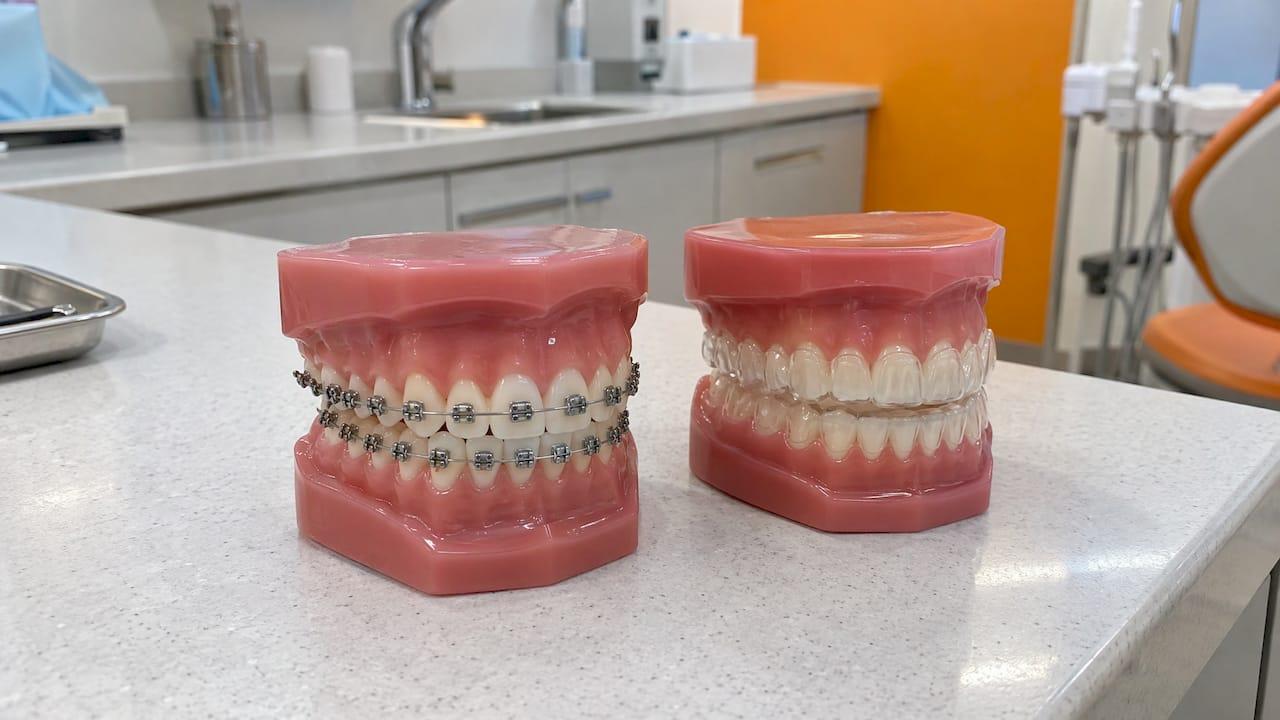
For most adults and teenagers, the choice between braces and Invisalign depends on the diagnosis, not on preference alone. Clear aligners such as Invisalign suit simple to moderately complex alignment problems and reward patients who wear them 20 to 22 hours a day. Fixed braces can treat nearly the full range of cases, including complex bite corrections, and do not depend on the patient's daily discipline. The reliable way to decide is a clinical examination of your teeth, gums and bite. You can start that with the dental team at Globallmed, which sits within our general outpatient clinic in Macau and serves patients from Macau, the Greater Bay Area and abroad.
This guide sets out how the two approaches differ, which orthodontic problems each one treats, what daily life looks like with each, how long treatment typically takes, and what to ask before you commit.
Table of Contents
- The short answer: braces or Invisalign
- How braces and clear aligners work
- Which problems each option can treat
- What the research says about effectiveness
- Daily life: visibility, comfort, eating and cleaning
- How long treatment takes
- Discomfort, risks and follow-up care
- Retention: will teeth move after braces?
- What age is best for braces?
- Questions to ask before you decide
- Where Globallmed fits in
- How to make the final choice
- FAQ
The short answer: braces or Invisalign
The question "which is better" has no universal answer, because the two are tools for different levels of complexity and different patient habits. A practical summary:
- Choose clear aligners when the problem is mild to moderate crowding, spacing or minor rotation, when you want a less visible appliance, and when you can reliably keep the trays in for most of the day.
- Choose fixed braces when the case involves a significant bite discrepancy, severe protrusion, rotated or tilted teeth that need precise root control, or when you would rather not manage a removable appliance.
- Let the diagnosis decide when you are unsure. The treatment plan, not the brand name, determines the result.
Consumer guidance in Hong Kong makes the same point: the outcome depends more on thorough communication with the orthodontist and on the practitioner's expertise than on which appliance is chosen. Remote or unsupervised aligner services, where no clinician examines your mouth in person, carry real risks, because problems with the gums, bone or bite can go unnoticed while teeth are being moved.
How braces and clear aligners work
Traditional braces
Fixed braces consist of brackets bonded to the teeth and an archwire that connects them. The wire is changed or adjusted at regular visits, and it applies steady, controlled force that moves each tooth in three dimensions. Brackets can be metal or tooth-colored ceramic. Because the appliance is fixed in place, the patient cannot take it off, and the treatment works around the clock without any cooperation beyond keeping the teeth clean and attending appointments.
Invisalign and other clear aligners
Clear aligners are custom-made, removable plastic trays. Digital planning maps the movement of teeth in small stages, and each tray in the series moves the teeth a fraction of a millimeter. You change to the next tray every one to two weeks, depending on the plan. You remove the trays to eat, drink anything other than water, and brush and floss.
Invisalign is one brand of clear aligner, and the principle is the same across the category. The trays only work while they are in your mouth. Hong Kong consumer guidance notes that aligners generally need to be worn 20 to 22 hours a day and changed every 7 to 14 days for the expected effect. Wear time is the single biggest factor you control.

Which problems each option can treat
This is where the two diverge most.
Clear aligners are well suited to simple and moderately complex cases: mild or moderate crowding, gaps between teeth, and minor relapse after earlier orthodontic treatment. Some situations are harder for aligners, and may not be suitable at all:
- cases that require tooth extractions as part of the plan
- severe protrusion of the front teeth
- crossbite
- open bite
- deep bite
- teeth with short clinical crowns, which give the trays little to grip
Fixed braces can treat the great majority of cases, including these complex ones. Where roots need to be tilted or uprighted, or where jaw relationships drive the problem, an appliance fixed to the teeth gives the clinician more direct control.
A further nuance: in some cases the best plan combines approaches, for example fixed appliances for the main correction followed by aligners to refine the final position. Only a clinician who has examined you and reviewed imaging can say whether that applies.
What the research says about effectiveness
Both methods work for malocclusion, meaning teeth that do not meet properly. A 2019 comparison of treatment effectiveness published in the open-access research archive PubMed Central found that aligners can be less effective than braces in achieving adequate occlusal contacts, controlling tooth torque and maintaining retention. Aligners did show an advantage in segmented tooth movement, where individual teeth or groups are moved on their own.
A 2025 review of clear aligner treatment reaches a similar conclusion: aligners are still regarded as inferior to fixed appliances in complex cases, particularly for torque control and for bringing roots closer together. A 2025 expert consensus on clinical strategies for aligner treatment stresses that clinicians should make a correct diagnosis, draw up a treatment plan and assess the difficulty of the case before recommending aligners.
In plain terms: for a well-selected case, aligners deliver a good result. For a poorly selected case, they can fall short of the planned outcome. Case selection is the clinician's job, and it is the reason a face-to-face assessment comes first.

Daily life: visibility, comfort, eating and cleaning
The table compares what you will notice day to day.
| Factor | Fixed braces | Clear aligners (Invisalign) |
|---|---|---|
| Visibility | Metal or ceramic brackets and wire are visible | Clear trays, much less noticeable |
| Removable | No, fixed for the whole treatment | Yes, removed to eat and clean |
| Wear requirement | Always on, no patient action needed | 20 to 22 hours a day |
| Eating | Avoid very hard, sticky or chewy foods | No restrictions while trays are out, but they must go back in after eating |
| Cleaning | Brushing around brackets, interdental brushes or floss threaders | Brush and floss normally, clean the trays daily |
| Discomfort | Soreness after adjustments, possible irritation from brackets | Pressure when starting each new tray |
| Appointments | Regular adjustment visits | Check-ups to monitor progress and issue new trays |
| Complex cases | Suited | May not be suitable |
Visibility
Aligners win on appearance. Many adults who speak to clients or present professionally prefer them for that reason. Ceramic braces narrow the gap, though the wire and bracket structure remain visible at close range.
Comfort
Neither option is painless. Teeth move because of controlled pressure, so a dull ache for a few days after a fitting, an adjustment or a new tray is normal with both. Braces can also irritate the lips and cheeks until they adapt. Aligners can cause a slight lisp for the first days and pressure at each tray change. Do not assume aligners are gentler: they apply a comparable amount of force to the teeth.
Eating and drinking
With aligners you take the trays out for meals, which means almost no food restrictions. The trade-off is discipline: every time you eat, the trays come out, and your teeth need brushing before they go back in. With braces you keep eating with the appliance in, but hard foods such as nuts and hard candy, and sticky foods, can break brackets or bend wires.
Cleaning
Oral hygiene matters more during orthodontic treatment, not less. Plaque collects around brackets and under trays. Brushing after meals, daily flossing and regular professional cleanings protect against cavities and gum inflammation. If you have existing gum or cavity problems, they should be treated before tooth movement begins.
How long treatment takes
Treatment time depends on the starting position of the teeth, how far they need to move, the complexity of the bite correction, your age and, for aligners, how consistently you wear them. As a general guide, minor alignment corrections may take roughly six months to a year, while typical comprehensive treatment runs about one to two years or longer for complex cases. Neither method is automatically faster. Claims that one appliance always finishes sooner are not a sound basis for a decision.
Factors that lengthen treatment include:
- missed appointments or broken brackets
- aligners worn fewer hours than prescribed
- the need for extractions or additional procedures
- gum disease or other dental problems that must be treated first
- changes to the plan after a mid-course review
Ask your dentist for a realistic range for your own case, and ask what happens if progress lags.
Discomfort, risks and follow-up care
Both treatments carry known risks that a clinician should explain before you start:
- Gum and tooth health: poor cleaning during treatment can lead to cavities, white spots on enamel and gum inflammation.
- Root resorption: a small amount of shortening of tooth roots can occur with any orthodontic movement, which is one reason monitoring matters.
- Unplanned results: if a case is too complex for aligners, teeth may not reach the planned position and the plan may need to change to braces.
- Relapse: teeth tend to drift back toward their former position unless they are held in place.
Supervision is the safeguard. Treatment that is planned, monitored and adjusted by a clinician who examines you in person lets problems be caught early. Hong Kong consumer guidance specifically warns against remote or unsupervised aligner services for this reason.
If you have pain that does not settle, a loose bracket that cuts the cheek, a cracked tooth, or swelling in the gums, contact your dentist promptly rather than waiting for the next scheduled visit.
Retention: will teeth move after braces?
A frequent question is whether teeth move again years after treatment. They can. After active treatment, the ligaments and bone around the teeth need time to stabilize, and teeth have a natural tendency to shift over a lifetime. Retainers, either a thin wire bonded behind the teeth or a removable clear or wire-and-acrylic retainer, hold the result. Your dentist will specify how long to wear them, often full time at first and then at night.
Research suggests that aligners may be less effective than braces at maintaining retention, which makes a clear retainer plan at the start even more important. Skipping retainers is the most common reason a corrected smile slips.
What age is best for braces?
Children are often assessed from around the time the permanent teeth begin to erupt, and many are treated in their early teens when growth is still active. Adults can have orthodontic treatment at any age provided their teeth and gums are healthy. An adult who had braces as a teenager and notices crowding returning is a common candidate for a limited aligner course, subject to examination.
For children, a dentist can monitor development and advise on timing. Our pediatrics department also supports families who want their child's overall health reviewed alongside dental care.
Questions to ask before you decide
Whatever you choose, put these questions to the clinician who examines you:
- What is my diagnosis, and what are the specific problems you plan to correct?
- Is my case simple, moderate or complex, and does that affect the choice between braces and aligners?
- Will any teeth need to be extracted or any dental work completed first?
- How long should treatment take, and how often will I be reviewed?
- What happens if the teeth do not move as planned?
- What is the retention plan, and who monitors it afterwards?
- What does the quoted fee cover: appliances, reviews, retainers and any refinements?
A clear, written answer to each of these is a sign of a well-organized treatment plan.
Where Globallmed fits in
Alignment starts with a healthy mouth, and a thorough dental examination is the first step whichever appliance you end up with. At Globallmed, the dental service is part of Macau's largest private outpatient clinic, which brings general practice, pediatrics, dermatology, dietetics and therapy services under one roof. We serve patients of more than 60 nationalities, our staff are multilingual, and our medical professionals are government-certified. For patients who travel from Hong Kong, the Greater Bay Area or further afield, we offer international patient support and direct billing with major international insurers, so you can ask about coverage when you book.
To arrange an assessment, use the online appointment booking form on the Globallmed website. Bring any previous dental records or X-rays if you have them, and note your goals and any concerns about appearance, comfort or schedule.
Because good dental and general health go together, patients often combine a dental visit with one of our health check-ups, which suit travelers who want to complete several appointments in a single trip. If a smile and appearance review is part of what you want, our beauty and wellness department covers dermatology and plastic surgery consultations too.
How to make the final choice
Use these criteria in order.
- Clinical suitability first. If your case involves a significant bite problem, severe protrusion, crossbite, open bite or deep bite, fixed braces are the more dependable route. If the case is simple or moderate, both are options.
- Your habits. Aligners need 20 to 22 hours of daily wear. If you travel frequently, forget to put trays back in after meals, or snack constantly, braces remove that risk. If you are organized and consistent, aligners work in your favor.
- Appearance priorities. If a discreet appliance matters for work or personal reasons and your case allows it, aligners are attractive. Ceramic braces are a middle option.
- Hygiene routine. Both require excellent cleaning. Choose the one you will actually maintain.
- Follow-up access. Orthodontic care involves repeated reviews over many months. Consider how easily you can attend them, especially if you live across the border or abroad, and discuss the schedule openly with your dentist.
- Total cost and coverage. Compare what each quote includes, and check with your insurer which parts of treatment, if any, are covered.
If you finish this list still undecided, that is normal. It is exactly the situation a clinical assessment resolves.
FAQ
Which is better, regular braces or Invisalign?
Neither is better in every case. Invisalign and other clear aligners are discreet and removable, and they suit simple to moderately complex problems. Fixed braces can treat nearly all cases, including complex bite corrections. The right choice follows from your diagnosis and your daily habits.
How often do you wear Invisalign?
Clear aligners are generally worn 20 to 22 hours a day, removed only to eat, drink anything but water, and clean your teeth and the trays. Each set is usually changed every 7 to 14 days, as your clinician specifies. Wearing them fewer hours slows progress and can prevent the planned result.
Will my teeth move 10 years after braces?
They can, because teeth naturally tend to shift over time. Wearing your retainers exactly as instructed is the best protection, and your dentist will tell you how long and how often to wear them. If you notice crowding returning, have it examined early, since small changes are easier to correct.
What is the best age to get braces?
There is no single best age. Many children are treated in their early teens while growth continues, and a dentist can advise on timing for your child. Adults can also be treated at any age if their teeth and gums are healthy, so a good first step at any age is a dental examination.
Does Invisalign hurt more than braces?
Both cause temporary soreness because they apply pressure to move teeth. With braces the ache tends to follow adjustments, and with aligners it tends to follow each new tray. The discomfort usually settles within a few days. Persistent pain should be checked by your dentist.