
Dysport and Botox both come from botulinum toxin type A, but they behave differently once injected. Dysport tends to work faster and spread further, making it suited to larger areas like the forehead, while Botox stays more localized, favoring smaller, precise sites like crow's feet. Neither is universally superior. Duration runs roughly 3 to 4 months for both, and the real variable is injector technique, not the label on the vial.
Table of Contents
- Botox vs Dysport: What Are They, Really?
- Onset, Spread, Dosing, and Cost: The Real Differences
- Side Effects: What's Common and What's a Warning Sign
- How to Choose: A Consultation Checklist
- What the Evidence Actually Shows
- Getting Botulinum Toxin Treatment at GLOBALLMED Medical Center
- Sources
- FAQ
Botox vs Dysport: What Are They, Really?
Both products work the same way: they block acetylcholine release at the neuromuscular junction, which temporarily stops the targeted muscle from contracting. That's why the lines above it soften. The active ingredient in each is botulinum toxin type A, but the formulations are not identical, and Cleveland Clinic's clinical comparison confirms the two should be evaluated as distinct drugs rather than interchangeable versions of the same product.
The naming reflects that distinction. Botox is onabotulinumtoxinA. Dysport is abobotulinumtoxinA. Each manufacturer runs its own potency assay to define a "unit," which means a unit of one product is not chemically equivalent to a unit of the other, even though both get measured in the same term.
Labeled aesthetic uses overlap heavily but approvals vary by jurisdiction and by indication:
- Both are commonly used for glabellar lines (the "11s" between the brows)
- Both address forehead lines and crow's feet, though off-label use for these areas is common in many markets
- Dysport carries specific pediatric approval for lower limb spasticity in some regions, reflecting its broader therapeutic footprint
- Botox has a long history of use for migraines, excessive sweating, and cervical dystonia in addition to cosmetic indications
Your injector will confirm which specific uses are approved where you're being treated, since regulatory status differs by country.
Onset, Spread, Dosing, and Cost: The Real Differences
This is where the two products actually diverge, and where most consultation conversations go wrong by treating them as identical.
Onset speed. Dysport tends to show visible effects within 2 to 3 days. Botox usually takes 3 to 7 days to reach full effect. If you have an event in 48 hours, that gap matters. If you're planning six weeks out, it barely registers.
Diffusion and spread. Dysport molecules are smaller and tend to diffuse more widely from the injection point. That's an advantage for broad, flat muscle groups like the forehead, where fewer injection points can cover more surface area. It's a liability in tight anatomical zones near the eyelid, where unwanted spread raises the risk of drooping. Botox's more contained diffusion pattern makes it a common choice for precision work like crow's feet or lip flips.
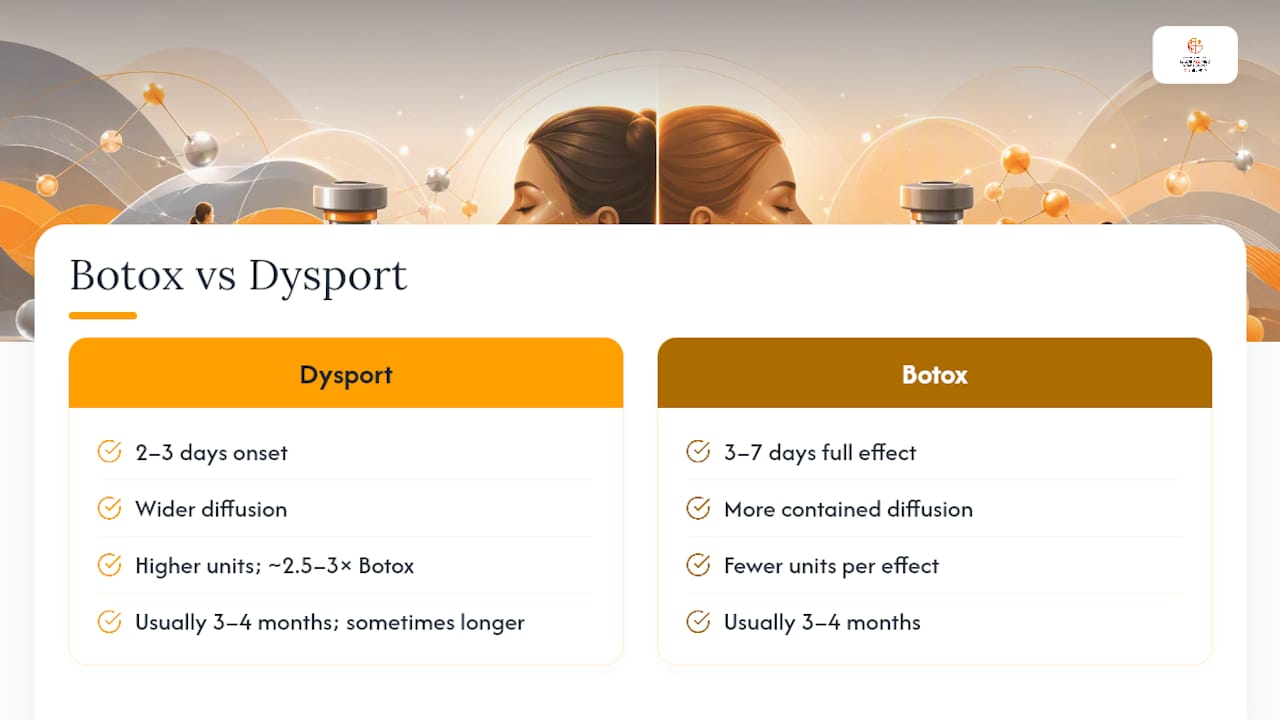
Units are not interchangeable. This trips up a lot of patients comparing quoted prices. Because each product's "unit" comes from a separate, proprietary potency assay, you cannot compare 20 units of Botox to 20 units of Dysport and expect equal effect. Clinical literature commonly cites conversion ratios between 2.5:1 and 3:1 (Dysport to Botox), with roughly 50 to 60 units of Dysport treated as a rough equivalent to 20 units of Botox for glabellar lines. These ratios are clinical approximations, not fixed biochemical conversions, and your injector's actual dosing will vary based on your muscle mass and treatment goals.
Duration. Most patients see results last 3 to 4 months on either product, but the split-face trial data is worth knowing.
Statistic: In a randomized, double-blind contralateral study using a 2.5:1 Dysport to Botox ratio, median duration of complete efficacy for frontalis lines was longer with Dysport than with Botox in a small sample of study subjects. A separate long-term series in hemifacial spasm patients, covering 108 patients and 665 treatments, similarly found longer duration of improvement with Dysport, with comparable side-effect rates between the two.
Small sample sizes mean these findings shouldn't be read as a guarantee Dysport outlasts Botox for you. They do show that when a proper conversion ratio is applied, differences can be statistically real, if modest.
Cost. Comparing per-unit price is misleading because Dysport requires more units to match Botox's effect. Total-session cost, after conversion, tends to land in a similar range for a given treatment area. Ask for the full session price, not the price-per-unit, when comparing quotes.
Area-specific patterns. Forehead and glabellar lines often favor Dysport's spread advantage. Crow's feet and lip flips often favor Botox's containment. Masseter (jaw) reduction and neck bands work with either, and the deciding factor is usually injector preference and your specific muscle anatomy rather than the product itself.
Side Effects: What's Common and What's a Warning Sign
Local side effects are similar between the two and mostly temporary: bruising, redness, swelling at the injection site, and occasional transient weakness in nearby muscles. Mayo Clinic's procedural guidance notes that most adverse events are technique-related rather than product-related, which is a point worth sitting with before you pick a product based on marketing rather than injector skill.
Diffusion-related complications are where the products' different spread profiles matter clinically:
- Eyelid ptosis (drooping) from toxin migrating into the levator muscle, more often discussed with Dysport given its wider spread
- Eyebrow asymmetry from uneven diffusion across the frontalis
- Difficulty swallowing (dysphagia) when neck muscles are treated, requiring conservative dosing and an experienced injector
Rare but serious systemic warnings apply to both products: distant spread of toxin effect beyond the injection site, which is why appropriate dosing and an injector who respects labeled dose limits matter more than which brand is in the syringe.
Certain patients should postpone or avoid treatment: pregnant or breastfeeding patients, people with neuromuscular disorders like myasthenia gravis, and anyone on medications that interfere with neuromuscular transmission (certain antibiotics, muscle relaxants). Tell your injector about every medication and supplement you take.
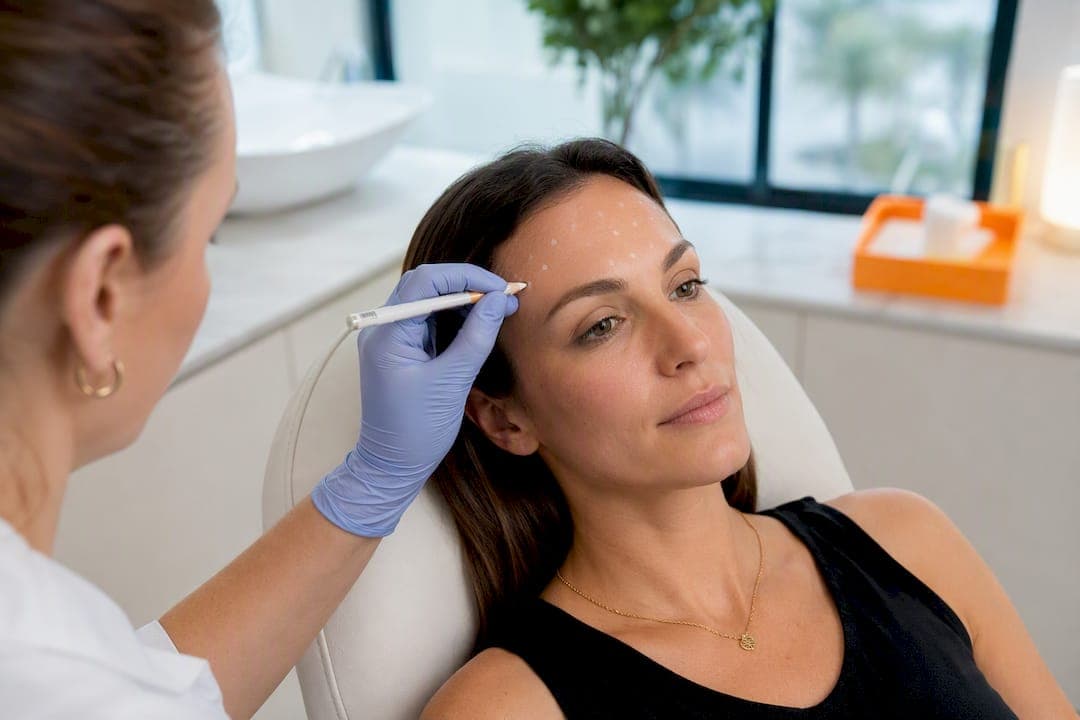
Pro Tip: Ask your injector to mark injection points on your skin before treating and to explain their dilution ratio. Higher dilution with more injection points at lower volume per point tends to limit unwanted spread, regardless of which toxin is used.
How to Choose: A Consultation Checklist
Neither product wins by default. Your decision should follow your priorities, not a brand preference walked in with.
- Name your priority first. Is speed the issue (event in days), area size (broad forehead vs. tight crow's feet), or how you've responded to treatment before?
- Ask what units mean for your dose. A qualified injector should explain their conversion rationale, not just quote a number.
- Ask about their technique. Dilution volume, injection depth, and number of points affect your result more than the brand name on the vial.
- Confirm the expected timeline. When should you expect visible change, and when should you return if results seem incomplete?
- Flag any red flags upfront. Pregnancy, neuromuscular conditions, and interfering medications should all be disclosed before the first injection, not after.
- Set a retreatment plan. Ask when you should book your next session, and what signs (asymmetry, drooping, unusual weakness) warrant an earlier follow-up call.
Pro Tip: If you've had a mediocre result with one product, that alone is a legitimate reason to try the other. Individual response varies more than most marketing admits.
What the Evidence Actually Shows
Clinical evidence supports a nuanced picture, not a winner. The most rigorous data point comes from lab analysis showing that at labeled recommended doses, Dysport vials contain more total neurotoxin protein than Botox vials (2.69 nanograms per 500-unit vial versus 0.90 nanograms per 100-unit vial). That's a plausible mechanistic reason some trials report longer duration with Dysport.
But mechanism isn't destiny in a treatment room. Contralateral split-face studies are useful because they control for individual variation. They also tend to run on small samples, and results shift depending on which conversion ratio the researchers apply.
Cleveland Clinic's clinical summary puts it plainly: neither product is inherently better, and the right choice depends on the patient's anatomy, the treatment area, and the practitioner's experience with that specific formulation.
That last point deserves weight. Injection variables an injector controls, dilution, depth, number of injection points, and dose per point, often influence diffusion and side effects more than which toxin is in the syringe. A skilled injector using Botox conservatively can outperform a rushed Dysport treatment, and vice versa.
Treatment planning for botulinum toxin injections generally starts with an anatomical assessment and a conversation about patient goals before recommending any product, rather than defaulting to whichever toxin is available at the clinic.
Getting Botulinum Toxin Treatment at GLOBALLMED Medical Center
If you're weighing Botox against Dysport, the honest starting point is a consultation, not a product decision made in advance. GLOBALLMED Medical Center's dermatology and plastic surgery services include cosmetic injectable treatments assessed individually, based on your facial anatomy, treatment goals, and any prior response to neuromodulators.
During a consultation, a clinician evaluates your muscle strength and movement patterns in the target area, reviews your medical history for contraindications, and discusses realistic timelines for onset and duration before recommending a specific product or dosing plan. This matters more than brand preference: the same injector who explains their dilution ratio and injection strategy for Botox can walk you through the equivalent plan for Dysport, and let your anatomy and goals drive the choice rather than the other way around.
If a fuller picture of your skin and overall health is useful before committing to a cosmetic procedure, GLOBALLMED Medical Center's executive health check-up for women and executive check-up for men both include broader clinical assessment alongside specialist referral. To move forward with a botulinum toxin consultation directly, book through the beauty, wellness, and wellbeing department and bring your questions about units, technique, and timeline. That conversation, not a product label, is what determines your result.

This article is general information, not a substitute for advice from a qualified doctor. Consult a qualified healthcare professional about your own circumstances before acting on anything here.
FAQ
What looks better, Botox or Dysport?
Neither looks categorically better; results depend on the treatment area and injector technique. Dysport's wider spread often suits broad areas like the forehead, while Botox's more contained diffusion tends to favor precise zones like crow's feet, according to Cleveland Clinic's clinical comparison.
Why are some younger patients avoiding Botox?
Some younger patients express hesitation around preventive or frequent use of neuromodulators, often citing a preference for natural movement or concern about long-term dependency on treatment. This trend reflects personal preference and social conversation more than new clinical safety findings, and the underlying mechanism and safety profile of botulinum toxin type A products haven't changed.
How much is 50 units of Dysport compared to Botox?
Fifty units of Dysport is not directly comparable to 50 units of Botox because each product uses its own potency assay. Clinical sources commonly cite conversion ratios between 2.5:1 and 3:1, meaning roughly 50 to 60 units of Dysport may approximate 20 units of Botox for glabellar lines, though your injector's actual dosing depends on your anatomy.
Does Dysport last longer than Botox?
Some randomized split-face trials found a longer median duration with Dysport when specific conversion ratios were applied, such as 72 days versus 56 days for frontalis lines in one small study. Most patients, however, can expect both products to last around 3 to 4 months, and individual results vary based on technique and metabolism.
Can GLOBALLMED Medical Center help me decide between Botox and Dysport?
Yes. A consultation through GLOBALLMED Medical Center's beauty, wellness, and wellbeing department includes an anatomical assessment and a discussion of your goals before any specific product is recommended. Current prices for cosmetic injectable treatments can be obtained directly through the clinic rather than from online listings.