
Allied health professionals make up nearly 60% of Macau’s healthcare workforce, yet most patients walk into an outpatient clinic without knowing exactly who these specialists are or how they shape recovery. You might see a physiotherapist after surgery, a nutritionist during a wellness check, or a respiratory therapist for breathing concerns — and never realize these roles fall under a single professional category with a defined scope of practice. This article breaks down what allied health actually means, who these experts are, and how they work alongside physicians to deliver better outcomes across medical, cosmetic, and wellness care in Macau.
Table of Contents
-
How allied health professionals support recovery and wellness
-
The mechanics of allied health in outpatient care: Tools, teamwork, and edge cases
-
Allied health vs. physician-led care: Collaboration, boundaries, and patient choices
-
Our view: Why most patients overlook allied health’s true value
-
Find expert allied health support in Macau’s leading clinics
Key Takeaways
| Point | Details |
|---|---|
| Wide-ranging allied health roles | Allied health professionals cover rehabilitation, diagnostics, and preventive care in Macau outpatient settings. |
| Teamwork drives better outcomes | Multidisciplinary collaboration between allied health, doctors, and nurses improves recovery and patient experience. |
| Distinction from cosmetic services | While allied health overlaps with wellness, most cosmetic care in Macau remains physician-led. |
| Patients should ask for AHP input | Proactive patients get better, more holistic care by involving allied health professionals in their treatment plan. |
What is allied health? Defining roles in outpatient care
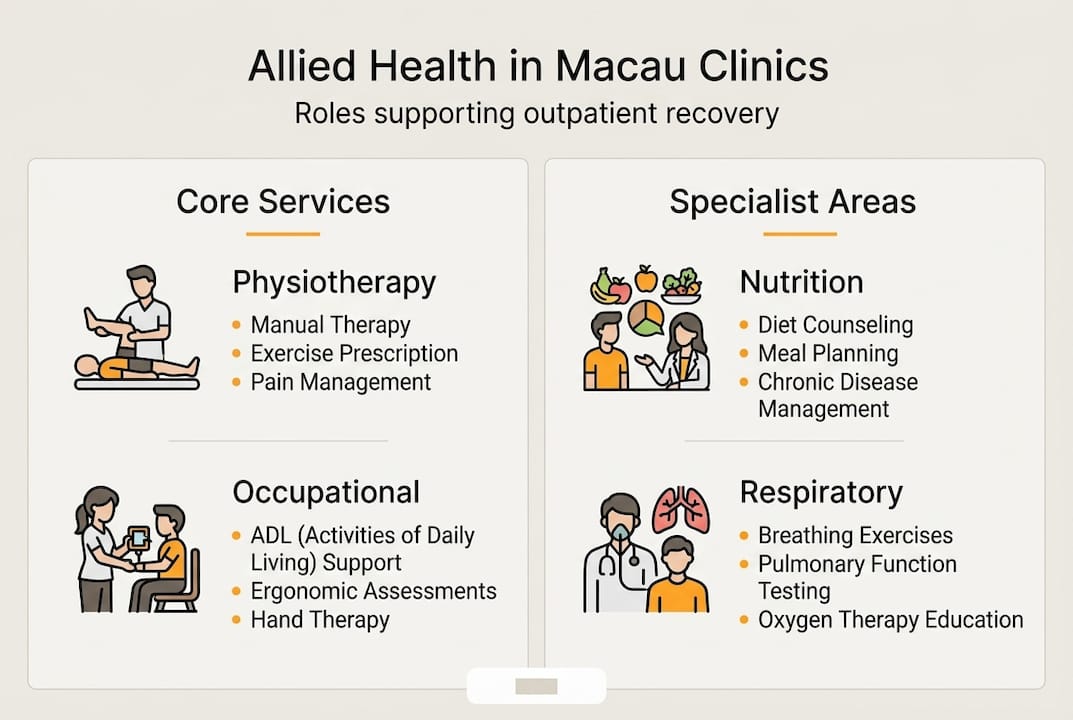
Allied health is a broad category of healthcare professionals who are not doctors or nurses but who provide critical services in diagnosis, treatment, rehabilitation, and prevention. Think physiotherapists, occupational therapists, nutritionists, speech therapists, and respiratory therapists. Each brings specialized training that directly affects how quickly and completely patients recover.
In outpatient settings, AHPs provide diagnostic support, rehabilitation, preventive care, and therapeutic services that sit outside the traditional physician consultation. This distinction matters because many patients assume only a doctor can move their treatment forward. In reality, a large portion of outpatient care progress depends on what happens between doctor visits.
Here are the most common allied health roles you will encounter at an outpatient center:
-
Physiotherapists: Restore movement, manage pain, support post-surgical rehab
-
Occupational therapists: Help patients regain daily functional skills after injury or illness
-
Nutritionists and dietitians: Guide dietary plans for chronic disease, weight management, and wellness
-
Respiratory therapists: Test and treat conditions affecting breathing and lung function
-
Diagnostic technologists: Operate imaging and testing equipment to support physician decisions
In Macau specifically, 12.6% of outpatient recipients use physiotherapy or rehabilitation services, representing roughly 252,000 visits in 2024. An aging population and rising rates of chronic disease are driving that number up.
| Allied health role | Primary focus | Outpatient setting |
|---|---|---|
| Physiotherapist | Movement and rehab | Rehabilitation clinics |
| Nutritionist | Diet and metabolic health | Wellness and chronic care |
| Respiratory therapist | Lung function testing | Pulmonary and general clinics |
| Occupational therapist | Functional independence | Post-surgical and elder care |
For a broader overview of outpatient options, the Allied Health Professionals overview gives useful context on how these roles fit the wider healthcare system. You can also explore top outpatient services available locally or learn more about allied health at the medical center.
Pro Tip: Before your first visit, ask your clinic which allied health services are part of your care plan. Knowing this in advance helps you prepare questions and set realistic recovery goals.
How allied health professionals support recovery and wellness
Understanding job titles is one thing. Seeing how allied health professionals actually work through a patient’s care journey is where the real clarity comes from.
Here is a typical outpatient recovery pathway with allied health involvement:
-
Initial assessment: A physician diagnoses the condition and flags the need for allied health support.
-
Referral and intake: The patient meets a physiotherapist or occupational therapist for a baseline functional assessment.
-
Targeted intervention: Hands-on therapy, exercise programs, or specialized equipment use begins.
-
Progress monitoring: AHPs track changes and communicate updates to the physician.
-
Discharge or transition: The patient moves to self-managed care or ongoing wellness support, often with a nutritionist or wellness coach.
This process applies across medical, cosmetic, and wellness contexts. Physiotherapy is the second largest outpatient service after Chinese medicine in Macau, which shows how embedded these professionals already are in local care culture.
| Care type | Allied health role | Example outcome |
|---|---|---|
| Medical rehab | Physiotherapy, respiratory care | Faster post-surgical recovery |
| Cosmetic support | Nutritionist, wellness coach | Pre/post-procedure body optimization |
| Wellness | Dietitian, occupational therapist | Chronic condition management |
For an elderly patient managing arthritis alongside hypertension, an allied health team might combine physiotherapy sessions with dietary counseling. For a younger patient recovering from a sports injury, the focus shifts to strength rebuilding and movement retraining. Both paths rely on allied health data showing that consistent AHP involvement reduces readmission rates and improves long-term function.
If you want to see how this fits a broader care plan, the outpatient treatment workflow article walks through each stage in detail, and the Macau care guide covers practical patient expectations.
Pro Tip: When scheduling an appointment after a procedure, specifically ask whether allied health follow-up is included. Patients who engage with post-treatment physiotherapy or nutritional guidance often recover faster and with fewer complications.
The mechanics of allied health in outpatient care: Tools, teamwork, and edge cases
Beyond day-to-day care, understanding the inner workings of allied health reveals their true impact in outpatient clinics.
AHPs do not work in isolation. Multidisciplinary teams assist complex chronic cases in the elderly population, and AHPs are often the ones operating ECG machines, ultrasound devices, and pulmonary function testing equipment. This means they are not simply support staff — they generate the diagnostic data physicians use to make clinical decisions.
Key tools used by allied health professionals in outpatient settings:
-
ECG and cardiac monitoring equipment
-
Ultrasound for soft tissue assessment
-
Spirometry for respiratory function testing
-
Rehabilitation machinery for motor recovery
-
Digital patient management systems for remote follow-up
Teamwork is central to the model. A physiotherapist working with an elderly patient post-hip replacement will coordinate with the orthopedic surgeon, the ward nurse, and sometimes a social worker to ensure safe discharge and functional independence at home. This is not informal coordination — it follows structured multidisciplinary team (MDT) protocols.
| Patient profile | MDT members involved | Primary AHP role |
|---|---|---|
| Post-surgical elderly | Surgeon, nurse, physiotherapist, social worker | Mobility and functional restoration |
| Chronic respiratory disease | Pulmonologist, respiratory therapist, nutritionist | Breathing function and dietary support |
| Sports injury | Sports physician, physiotherapist, strength coach | Movement retraining and return to sport |
Edge cases are where allied health expertise becomes especially visible. Rare disease patients and those with complex comorbidities often rely more on AHP continuity than on episodic physician contact. Their ability to adapt treatment plans across visits — adjusting to patient response, fatigue, and progress — is something standard medical consultations rarely have time to do.
The allied health overview offers further background on these mechanics. For a local view of how multi-therapy collaboration works in practice, or how telemedicine tools extend AHP reach beyond clinic walls, both resources provide useful context. You can also review different consultation types to understand when allied health involvement is most appropriate.
Allied health vs. physician-led care: Collaboration, boundaries, and patient choices
Having explored team roles and tools, let’s look at how allied health and doctors work together — and what that means for your treatment choices.
Patients sometimes assume that if something is not done by a doctor, it is less important. That assumption costs recovery time. Allied health enhances efficiency by freeing physicians for acute care, but scope limitations require caution, particularly with informal consults outside a structured care setting.
| Service type | Physician-led | Allied health-led |
|---|---|---|
| Medical diagnosis | Yes | Diagnostic support only |
| Rehabilitation plan | Initiated by physician | Delivered and adjusted by AHP |
| Cosmetic procedures | Yes | Pre/post-procedure wellness support |
| Nutrition and wellness | Advisory | Primary care delivery |
| Respiratory testing | Oversight | Equipment operation and reporting |
The boundaries are practical, not hierarchical. A physiotherapist cannot prescribe medication, but they can significantly alter a patient’s pain experience through manual therapy and movement retraining. A nutritionist cannot order imaging, but their intervention can reduce the frequency of medical flare-ups in conditions like diabetes or inflammatory bowel disease.
For cosmetic and wellness patients, the division is often clearer. A physician leads injectable treatments or laser procedures, while an allied health professional supports skin health, recovery nutrition, and post-procedure mobility. Knowing this helps you ask better questions and set realistic expectations.
Here is what you should look for when choosing your care pathway:
-
Verify that your allied health professional holds recognized credentials
-
Ask whether a physician oversees the care plan
-
Confirm that MDT communication is in place for complex cases
-
Check whether referrals are needed before accessing specialized AHP services
For services for health and wellness or specific beauty, wellness and wellbeing offerings, both resources help clarify what is physician-led versus AHP-led. The wellness overlaps reference also explains where boundaries tend to blur.
Pro Tip: Always check credentials and ask about multi-disciplinary support. A quality outpatient center should be transparent about who is involved in your care and in what capacity.
Our view: Why most patients overlook allied health’s true value
Most patients focus on the physician’s name. They want to know who the doctor is, what their qualifications are, and how long they have been practicing. That instinct is understandable, but it misses a significant part of the picture.
In our experience, the outcomes that matter most to patients — pain reduction, faster return to activity, sustained wellness — are often driven by allied health engagement. These professionals spend more hands-on time with patients than physicians typically can in an outpatient setting. Yet because they are less visible in patient communications and marketing materials, their value is routinely underestimated.
Macau’s rapidly aging population and growing chronic disease burden make this gap even more consequential. Patients who actively ask about and engage with multi-therapy experiences consistently report better functional results. Those who treat physiotherapy or nutritional counseling as optional often plateau or regress.
Moving away from a doctor-centric view of outpatient care is not about reducing trust in physicians. It is about recognizing that recovery and wellness are team achievements. The patients who get the best results are the ones who treat every member of their care team as essential.
Find expert allied health support in Macau’s leading clinics
If you’re ready to experience allied health care done right, Globallmed makes it straightforward to access coordinated, multi-disciplinary outpatient services in Macau.

Our team includes credentialed allied health professionals working alongside physicians across medical, cosmetic, and wellness programs. Whether you need physiotherapy, nutritional guidance, or post-procedure recovery support, our medical clinic department and beauty, wellness and wellbeing departments offer integrated care built around your specific needs. Visit Globallmed to explore your options, book a consultation, or learn more about the full range of outpatient services available to local and international patients.
Frequently asked questions
What is considered an allied health service in outpatient care?
Allied health services include physiotherapy, occupational therapy, nutrition, respiratory care, and diagnostic and therapeutic services delivered outside a hospital setting. These are distinct from physician consultations and nursing care.
Are allied health professionals as important as doctors for outpatient recovery?
Yes. AHPs enhance efficiency by handling rehabilitation, patient education, and preventive care, which allows physicians to focus on acute and complex clinical decisions. Both roles are essential.
Can I access cosmetic or wellness services through allied health in Macau?
Certain wellness and nutrition services are led by allied health professionals, but most cosmetic procedures in Macau’s private clinics remain physician-led, with AHPs providing pre and post-procedure support.
Do I need a doctor’s referral to see an allied health professional in Macau?
Some services allow self-referral, but specialized programs often require a physician referral to ensure proper multidisciplinary coordination and safe, evidence-based care.
How do allied health professionals collaborate with other outpatient care teams?
MDT protocols bring AHPs together with physicians, nurses, and other specialists to coordinate care plans, share progress data, and ensure patients receive holistic support across every stage of treatment.